


Navi Mumbai International Airport Takes First Historic Flight
Newzdaddy Business Updates
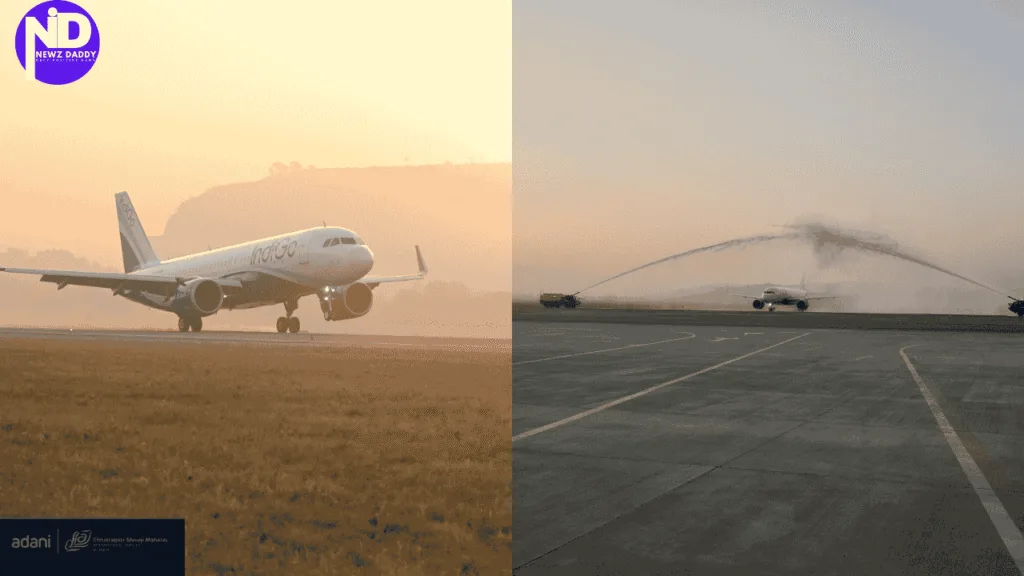
First Visuals: Navi Mumbai International Airport begins commercial operation with its first arrival and departure flights
Navi Mumbai International Airport commenced its airside operations on 25 December 2025 with the arrival of its first commercial flight. The aircraft was accorded a ceremonial water cannon salute on arrival, a time-honoured aviation tradition marking NMIA’s first commercial touchdown and departure. The inaugural arrival, IndiGo flight 6E460 from Bengaluru, touched down at 08:00 hrs and was welcomed with the traditional water salute. This was followed by the airport’s first departure IndiGo flight 6E882 to Hyderabad, which took off at 08:40 hrs, completing NMIA’s inaugural arrival and departure cycle. The commencement of scheduled passenger operations at NMIA signifies a key milestone for India’s civil aviation sector while expanding air travel capacity for the Mumbai Metropolitan Region (MMR).
The start of commercial operations at Navi Mumbai International Airport comes after years of planning, construction and coordination between multiple agencies. The airport has been developed to reduce the heavy load on Chhatrapati Shivaji Maharaj International Airport, which has long been operating close to its maximum capacity. With Mumbai being India’s financial capital, air traffic in the region has grown steadily over the past decade, making a second airport not just useful but necessary.
The water cannon salute given to the first arriving aircraft is a global aviation custom. It is usually reserved for special moments such as the first landing at a new airport, the final flight of an aircraft type, or the retirement of a senior pilot. For passengers on board the Bengaluru to Navi Mumbai flight, the salute made the journey memorable and marked their place in aviation history as the first commercial travellers to land at the new airport.
Choosing Bengaluru, India’s technology hub, as the origin for the first arrival reflects the strong business and travel link between the two cities. Bengaluru and Hyderabad were also natural choices for the first set of flights as both are major metro cities with high daily passenger movement. IndiGo’s role as the first airline to operate at NMIA highlights its position as India’s largest carrier by market share and fleet size.
Navi Mumbai International Airport has been designed as a modern and future-ready facility. It features long runways capable of handling large aircraft, advanced air traffic systems, and passenger-friendly terminal spaces. The airport has been planned to support smooth movement, with shorter taxi times for aircraft and efficient boarding processes for passengers. Over time, it is expected to handle tens of millions of passengers every year.
For residents of Navi Mumbai International Airport, Panvel, Raigad and nearby areas, the airport is expected to cut travel time significantly. Until now, many travellers had to cross the city to reach the existing Mumbai airport, often spending hours in traffic. The new airport brings air travel closer to home for a large population and is likely to ease road congestion across the Mumbai region.
The opening of Navi Mumbai International Airport takes the First Historic flight, it is also expected to boost jobs and local businesses. Airports create direct employment for airline staff, ground handlers, security teams and retail workers. They also support indirect jobs in hotels, transport services, logistics and tourism. Local traders and service providers around Navi Mumbai are likely to see increased demand as passenger footfall grows.
From a national point of view, the airport supports India’s long-term aviation growth plans. Passenger numbers in India have been rising year after year, driven by affordable airfares and expanding regional routes. New airports like NMIA help the country prepare for future demand while improving connectivity between cities.
Environmental planning has also been a part of the airport’s development. Measures such as modern drainage systems, noise management and efficient fuel handling have been built into operations. While large infrastructure projects always raise concerns, authorities have stated that the airport follows required environmental norms and safety standards.
The first arrival and departure at Navi Mumbai International Airport may seem like just two flights, but they represent much more. They mark the beginning of a new chapter for Mumbai’s air travel story and signal readiness for the next phase of growth. As more airlines, routes and passengers are added in the coming months, NMIA is set to become a key gateway for western India and a major pillar of the country’s aviation network.
Must Read:
PM Modi Launches Navi Mumbai International Airport
Gautam Adani Inspects Navi Mumbai International Airport