


Netra AEW&C Gives India A Stronger Eye In The Sky
IAF Receives Final Operational Clearance for Indigenous Netra Airborne Early Warning System
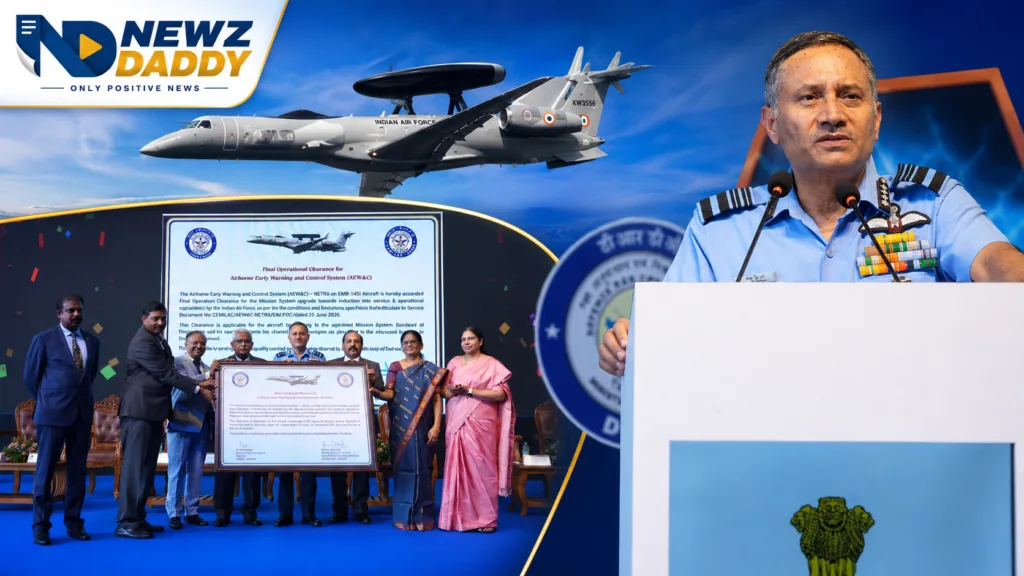
India has taken another step in strengthening its indigenous defence capability after the Defence Research and Development Organisation (DRDO) handed over the Final Operational Clearance (FOC) certificate for the Netra Airborne Early Warning and Control (AEW&C) system to the Indian Air Force (IAF). The clearance confirms that the system has completed its development, testing and operational evaluation and is ready for full military service.
The handover ceremony took place in Bengaluru, Karnataka, on June 25, 2026. It was presided over by Deputy Chief of the Air Staff Air Marshal Awadhesh Kumar Bharti. Among those present were former Chief of the Air Staff Air Chief Marshal RKS Bhadauria (Retd), formNetra AEW&C Gives India a Stronger Eye in the Skyer DRDO Chairman Dr S Christopher, senior serving and retired officers of the Indian Air Force, senior DRDO scientists, industry partners and officials associated with the programme.
The Netra AEW&C system has been developed jointly by the Indian Air Force, DRDO and Indian industry. It is designed to improve airborne surveillance, situational awareness and battle management. The programme received Initial Operational Clearance (IOC) in 2017, allowing the system to enter service while further testing and improvements continued. The latest clearance marks the completion of that process and confirms that the system meets the operational requirements set by the Air Force.
Airborne Early Warning and Control aircraft are often described as flying command centres. Equipped with powerful radar and communication systems, they can detect aircraft, missiles and other airborne threats over long distances. They also help commanders coordinate fighter aircraft and air defence operations by providing a wider picture of the battlefield. Such aircraft are considered an important force multiplier because they improve the speed and quality of military decision-making.
India’s Netra system is mounted on the Embraer ERJ-145 aircraft and uses an Active Electronically Scanned Array (AESA) radar developed in the country. The platform supports surveillance, identification of aerial targets, communication with fighter aircraft and ground stations, and electronic intelligence functions. The system has been developed as part of India’s long-term effort to reduce dependence on imported defence technology while strengthening domestic research and manufacturing.
Addressing the gathering, Air Marshal Awadhesh Kumar Bharti appreciated the successful completion of the programme and referred to the operational use of the Netra system during Operation Sindoor and the Balakot strikes. He said its performance had demonstrated the reliability of indigenous technology in real operational conditions. He also noted that home-grown systems provide the armed forces with greater flexibility to introduce upgrades and modifications as operational needs change. He praised the cooperation between DRDO, the Indian Air Force and industry, describing it as an important factor behind the programme’s success.
Distinguished Scientist and Director General of DRDO’s Aeronautics Cluster, Dr K Rajalakshmi Menon, spoke about the development of the programme from its early stages to operational readiness. She discussed the technical challenges faced by the team and the engineering decisions that helped the project achieve its objectives. She also stressed the importance of system engineering in planning and carrying out the flight-test campaign.
Distinguished Scientist and Director General of DRDO’s Electronics Cluster, Dr BK Das, said the close cooperation between all stakeholders had been central to the programme. He described the Netra AEW&C system as an example of India’s growing capability in advanced defence technology and linked the achievement to the country’s broader goal of building a stronger domestic defence industry.
During the ceremony, organisations and units that contributed to the design, testing and operational deployment of the Netra AEW&C system were recognised for their work. Officials said the programme demonstrated how operational users, scientific institutions and defence production organisations can work together on complex military projects.
The Netra programme also carries historical importance. It follows decades of Indian efforts to build an indigenous airborne surveillance capability after earlier projects faced technical challenges, including the loss of the Airborne Surveillance Platform aircraft in 1999. The successful completion of Netra marks a major milestone in that long development journey and reflects sustained investment in domestic aerospace research.
India currently operates three Netra Mk 1 aircraft, and the government has approved plans for more advanced versions under the Netra Mk 1A and Netra Mk 2 programmes. These future systems are expected to provide greater radar coverage, improved electronic warfare capability and stronger integration with the Indian Air Force’s network-centric operations. They form part of wider modernisation plans aimed at improving surveillance across India’s land and maritime borders.
Raksha Mantri Rajnath Singh congratulated DRDO, the Indian Air Force and industry partners on achieving the Final Operational Clearance. He said the milestone represented both a technological achievement and an important step in strengthening India’s airborne surveillance and command-and-control capability.
Defence Secretary and Secretary, Department of Defence Research and Development, as well as Chairman of DRDO, Rajesh Kumar Singh, also congratulated the Director General of the Aeronautics Cluster and the entire AEW&C team for completing the programme.
The Final Operational Clearance of the Netra system comes at a time when many countries are increasing investment in advanced surveillance and networked defence systems to respond to changing security challenges. For India, the achievement strengthens a critical military capability while supporting the country’s long-standing policy of expanding indigenous defence research, production and technological self-reliance.