


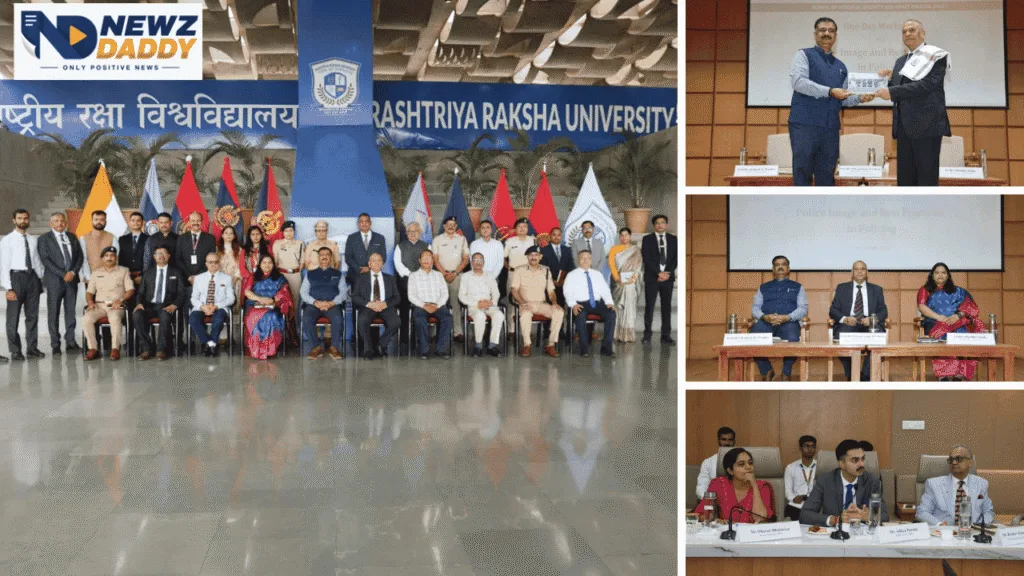
Police Image and Best Practices in Policing Discussed at RRU
Police Leaders Call for Trust-Based, Technology-Driven Policing at RRU Workshop
GANDHINAGAR, July 14: Senior police officers from across India gathered at Rashtriya Raksha University (RRU) on Monday to discuss how police forces can improve public confidence, strengthen women’s safety and use technology to prevent crime before it happens.
The one-day workshop, organised by the School of Internal Security and SMART Policing (SISSP) at RRU, brought together Director Generals of Police, Inspectors General and other senior officers from Uttar Pradesh, Uttarakhand, Delhi, Meghalaya, Gujarat, West Bengal and Rajasthan, along with representatives from the Union Territories of Daman and Diu and Dadra and Nagar Haveli.
The discussions centred on one of the biggest challenges facing police organisations today. While India has one of the world’s largest police systems, experts said public confidence remains the foundation of effective law enforcement. They argued that policing is judged not only by crime statistics but also by how fairly, respectfully and efficiently officers deal with citizens.
Speaking as the Guest of Honour, Prof. (Dr.) Vikram Singh, IPS (Retd.), former Director General of Police, Uttar Pradesh, and Chancellor of Noida International University, urged police organisations to move beyond practices inherited from the colonial era.
He said police must leave behind the “feudal” approach associated with the Police Act of 1861 and adopt policing built on public confidence and ethical conduct. He cautioned against relying on publicity campaigns or unauthorised media interactions to improve the police’s image.
“A positive police image is built not through publicity, but through consistent, ethical conduct and genuine public service, earning the trust and confidence of citizens through action rather than optics,” he said.
The Police Act of 1861 was introduced during British rule after the Revolt of 1857. Many police reform committees, including the Supreme Court in the Prakash Singh case, have recommended modernising police administration to make it more accountable, transparent and responsive to citizens.
Prof. Singh devoted significant attention to the treatment of women who approach the police. Referring to Kolkata Police’s “LISTEN” model and Uttarakhand Police’s safe space reporting system, he said police stations have traditionally functioned as a “boys’ club,” discouraging many women from reporting offences.
Quoting former Supreme Court judge Justice V.R. Krishna Iyer, he reminded officers that “while murder destroys the body, rape destroys the soul.” He asked police personnel to treat victims with dignity, remain impartial during domestic disputes and shift policing “from the danda to data-centric.”
India has introduced several initiatives in recent years to improve women’s safety, including emergency helplines, dedicated women’s help desks, cybercrime reporting systems and technology-based policing tools. Many states have also expanded the use of women police officers and specialised investigation units.
Delivering the inaugural address, Prof. (Dr.) Kalpesh H. Wandra said policing in India is moving from a system that mainly responds after crimes occur to one that predicts and prevents crime through technology.
He linked this transition to the Prime Minister’s vision of SMART policing, an approach that promotes policing that is strict and sensitive, modern and mobile, alert and accountable, reliable and responsive, and trained and technology-enabled.
Prof. Wandra noted that India operates nearly 20,000 police stations and has about 2.6 million police personnel serving a population of more than 1.4 billion. He said these numbers alone do not guarantee effective policing, adding that cooperation between citizens and police remains essential.
He also pointed to the workshop programme, which included 54 lectures covering technology adoption, community policing and women’s safety. According to him, these discussions reflect wider efforts to build policing that is transparent, service-oriented and consistent with the national goal of Viksit Bharat 2047.
The programme opened with a welcome address by Lt. (Dr.) Ruchika Singla, Director I/C of SISSP, outlined RRU’s efforts to prepare police personnel for changing security challenges.
She said the university is working towards a technology-driven, specialised and citizen-focused policing system through skill development and professional training. She referred to Mission Karmayogi, the Government of India’s capacity-building programme for public servants, as well as initiatives promoting women in policing and specialised training across different ranks.
Dr Singla also said RRU has organised its “Police Image” lecture series on the 22nd of every month and has completed 54 lectures. She said the initiative aims to connect academic learning with practical policing while supporting the university’s guiding principle that “National Security is Supreme.”
Throughout the day, officers from different states shared examples of policing practices developed in their respective organisations.
Shri Anant Takwale, IPS, Inspector General (Training), Uttarakhand Police, discussed community-based policing initiatives in Uttarakhand.
Shri Dev Ranjan Verma, IPS, Deputy Inspector General (Training), Uttar Pradesh, presented the state’s Women Power Line 1090 programme, which uses technology to help women report harassment and seek assistance.
Mrs Neha Yadav, IPS, Additional Commissioner of Police, Delhi Police, explained policing initiatives implemented in the national capital.
Shri Lakador Syiem, IPS, Administrative Officer at Meghalaya Police Academy, spoke about policing practices in Meghalaya.
Shri Hardik N. Prajapati, Deputy Superintendent of Police and SDPO, Kadi, Gujarat, outlined policing initiatives introduced by Gujarat Police.
Shri Sujit Bhattacharjee, Inspector at Swami Vivekananda State Police Academy, West Bengal, delivered a presentation titled “The Policing Paradigm: Fostering Public Trust, Police Image and Best Practices of West Bengal Police.”
Smt. Toniya Sharma, Company Commander, 4th RAC Battalion, Jaipur, concluded the technical sessions by discussing policing practices followed in Rajasthan.
Their presentations examined different approaches to citizen engagement, technology, women’s safety and building trust between police organisations and local communities. Although policing challenges vary across states, the speakers agreed that public confidence remains central to successful law enforcement.
The workshop concluded with a vote of thanks delivered by Mr Vishal Katariya, I/C Coordinator, State and UT Police, Director, SISSP. He thanked the Guest of Honour, Vice Chancellor, speakers, delegates and officers from participating states for sharing practical experiences that could be adapted across different police organisations.
As governments increasingly invest in digital policing, artificial intelligence, cybercrime investigation and public service delivery, experts at the workshop said the future of policing will depend as much on public trust and ethical conduct as on technology itself. Their message was clear: better policing begins with better relationships between the police and the people they serve.