


Purushottam Manoraths at Bhagwat Vidyapith, Ahmedabad
Various Manorathas Organised During Purushottam Month at Shri Bhagwat Vidyapith: Shri Bhagwat Rishi
This year, on the occasion of the Purushottam Maas, various Manoraths of Shri Rasaraj Prabhu have been organised in the main temple of Shri Kalpataru Prasad at Sola Bhagwat Vidyapith from 17 May 2026 to 15 June 2026. Besides this, plans have also been made for the construction of a grand new hostel building for the Rishi Kumaras studying at Bhagwat Vidyapith. The project is expected to help students from different parts of Gujarat and India get better residential facilities while continuing their Sanskrit and Vedic studies. Across India, many traditional Sanskrit institutions are now improving hostel and campus facilities so that young students can continue ancient learning in a modern and comfortable environment.
Also Read:
“Gau Seva Mahotsav at Shri Bhagwat Vidyapith”
A lavish Brahmo Choryasi feast for the Brahmins was held at Sola Bhagwat, Ahmedabad.
Managing Trustee of Sola Bhagwat Vidyapith, Hon. Shri Bhagwat Rishiji, said that on the occasion of the 24th death anniversary of the world-renowned P.H. Shri Krishna Shankar Shastriji (P. Dadaji), founder of Shri Bhagwat Vidyapith, Shri Vallabhanidhi Trust and Shri Krishnanidhi Trust, various worship and prayer programmes along with a musical performance by the famous Vikram Labdiya Group have been organised on 10 May 2026 at 7.00 pm. Spiritual institutions across Gujarat often organise devotional music events during religious gatherings because bhajans and kirtans help younger generations connect with Indian culture and traditions in a simple and emotional way. Religious music programmes are also becoming popular among urban families who wish to stay connected with their roots.

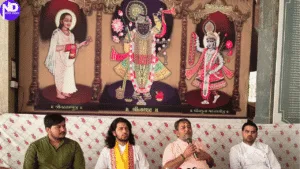
Pujya Shri Bhagwat Rishiji further said that Lord Krishna gave His own name to the extra month, which is why the additional lunar month is known as Purushottam Maas. In Hindu belief, this month is considered highly sacred for prayer, fasting, charity and devotion. Many devotees across Gujarat, Rajasthan and other states visit temples daily during this period. Religious scholars often describe Purushottam Maas as a time for self-discipline, spiritual learning and good deeds. Many families also organise Bhagwat Kathas, Ram Kathas and food donation programmes during this month.
Various Manoraths have been organised from Adhik Jeth Sud-1 to Adhik Jeth Vad-30 Amasa. These include Samvatsarov, Rath Yatra, Gocharan Leela, Vasant Panchami, Shrinathji’s appearance, Radha Ashtami, Gopashtami, Ram Navami, Naav Manorath, Dan Leela Manorath, Pavitra Ekadashi, Vaman Jayanti, Morkuti Manorath, Narsingh Jayanti, Sharadotsav Raas, Chhak Manorath, Gokul-Mathura, Akash Jhula, Janmashtami Mahotsav, Nand Mahotsav, Gunsaiji’s festival, Sawan-Bhada, Mahaprabhuji’s festival, Sheesh Mahal and Govardhan Puja-Annakut Manorath. Such festivals are deeply connected with the Pushtimarg tradition and Krishna devotion. In recent years, many young devotees have started attending these events to understand Indian traditions, temple rituals and spiritual storytelling. Temple festivals also help local artisans, flower sellers, musicians and small traders who are connected with religious tourism and devotional events.
Shri Anantkrishna Shastri said that more than five thousand Brahmin children, known as Rishi Kumaras, have studied Sanskrit along with Vedas and Upanishads at Shri Bhagwat Vidyapeeth. Sanskrit learning has seen renewed interest in India during the last few years. Several universities and institutions are now offering Sanskrit courses with modern subjects such as computers, spoken English and digital learning. Experts believe this helps students build careers while preserving ancient Indian knowledge. Gujarat itself has several Sanskrit institutions and universities working to protect Vedic education and Indian philosophy.
He further said that students from the institution are now serving as teachers in convent and C.B.S.E. schools in metropolitan cities. Many former students are working as storytellers, ritual experts and astrologers, while others hold important posts in universities. More than fifty Rishi Kumaras from the institution are serving as priests in Hindu temples abroad. Across countries such as the United States, Canada, Australia and the United Kingdom, Hindu temples are increasingly inviting trained Sanskrit scholars and priests from India because of the growing Indian diaspora. Religious and cultural education has become an important part of keeping Indian traditions alive among families living overseas.
Apart from Sanskrit education, various classes are currently being conducted at the institution, including yoga, karate and weekly Sangh classes held every Sunday on the main ground. Bharatanatyam classes are also expected to begin soon. Educational experts today often say that combining physical fitness, cultural learning and spiritual education helps children grow with discipline and confidence. Many traditional institutions in India are now introducing activities such as yoga, classical dance and martial arts along with academic education to support the all-round development of students.
Diploma classes at Shrivartantu Sanskrit Mahavidyalaya, run by Shri Bhagwat Vidyapeeth, begin every year in August. Sanskrit colleges in Gujarat and other states are now trying to connect ancient studies with present-day career opportunities. Students trained in Sanskrit and Indian scriptures are increasingly finding work in teaching, research, religious services and cultural organisations both in India and abroad.