


Rajnath Singh Backs Sri Lanka as India Deepens Ties in Colombo
Rajnath Singh in Sri Lanka: India Signals Continued Support as Defence and Economic Ties Grow
India will stand with Sri Lanka when the island nation faces a crisis, Defence Minister Rajnath Singh said in Colombo on September 8 as he began his first official visit to the country.

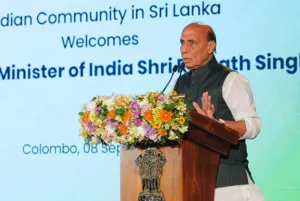
Speaking to members of the Indian diaspora, Singh placed the visit in the wider setting of India-Sri Lanka relations, pointing to their long cultural and civilisational links. His three-day visit, from September 8 to 10, includes talks with Sri Lankan leaders and is being led by a high-level delegation from the Ministry of Defence and Ministry of External Affairs. Defence and maritime cooperation are expected to remain important parts of the discussions.
The timing carries weight for both countries. Sri Lanka has spent the past few years dealing with the effects of its severe economic crisis. India provided close to $4 billion in assistance during the 2022 crisis, including credit for fuel and essential goods and a currency swap. India also provided medicines and other emergency supplies.
India’s support continued during later emergencies. The Indian government said it was among the first responders after Cyclone Ditwah struck Sri Lanka in 2025. The episode added another practical dimension to a relationship that covers security, trade, connectivity, development and people-to-people links.
At his Colombo meeting, Singh spent much of his speech describing India’s economic changes over the past 12 years. He said India’s economy had grown from about $2 trillion in 2014 to around $4 trillion, while the country recorded 7.8% growth in the first quarter of financial year 2026-27. Official Indian statistics confirm that the first-quarter GDP estimates for 2026-27 were released on August 31.
Rajnath Singh also said India now contributes more than 16% of global growth. He compared average inflation over the past 12 years, which he put at about 4.7%, with the 10-11% level he cited for the earlier period.
Rajnath Singh said the value of India’s goods and services exports had increased from Rs 45 lakh crore in 2014 to Rs 79 lakh crore in FY 2025-26. Electronics and mobile phone production were among the areas he singled out. According to Singh, electronics production increased from Rs 1.9 lakh crore to more than Rs 11 lakh crore, while electronics exports rose from about Rs 38,000 crore to more than Rs 3 lakh crore.
Rajnath Singh also said India had become the world’s second-largest mobile phone manufacturer. The number of manufacturing units, he said, had risen from two in 2014 to more than 300, while mobile production increased from Rs 18,000 crore to Rs 5.5 lakh crore. Mobile exports, he said, had risen nearly 163 times to Rs 2.6 lakh crore. Automobile exports were put at Rs 1.20 lakh crore a year, compared with about Rs 50,000 crore earlier.
Singh linked these figures to India’s growing trade network. He said India had concluded trade deals with 38 countries over the past 12 years, including free trade agreements with eight major nations, compared with four before 2014. He described the India-European Union FTA as the “Mother of All Deals”, saying it gives Indian businesses access to the large European market.
Trade is already a major part of India’s relationship with Sri Lanka. The Ministry of External Affairs says merchandise trade between the two countries reached $5.54 billion in FY 2023-24, with Indian exports accounting for $4.11 billion and Sri Lankan exports $1.42 billion. India is also one of Sri Lanka’s major sources of foreign investment.
Connectivity has expanded alongside trade. India and Sri Lanka have restored air links between Chennai and Jaffna, started a passenger ferry service between Nagapattinam and Kankesanthurai, and introduced UPI-based payments in Sri Lanka. Discussions have also covered power links, fuel pipelines and further ferry connections.
Defence was another major part of Singh’s address. He said India’s defence exports had risen from about Rs 600 crore 12 years ago to around Rs 39,000 crore. The latest government figure puts defence exports at Rs 38,424 crore in FY 2025-26, up 62.66% from the previous year. Defence production also reached a record Rs 1.78 lakh crore in the same financial year.
Singh said the defence budget had risen from about Rs 2 lakh crore in FY 2013-14 to Rs 7.25 lakh crore in FY 2025-26. He presented the increase as part of India’s effort to reduce dependence on imported defence equipment and expand domestic manufacturing.
The wider shift is visible in official production figures. The Ministry of Defence says defence production has risen almost fourfold from Rs 43,746 crore in FY 2013-14 to Rs 1.78 lakh crore in FY 2025-26. The private sector accounted for about 24% of production in the latest financial year.
Singh also referred to India’s start-up sector, saying the country now has the world’s third-largest start-up ecosystem. He pointed to the rise in unicorn companies as evidence of growing business activity among young Indians.
His speech also covered domestic policy. He referred to the Goods and Services Tax as the basis of a “One Nation, One Tax” system and said tax relief measures had reduced the burden on individual taxpayers. He claimed that about 25 crore Indians had moved out of poverty and that social security coverage had expanded from around 25 crore people in 2014 to about 95 crore today.
Digital services and infrastructure were also part of his account. Singh cited the expansion of broadband networks, the rapid spread of UPI, wider highway and airport networks and the electrification of Indian Railways. He said the Direct Benefit Transfer system had transferred Rs 51 lakh crore into people’s bank accounts.
The Colombo event was attended by Sri Lankan Cabinet Minister Saroja Savithri Paulraj, Western Province Governor Hanif Yusoof, Sri Lankan Deputy Minister Sundaralingam Pradeep, Indian High Commissioner Santosh Jha, senior Indian civil and military officials and members of the Indian community.
For Sri Lanka, the immediate importance of Singh’s visit lies in the continued attention India is giving to security and economic cooperation. For India, Sri Lanka remains an important neighbour in the Indian Ocean, with defence, trade, connectivity and crisis assistance all forming part of a relationship that has grown considerably in recent years.