


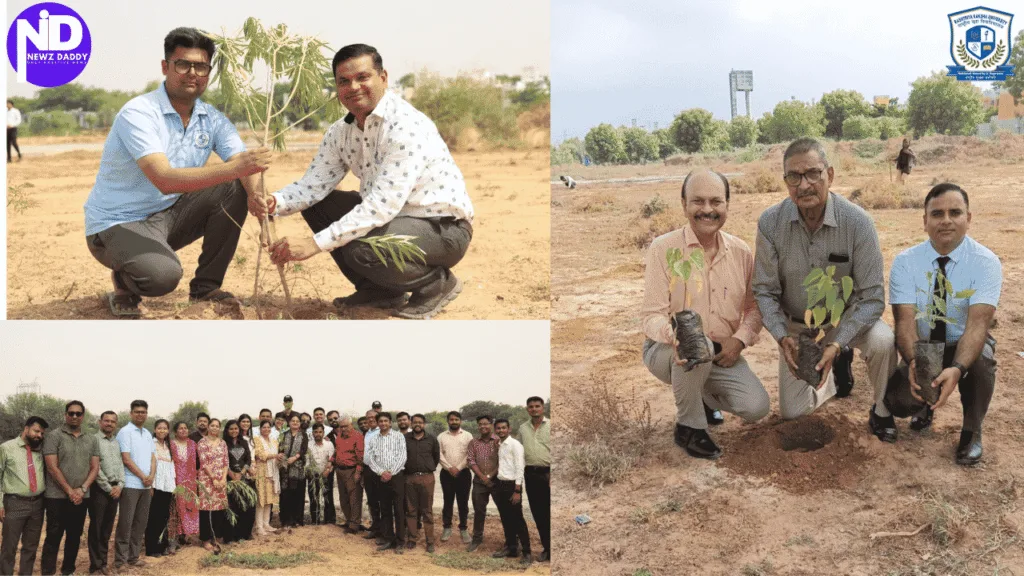
Rashtriya Raksha University Tree Plantation Drive Targets 10K Trees
Rashtriya Raksha University Launches Major Tree Plantation Drive, Targets 10,000 Trees by Van Mahotsav 2026
Rashtriya Raksha University (RRU), a national institution focused on security and police education, has launched a large-scale tree plantation campaign aimed at planting around 10,000 trees and saplings across its campus by the end of Van Mahotsav 2026 on 7 July.
The initiative, announced on the occasion of World Earth Day and continuing through World Environment Day activities, forms part of the university’s broader efforts to strengthen environmental sustainability, improve biodiversity and expand green spaces within its campus at Lavad in Gandhinagar district.
According to university officials, more than 3,000 trees and saplings have already been planted under the campaign titled “From Earth Day to Environment Day”, marking substantial progress towards the overall target. Students, faculty members, staff and volunteers have participated in plantation activities across designated areas of the campus.
The drive is being carried out under the guidance of Vice-Chancellor Prof. (Dr.) Bimal N. Patel, as part of the university’s efforts to integrate environmental responsibility into its educational and institutional activities.
The university said the programme focuses on planting indigenous and environmentally suitable tree species to improve the campus ecosystem and support local biodiversity. Such species are generally considered better adapted to local climatic conditions and can provide long-term ecological benefits, including improved soil health, habitat creation for birds and insects, and greater resilience to changing weather patterns.
Environmental experts increasingly emphasise the importance of native tree species in restoration and afforestation projects. Indigenous trees often require less maintenance, support local wildlife and are more likely to survive in regional soil and climate conditions. Across India, several government and community-led plantation programmes have shifted towards native species for these reasons.
The RRU campaign comes at a time when environmental sustainability is becoming a growing priority for educational institutions across the country. Universities and schools are increasingly adopting green campus initiatives that include tree planting, waste management, water conservation, renewable energy use and biodiversity protection.
India has also placed significant emphasis on increasing green cover through national and state-level programmes. Tree plantation drives are commonly organised around World Environment Day, observed annually on 5 June, and Van Mahotsav, the nationwide tree-planting festival traditionally celebrated during the monsoon season.
Environmental researchers note that urbanisation, infrastructure development and population growth have placed increasing pressure on green spaces in many parts of India. As a result, institutional campuses are often viewed as important locations for developing urban forests and biodiversity corridors.
RRU officials said the plantation campaign is intended not only to increase green cover but also to contribute to climate resilience and ecological balance over the long term. Trees play a critical role in absorbing carbon dioxide, improving air quality, reducing surface temperatures and supporting groundwater recharge. Large plantations can also help create healthier environments for students and staff.
University authorities highlighted the importance of collective participation in addressing environmental challenges and encouraged stakeholders to contribute to the campaign. The plantation drive has attracted support from members of the university community, including students and employees who have volunteered their time during the planting activities.
The university has also announced plans for ongoing monitoring and maintenance of the newly planted saplings. Environmental projects often face challenges related to survival rates after planting, making long-term care an important part of successful afforestation efforts. RRU said it has developed measures to ensure the healthy growth and sustainability of the planted trees, including regular monitoring and nurturing activities.
The initiative received additional support from representatives of the ICICI Foundation, who visited the campus during the programme. The visiting team reviewed the plantation activities and discussed possibilities for future environmental and community-focused collaborations with the university.
The involvement of the ICICI Foundation reflects a broader trend of corporate social responsibility participation in environmental projects across India. The foundation has supported plantation, watershed development and environmental conservation initiatives in several parts of the country. According to information released by the organisation, millions of trees have been planted through its environmental programmes in partnership with institutions, communities and local authorities.
Corporate participation has become an increasingly important source of support for environmental projects, particularly those involving afforestation, water conservation and climate adaptation measures. Such partnerships often combine institutional resources with volunteer participation and technical expertise.
For Rashtriya Raksha University, the plantation campaign also aligns with its growing role as a national institution. Originally established by the Government of Gujarat as Raksha Shakti University, the institution was upgraded through an Act of Parliament in 2020 and declared an Institution of National Importance. It now functions under the Ministry of Home Affairs and focuses on education, research and training in areas related to national security, policing and criminal justice.
While the university is primarily known for its security and law enforcement programmes, officials have increasingly promoted environmental sustainability as part of campus development. Green campuses are viewed by many higher education institutions as an important component of creating healthier and more sustainable learning environments.
The current plantation drive is expected to continue until Van Mahotsav 2026, with additional plantation activities planned over the coming weeks. If the university achieves its target of around 10,000 trees and saplings, the project would significantly expand the green cover of the campus and contribute to long-term ecological improvement in the area.
The initiative also reflects a wider recognition that environmental conservation requires participation from multiple sectors, including educational institutions, businesses, government agencies and local communities. As climate change, biodiversity loss and environmental degradation remain major global concerns, tree plantation programmes continue to be promoted as one of several practical measures to support ecological restoration and environmental awareness.
RRU has invited students, staff members, partner organisations and community participants to join the ongoing campaign. University officials say the effort is intended to create lasting environmental benefits while encouraging greater awareness of sustainability and conservation among future generations.
With more than 3,000 trees already planted and further plantation activities scheduled before Van Mahotsav, the university’s campaign represents one of the larger ongoing green campus initiatives currently underway in Gujarat’s higher education sector. As the programme progresses, its long-term success will depend not only on the number of trees planted but also on the survival and growth of those saplings in the years ahead.