


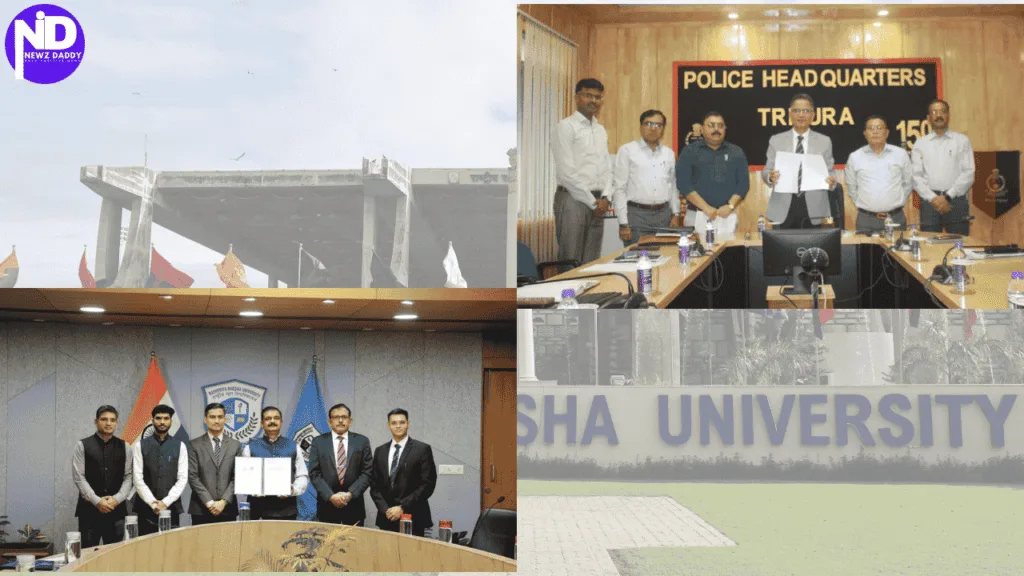
Rashtriya Raksha University Tripura Police MoU boosts Northeast security
Rashtriya Raksha University and Tripura Police Sign Landmark MoU to Strengthen National Security Architecture in the Northeast
Gandhinagar, Gujarat, India – In a major step toward fulfilling the vision of the Hon’ble Prime Minister and the Hon’ble Union Home Minister for seamless collaboration across all national security and police organisations, Rashtriya Raksha University (RRU) officially signed a Memorandum of Understanding (MoU) with the Tripura Police today. Under the leadership of Prof. (Dr.) Bimal N. Patel, Hon’ble Vice-Chancellor, RRU, continues its path as an Institution of National Importance (INI), a status given only to top institutions that support the country in critical sectors like defence and policing.
This kind of collaboration is important because India’s Northeast region shares long international borders. Security experts have often highlighted that states like Tripura face unique challenges, such as cross-border crimes and illegal trade. Strengthening coordination between academic institutions and police forces is seen as a practical way to improve skills and preparedness on the ground.
The virtual signing ceremony was attended by senior officials from both sides. From RRU, the MoU was signed by Prof. (Dr.) Kalpesh H. Wandra, Pro-Vice Chancellor, and Mr Avinash Kharel, Dean (I/C), Accreditation and Affiliation. Representing Tripura Police were Shri Anurag, IPS, Director General of Police (DGP), and Shri Bogati Jagdeeswar Reddy, IPS, Assistant Inspector General of Police (AIGP).
Such high-level participation shows how seriously both institutions are taking this partnership. In recent years, police reforms in India have focused on leadership training and modern policing methods. Senior officers are now expected to understand not only law enforcement but also technology, cyber threats, and community relations.
This partnership marks RRU’s 26th collaboration with state and Union Territory police organisations. The university has already worked with forces in states like Arunachal Pradesh, Assam, Meghalaya, and Nagaland. These partnerships have helped improve training standards and brought uniformity in policing methods across regions.
Experts say this expansion into Tripura is a timely move. The Northeast has seen rapid development in infrastructure and connectivity, but with that comes new security risks. Better-trained police forces can help prevent crime rather than only respond to it. RRU’s growing network shows a long-term plan to build a strong and skilled national security system.
A key highlight of this collaboration is the plan to set up a dedicated RRU Centre in Tripura. This centre will act as a regional hub for specialised training. It builds on earlier success where 60 Tripura Police personnel were trained in areas such as technology, police management, internal security, tourism policing, and new criminal laws.
Training centres like this are becoming common across India. They help officers learn practical skills, not just theory. For example, tourism policing is gaining importance as states try to attract more visitors. A safe and friendly environment for tourists directly supports the local economy.
The collaboration will also focus on major security challenges. Border region crimes like drug trafficking and human trafficking remain serious issues in the Northeast. Reports from various agencies show that illegal networks often use remote border areas to move goods and people. Training police to detect and stop these crimes early can save many lives.
Modern investigation techniques will also be a key focus. Cybersecurity and financial crimes are rising fast across India. With more people using digital payments and online services, criminals are also finding new ways to cheat. Police officers now need skills in digital tracking, data analysis, and cyber laws to keep up with these changes.
Public safety is another important area. The MoU includes training on community policing and crimes against women. Community policing helps build trust between citizens and the police. When people feel safe to report issues, crime rates often go down. At the same time, focused training on crimes against women ensures that cases are handled with care and sensitivity.
Legal and administrative training will also be part of the programme. India has recently updated its criminal laws, and officers need to understand these changes clearly. Proper knowledge of laws helps in faster investigations and stronger cases in court. Training in prison management will also help improve how correctional facilities are run.
Officials from both sides said that this MoU is more than just a formal agreement. It is a shared effort to improve the skills and professionalism of the Tripura Police. By combining academic knowledge with field experience, the partnership aims to create a safer environment for citizens.
In the larger picture, such collaborations show how India is trying to modernise its security system. Instead of working in silos, institutions and police forces are now joining hands. This approach is likely to play a key role in building a strong and secure nation in the years ahead.
Must Read:
Rashtriya Raksha University Defence Attachés Conference Shines