


Research Paper Publishing Workshop Held at Swarrnim University
Swarrnim University Workshop Focuses on the Real Challenges of Research Publishing
For many university researchers, writing a research paper is only one part of the work. Finding the right journal, preparing a manuscript to meet its requirements, handling peer review, and dealing with rejection can take just as much time. These issues were at the centre of a research publishing workshop held by Swarrnim Startup & Innovation University in Gandhinagar on Thursday.

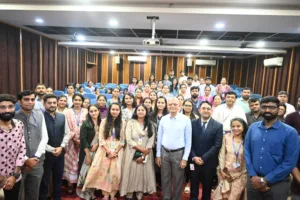
The university organised a specialised session titled “Winning the Game of Publishing Research Papers in Top-Quality Journals” for its faculty members and research scholars. The workshop was conducted with experts from Wiley, the international academic publishing company.
Wiley experts Yateendra Joshi, Rishabh Bajaj and Vipin Danial led the session. They discussed the practical steps involved in taking a research manuscript from preparation to journal submission and later stages of publication.
A total of 104 faculty members and research scholars took part in the workshop. The programme also included an interactive question-and-answer session, allowing participants to raise issues linked to their own research and publishing work.
The subject is relevant to researchers because publication in a recognised journal involves more than completing a paper and sending it to an editor. Researchers must first identify journals that match the subject and scope of their work. They also need to understand the journal’s submission rules, prepare references correctly, and be ready to respond to reviewers’ comments.
Yateendra Joshi has worked for many years in academic and scientific publishing and has conducted research-writing and publishing programmes at universities and research institutions in India and abroad. His work has included training on journal selection, manuscript preparation, peer review and publication ethics. An IIT Bhubaneswar annual report, for example, records Wiley author workshops led by Joshi in 2022, where participants were introduced to paper structure, peer review and publishing ethics.
Joshi has also written about the difficulties researchers face when trying to publish in respected journals. In a 2020 paper inCurrent Science, he noted that researchers in India often have limited opportunities to learn the practical skills needed to write papers for prestigious journals. He described training programmes conducted for researchers at more than 30 institutions in India and the Middle East.
The Gandhinagar workshop covered several parts of that publishing process. Participants were guided on how to select an appropriate journal, improve the quality of a manuscript and understand what happens after a paper is submitted. The discussion also covered citation practices and ways to respond to reviewer comments.
Peer review is a key part of scholarly publishing. Researchers submit their work to a journal, after which experts in the relevant field assess the paper and may suggest changes before a final decision is made. A paper can be rejected at different stages, including because its subject does not fit the journal, its methods are weak, its findings are not clear, or the manuscript does not meet the publication’s requirements.
Rejection is therefore a normal part of academic publishing. Learning how to read reviewers’ comments and make useful changes can help researchers improve future submissions.
Another important subject discussed at Swarrnim was publication ethics. Researchers were warned about the risks of predatory journals, which can appear to offer an easy route to publication but may not provide proper editorial checks or meaningful peer review.
Research published by Wiley has examined why authors can be drawn towards such journals. One study found that the promise of quick publication was a major reason reported by authors who had published in journals later identified as predatory. Another review focusing on South Asian healthcare researchers found that pressure to publish and limited research support were among the factors linked to publication in questionable journals.
The problem is serious because a journal’s appearance or website does not by itself prove that it follows accepted academic standards. Wiley advises researchers to look carefully at claims about peer review, publishing policies, indexing and other journal information before submitting a paper. The Committee on Publication Ethics has also published warning signs that researchers can use when checking questionable journals.
This makes journal selection an important decision for researchers, particularly those who are still building their academic record. A paper published in a credible journal can be easier for other researchers to find, read and cite. A paper placed in a questionable publication can raise doubts about the quality of the publishing process.
For Swarrnim Startup & Innovation University, the workshop also fits with the research policies outlined in its institutional documents. The university has stated that it wants to encourage faculty research, support participation in national and international conferences, recognise publications in high-impact journals and provide incentives for research published in selected recognised journals. Its institutional development plan also lists Wiley among the journal and publishing platforms covered by its research incentive scheme.
The university’s research plans are being pursued as it continues to develop its academic and research activities. Its institutional documents also refer to research infrastructure, collaboration with international higher education institutions and opportunities for faculty and student research exchanges.
For the 104 participants attending the 13 August workshop, the immediate focus was more practical: how to turn research work into a paper that can stand up to editorial and peer review checks, and how to choose a journal with care.
The session also gave researchers a chance to discuss problems that often arise after a manuscript is completed. Questions from participants and the interaction with the Wiley speakers formed part of the programme.
For researchers working towards stronger academic publication records, these skills can affect what happens to their work after the research itself is finished. The quality of the journal, the care taken during submission and the ability to respond to review can all shape whether a paper reaches its intended academic audience.