


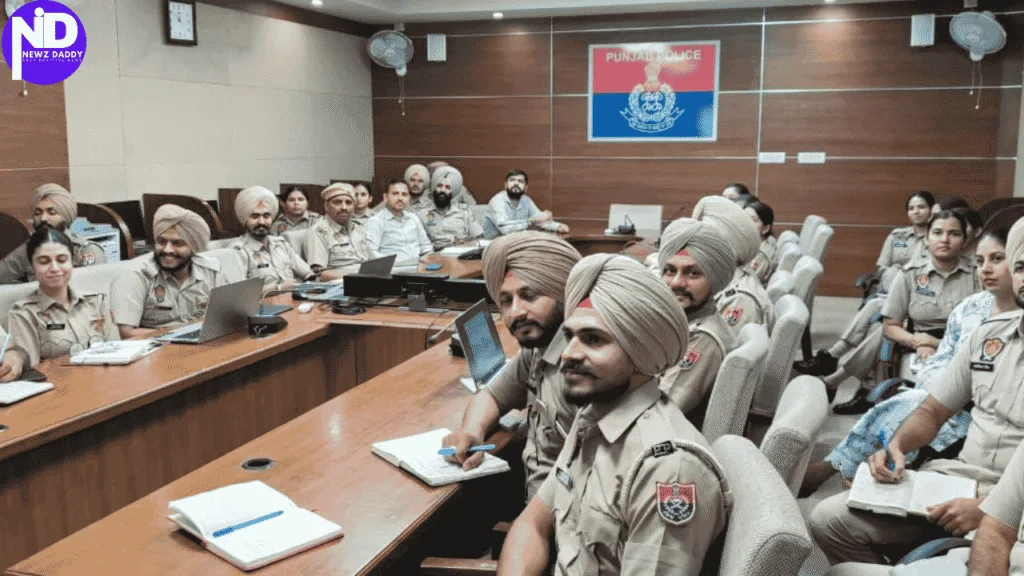
RRU AI Training for Punjab Police Covers Claude and AI Tools
Punjab Police Officers Complete AI and Prompt Engineering Training at Rashtriya Raksha University
As police organisations around the world look for ways to handle growing volumes of digital information, a group of 261 Punjab Police officers has completed specialised training in artificial intelligence at Rashtriya Raksha University (RRU) in Gujarat.
The three-day Foundation Course on “Claude AI 101 & Prompt Engineering” was conducted online from 15 to 17 June 2026 by the university’s School of Information Technology, Artificial Intelligence and Cyber Security (SITAICS). The programme brought together officers from different units of Punjab Police to learn how emerging AI tools can support modern policing, investigation, document management and administrative work.
The training reflects a wider trend in law enforcement agencies across India and internationally, where police departments are examining how artificial intelligence can assist officers while maintaining human oversight and accountability.
The programme opened with an address by Dr Jasbirkaur Thadhani, University Dean (I/c), who said AI tools can help officers deal with increasing amounts of information and reduce time spent on routine paperwork.
“AI tools help officers manage growing information volumes and automate routine paperwork, freeing their judgement for where it matters most,” she said.
The course was convened by Dr Chandresh Parekh, Director, SITAICS, and coordinated by Mr Poojan Shah, Assistant Professor, SITAICS.
Over nine sessions, participants received six hours of practical instruction designed specifically for policing and security environments. Rather than focusing only on theory, the programme introduced officers to tools and techniques that could be used in everyday professional work.
The first day concentrated on the fundamentals of artificial intelligence. Participants were introduced to the architecture of Large Language Models (LLMs), the technology that powers conversational AI systems. Officers also learned the basics of prompt engineering, a process that involves giving clear instructions to AI systems to obtain accurate and useful responses.
Faculty members explained four key components of effective prompting: Role, Task, Context and Output Format. These elements are increasingly recognised within the AI industry as important factors in improving the quality and reliability of responses generated by language models.
Participants were also introduced to offline AI platforms such as Ollama and LM Studio. Such tools allow organisations to run AI models on local systems without sending information to external servers. This capability is considered particularly relevant for government agencies, law enforcement bodies and organisations that handle sensitive information.
The sessions also examined applications such as Google AI Edge Gallery, which support AI operations in environments with limited or no internet connectivity.
The second day focused on document intelligence and information management. Officers learned how to create cross-document knowledge bases using Claude Projects and NotebookLM. These systems allow users to organise large collections of documents and search for information more efficiently.
The training included exercises in citation-supported analysis across multiple documents. Such methods can help investigators, analysts and administrative officers review large amounts of information while maintaining traceability of sources.
Another part of the programme introduced Bhashini, the Government of India’s language technology platform. Developed under the Ministry of Electronics and Information Technology, Bhashini supports text and speech processing across Indian languages. The platform forms part of the government’s broader effort to improve digital access and language inclusion in a country with hundreds of languages and dialects.
For police organisations, multilingual technology can be valuable when dealing with complaints, witness statements and public communication in different languages.
The final day addressed issues that have become central to discussions about artificial intelligence worldwide. Participants explored responsible AI practices, governance frameworks and red-teaming exercises designed to identify weaknesses, risks and unintended outcomes in AI systems.
The programme also covered no-code automation through Zapier, allowing users to automate routine digital tasks without advanced programming skills.
As AI adoption accelerates, questions about reliability, bias, privacy and accountability continue to attract attention from governments, researchers and industry groups. Several countries have introduced guidelines or regulatory frameworks aimed at ensuring that AI systems are used responsibly, particularly in sectors linked to public safety and justice.
These concerns are especially significant in policing, where decisions can affect investigations, public trust and individual rights. Experts generally emphasise that AI should support human decision-making rather than replace it.
This principle was echoed during the valedictory session by Dr Dharmeshkumar Prajapati, Registrar (I/c).
He congratulated participants on completing the programme and stressed that “the human-in-the-loop remains non-negotiable in all AI-assisted workflows.”
The phrase refers to a model in which human professionals remain responsible for reviewing, validating and approving outputs generated by artificial intelligence systems.
Feedback from participants suggested a strong interest in further AI-related training. Officers described the programme as informative and practical, noting that hands-on exercises helped them understand both the opportunities and limitations of AI tools.
Several participants also expressed interest in learning about future developments in the field and requested updated programmes as new technologies emerge.
Their response mirrors a broader pattern across public-sector organisations. Over the past few years, agencies responsible for policing, defence, cybersecurity and public administration have increased investment in digital skills training. Many institutions now view AI literacy as an important professional capability alongside traditional technical and investigative skills.
Founded as a national institution focused on security, policing and criminal justice education, Rashtriya Raksha University has expanded its activities in areas including cybersecurity, artificial intelligence, forensic sciences and internal security studies. The university regularly collaborates with police organisations, government agencies and international partners on specialised training programmes.
The latest initiative involving Punjab Police comes at a time when Indian law enforcement agencies are exploring ways to improve efficiency while dealing with growing volumes of digital evidence, online crime, cyber threats and complex investigations.
While AI tools continue to evolve rapidly, experts generally agree that their effectiveness depends on the quality of training provided to users and the safeguards put in place around their deployment. Programmes such as the one conducted by RRU seek to address both aspects by combining technical instruction with discussions on ethics, governance and responsible use.
According to the university, it intends to continue working with state police forces and national security organisations to promote the informed use of AI technologies. As policing increasingly intersects with data, digital systems and emerging technologies, demand for such training is expected to grow in the years ahead.