


RRU Lecture Explains the Future of Legal Startups Today
Legal Start-ups and Innovation Take Focus at Rashtriya Raksha University
Students of law at Rashtriya Raksha University, Lavad, Gandhinagar, were introduced to the growing idea of legal start-ups and the role of innovation in the legal field during a special lecture held on 28 September 2026.
The programme was organised by the School of Criminal Law and Military Law. The session brought together students of the fourth-year LLB and LLM programmes for a discussion on legal entrepreneurship, start-up development and free legal services.

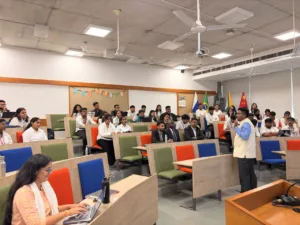
The main speaker was Dr Kalpesh K. Gupta, founder of ProBono India and Start-ups and Law Teachers India. The session was coordinated by Dr Anand Kumar Tripathi, Chairperson of the Centre for Postgraduate Legal Studies. Ms V. Jayashree, Assistant Professor in the Department of Law, hosted the session.
Dr Gupta introduced students to the term “legalpreneur”, a concept that links legal knowledge with entrepreneurship. He explained how people with legal training can identify problems faced by individuals, businesses and communities and build services or products to address those problems.
For law students, the idea opens a wider discussion about careers. Legal work is no longer limited to traditional practice, courts, law firms or government service. Technology and new business models are also creating ways for legal professionals to work on services, information, compliance and access to justice.
The School of Criminal Law and Military Law at Rashtriya Raksha University already places research, practical learning and access to justice within its academic work. Its official material says the school works in criminal and security law and also provides pro bono legal aid services. The school has previously conducted activities related to legal literacy and has also held a workshop on legal start-ups, innovation and incubation.
A major part of Dr Gupta’s talk dealt with the start-up system in India and the different stages through which a new business can develop.
The Central Government’s Startup India programme provides a formal system for eligible businesses to seek recognition from the Department for Promotion of Industry and Internal Trade, or DPIIT. Under the current rules, a normal start-up can qualify for recognition for up to 10 years from incorporation, while eligible deep-tech start-ups can qualify for up to 20 years. The rules also set turnover limits and require the business to work towards innovation, improvement of products, processes or services, or a scalable business model with potential to create jobs or wealth.
The rules were updated in 2026. The turnover limit for normal start-up recognition was raised from ₹100 crore to ₹200 crore. For recognised deep-tech start-ups, the limit is ₹300 crore.
This wider start-up framework is relevant to legal businesses because a legal service can also be built around a specific problem. For example, a new venture may focus on helping people understand legal documents, supporting businesses with compliance work, or making legal information easier to access. The success of such a venture would still depend on its legal structure, service quality, business model and compliance with professional rules.
The Startup India programme also lists support areas such as intellectual property protection, easier compliance and access to certain tax and procurement benefits for eligible recognised start-ups.
The lecture also turned attention to pro bono legal work. In simple terms, pro bono work means providing legal help without charging the person receiving the service.
This area has a direct connection with access to justice. The Department of Justice’s Nyaya Bandhu programme allows advocates to register and voluntarily provide legal assistance to people who need help. As of 30 November 2025, the department reported 9,776 advocates registered on the Nyaya Bandhu pro bono portal. It also said Pro Bono Clubs were operating in 109 law schools, while Nyaya Bandhu panels had been made functional in 23 High Courts.
The Department of Justice has also linked pro bono work with technology and legal access. Its Tele-Law programme provides pre-litigation legal advice through lawyers using telephone and video facilities. According to the department, more than 1.04 crore beneficiaries had received pre-litigation advice through the programme across 36 States and Union Territories by 31 December 2024.
For students entering the legal profession, these developments show that legal services can be connected with public service as well as business. The challenge is to make such services useful, reliable and accessible while following the rules that govern legal practice.
The Gandhinagar session placed these questions before students at an early stage of their legal careers. Dr Gupta discussed how start-ups can address practical problems, contribute to economic activity and create employment.
The discussion also connected entrepreneurship with the needs of people who may struggle to obtain legal help. For students, this brings together two areas that are often discussed separately: building a career and improving access to legal services.
The programme was attended mainly by fourth-year LLB and LLM students. The session ended with student participation, discussion and questions around new possibilities in the legal field.
Jyotsna Singh, Student Representative of the LLM programme, conducted the programme. Ms V. Jayashree, Assistant Professor (Law) at the School, gave the vote of thanks.
For Rashtriya Raksha University, the session added another practical topic to the legal education offered at its Lavad campus. For the students who attended, it offered a look at a part of the profession that sits at the meeting point of law, business, technology and public service.
Must Read:
RRU Expands PRAHARI Training for Prison Officers Across India
RRU, CAPSI Sign MoU to Set Bharat Private Security Standard