


RRU Stress Management Training for 1,000 Nigerian Officers
India and Nigeria turn attention to the mental health of law enforcement officers
A 10-day training programme involving about 1,000 Nigerian security personnel is bringing stress management and emotional well-being into law enforcement training, with sessions being held in Abuja and Udi.
ABUJA/UDI, NIGERIA: Law enforcement officers often work at accident scenes, disasters, security incidents and other emergencies where they may face death, injury and intense pressure. A new India-Nigeria training programme is putting the mental health of such personnel at the centre of professional training.
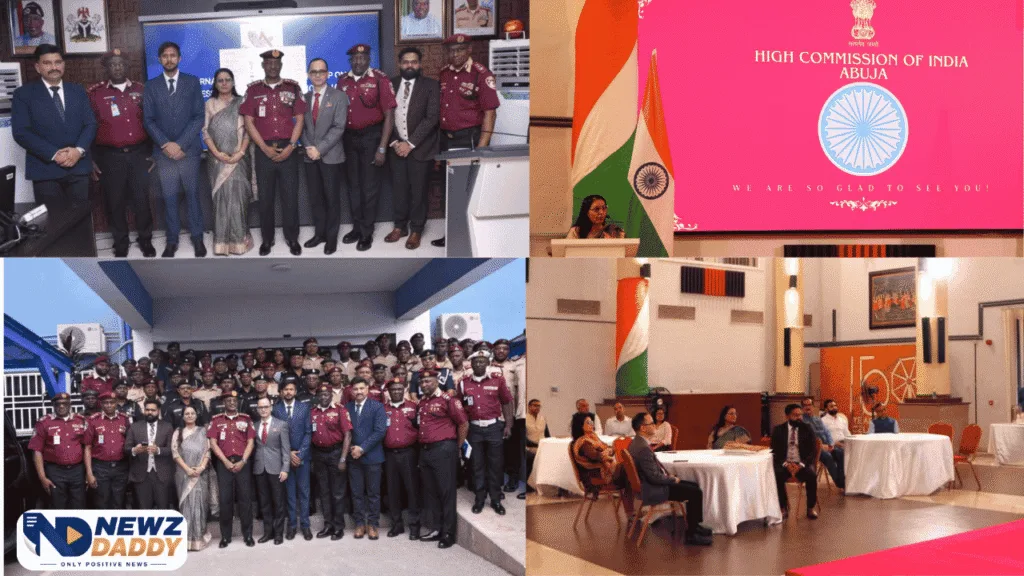
The 10-day programme on stress management and emotional well-being is being conducted by Rashtriya Raksha University (RRU), Gujarat, in partnership with the Federal Road Safety Corps (FRSC), Nigeria. Sessions are being held in Abuja and at the FRSC Academy in Udi, Enugu State.
About 1,000 personnel are expected to take part. The group includes officers from the FRSC as well as the Nigeria Police Force, Nigeria Immigration Service, Nigeria Correctional Service, Nigeria Customs Service, Federal Fire Service and Nigeria Security and Civil Defence Corps (NSCDC).
The training covers stress management, emotional regulation, psychological resilience, self-management, behavioural awareness, peer support and ways to deal with difficult situations. For officers who regularly respond to road crashes, emergencies, disasters, casualties and security incidents, these skills can form part of their preparation for demanding work.
The Federal Road Safety Corps has a role that goes well beyond traffic enforcement. Its national headquarters in Abuja coordinates road safety operations across Nigeria, while its work includes education, enforcement and emergency response. The organisation was created by the Nigerian government in 1988 and has operated for more than three decades.
FRSC Corps Marshal Shehu Mohammed has stressed the need to consider the health of personnel who work under pressure. The programme, according to the material released about the initiative, is intended to help officers recognise sources of occupational and personal stress and learn practical ways to manage them.
The subject has wider relevance. The International Labour Organisation’s 2026 report on psychosocial risks at work says factors such as long working hours, heavy workloads, low control over work and poor workplace support can affect workers’ health and performance. The report estimates that health conditions linked to psychosocial risks account for more than 840,000 deaths each year worldwide.
For emergency personnel, the pressure can be especially difficult because the work may involve repeated exposure to serious accidents and other traumatic events. The World Health Organisation also identifies work pressure, long hours, shift work and lack of support as factors that can contribute to occupational stress and fatigue. It recommends workplace measures as well as training in mental health awareness and stress management for emergency workers.
The Nigerian programme therefore places a workplace issue inside the training of public safety personnel. Rather than treating stress only as a personal matter, the course looks at skills officers can use while carrying out their duties and ways colleagues can support one another.
The programme was inaugurated on behalf of the Indian High Commissioner to Nigeria by Col. Manoj Singh, Defence Advisor at the High Commission of India in Abuja. He spoke about the long relationship between India and Nigeria and the value of practical cooperation between institutions working in security and public safety.
India and Nigeria already have a long record of cooperation in defence and security. India’s Ministry of External Affairs says defence ties have developed since Nigerian independence in 1960. India has also assisted in the development of institutions including the Nigerian Defence Academy in Kaduna and the Naval College in Port Harcourt. A bilateral memorandum on defence cooperation was signed in 2007.
The latest programme adds law enforcement education and behavioural skills to that wider relationship.
For RRU, the work in Nigeria is part of its international training activities. The university was established as an Institution of National Importance through the Rashtriya Raksha University Act, 2020, under the Ministry of Home Affairs, Government of India. The law came into force on 1 October 2020. RRU’s main campus is at Lavad in Gandhinagar, Gujarat.
RRU has previously conducted training programmes for Nigerian law enforcement officials. Its international cooperation records list a customised course for Nigerian law enforcement officials in January 2023, along with programmes covering cyber security, financial fraud investigation, road safety and traffic enforcement, and other security subjects. The university also lists Nigerian students among its international student population.
Representing RRU Vice Chancellor Dr Jasbirkaur Thadhani, Dean Academic Dr Jasbirkaur Thadhani has reaffirmed the university’s role in international training and cooperation in law enforcement education, behavioural sciences and professional development. RRU’s own records list her as University Dean (I/c) and an Assistant Professor in the School of Behavioural Sciences and Forensic Investigations, with a PhD in Psychology and research work in psychometric assessment and data analysis.
The Indian delegation includes Dr Jasbirkaur Thadhani, Dean Academics, RRU; Arsh G., Campus Director, RRU Puducherry; Kalpesh Sharma, Head of Sports Training, Strength & Conditioning; and Chandrakant Yadav, Head and Section Officer at the Atal Incubation Centre, RRU.
The programme also builds on earlier contact between RRU and Nigerian agencies. In 2025, Nigerian reports said the FRSC and RRU had agreed to train 1,000 FRSC personnel in stress management and emotional well-being. Those reports also said the cooperation had begun with training for Nigerian personnel in Gujarat and that 10 FRSC personnel were preparing to undertake master’s programmes in areas including information technology, cybersecurity, data management, and traffic enforcement.
For the officers taking part, the practical test will come after the classroom sessions, when they return to roads, stations and emergency scenes. The stated aim is to provide personnel with better tools to handle pressure while continuing the demanding work of keeping people safe.