


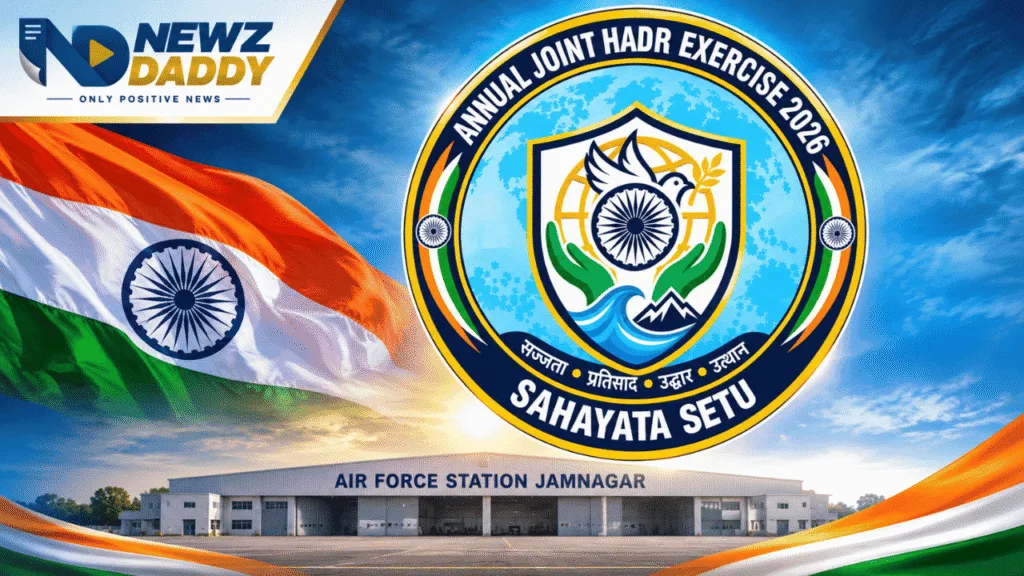
Sahayata Setu: IAF to Hold Jamnagar Disaster Drill in November
Indian Air Force to Hold Multinational Disaster Relief Exercise Sahayata Setu in Jamnagar
The Indian Air Force will host a multinational disaster relief exercise, Sahayata Setu, at Air Force Station Jamnagar in Gujarat from 17 to 19 November 2026. The exercise will bring together Indian defence forces, national agencies and representatives of Friendly Foreign Countries (FFCs) to practise working together during major natural disasters and humanitarian emergencies.
The exercise will be conducted under the guidance of Headquarters Integrated Defence Staff (HQ IDS) and Headquarters South Western Air Command (HQ SWAC). The Indian Air Force will lead the activities as part of an integrated defence framework, following directions from the Government of India.
The announcement comes at a time when disaster response has become an important part of India’s defence planning. Cyclones, floods, earthquakes and other emergencies can affect large areas, leaving local authorities with an urgent need for aircraft, medical teams, rescue workers and supplies. In such situations, the armed forces can help move people and equipment quickly, particularly when roads and other transport links are damaged.
The Indian Air Force’s transport aircraft and helicopters are suited to this work. Aircraft such as the C-17 Globemaster III, C-130J Super Hercules and IL-76 can carry large quantities of relief supplies and personnel over long distances. Helicopters can reach areas where large aircraft cannot land, making them useful for rescue work and the delivery of food, medicines and other essential items.
India has used these capabilities during several major emergencies. In April 2015, the Indian Air Force began relief operations in Nepal within four hours of the earthquake. The operation continued until 4 June 2015. According to the Ministry of Defence, the IAF carried out 1,677 sorties, including 1,569 helicopter sorties. Its aircraft transported 1,348.995 tonnes of supplies and evacuated 5,188 people, including 780 casualties.
The Nepal operation, known as Operation Maitri, involved aircraft such as the C-130J, C-17, IL-76 and An-32, along with Mi-17 helicopters. The aircraft carried medical teams, medicines, tents, blankets, food, water treatment equipment and hospital supplies. Helicopters also reached villages and settlements cut off by damaged roads and difficult terrain.
The Air Force has also supported evacuation work outside India. During Operation Raahat in Yemen in April 2015, its C-17 aircraft flew 12 shuttle services between Djibouti and Mumbai and Kochi. The IAF evacuated 2,096 people during the operation, which ended on 10 April 2015. Such missions have given Indian forces experience in moving people across borders and working with several agencies during emergencies.
Jamnagar’s selection as the venue places the exercise in Gujarat, a state with a long coastline and exposure to weather-related emergencies. Coastal districts face risks from cyclonic storms, heavy rainfall and flooding. The ability to organise rescue and relief work across agencies is therefore relevant to the state’s emergency planning.
The exercise is expected to include representatives of friendly foreign countries. Their participation will allow teams from different nations to practise working under a common response plan. Disaster relief often involves several governments and organisations, each with its own command arrangements, equipment and communication systems. Differences in procedures can slow down operations when time is limited. Joint exercises allow participants to understand one another’s working methods before an actual emergency occurs.
The National Disaster Management Authority (NDMA) is India’s apex body for disaster management. It was established under the Disaster Management Act, 2005, and is responsible for laying down policies, plans and guidelines for disaster management. The national response system also involves the National Disaster Response Force (NDRF), state disaster response teams, local administrations and other public agencies.
The armed forces generally support civilian authorities when an emergency requires additional manpower, specialist equipment or transport capacity. The Army can provide rescue teams, engineers and medical support. The Navy and Indian Coast Guard can assist with coastal emergencies and evacuations, while the Air Force can transport relief teams and supplies by air. Coordination between these services and civilian agencies is an important part of disaster response.
The Government of India has also placed greater attention on international cooperation in disaster relief. India’s experience in Nepal and Yemen showed how air transport, naval support, medical assistance and coordination between government departments can help during emergencies involving more than one country. Exercises involving foreign partners give participating teams a chance to practise these arrangements before they are needed.
For the Jamnagar exercise, the Indian Air Force has also referred to the event in its public communication as the Annual Joint Humanitarian Assistance and Disaster Relief Exercise 2026 (AJHE-26). The participating Indian organisations named in that communication include the Indian Army, Indian Navy, Indian Air Force, Indian Coast Guard and NDMA. The planned disaster scenarios include cyclonic storms, earthquakes, floods and chemical emergencies.
The use of technology will form part of the exercise. Modern disaster response depends on timely information, reliable communication and the ability to assess conditions in affected areas. Teams must be able to identify locations requiring assistance, arrange transport and share information with other agencies. Training in these areas can help reduce delays when several organisations are working at the same site.
The exercise is expected to be witnessed by the Prime Minister of India, Union Ministers, dignitaries from Gujarat, the Chief of Defence Staff (CDS), the service chiefs of the Indian Defence Forces and other invited guests. Their expected presence reflects the importance attached to disaster management and India’s cooperation with other countries.
For Jamnagar, hosting the three-day programme will bring national and international defence and disaster management representatives to Gujarat. The city will also provide the setting for discussions and practical activities involving organisations that may have to work together during a major emergency.
The results of such training are best judged by how well participating teams can apply what they practise. Clear command arrangements, quick communication, access to transport and an agreed division of responsibilities can affect the speed at which help reaches people in danger.
As preparations continue for the November exercise, Sahayata Setu will allow Indian agencies and their foreign partners to test their response arrangements. The experience will add to India’s record of disaster relief work and help participating teams prepare for emergencies that may require assistance across national borders.
Must Read:
Suryakiran Air Show: Indian Air Force Jets Fly Over Bhavnagar