


Samudra Pradakshina: 9 Women Officers Felicitated in Ahmedabad
Samudra Pradakshina: Women Officers Felicitated in Ahmedabad After 314-Day Global Voyage
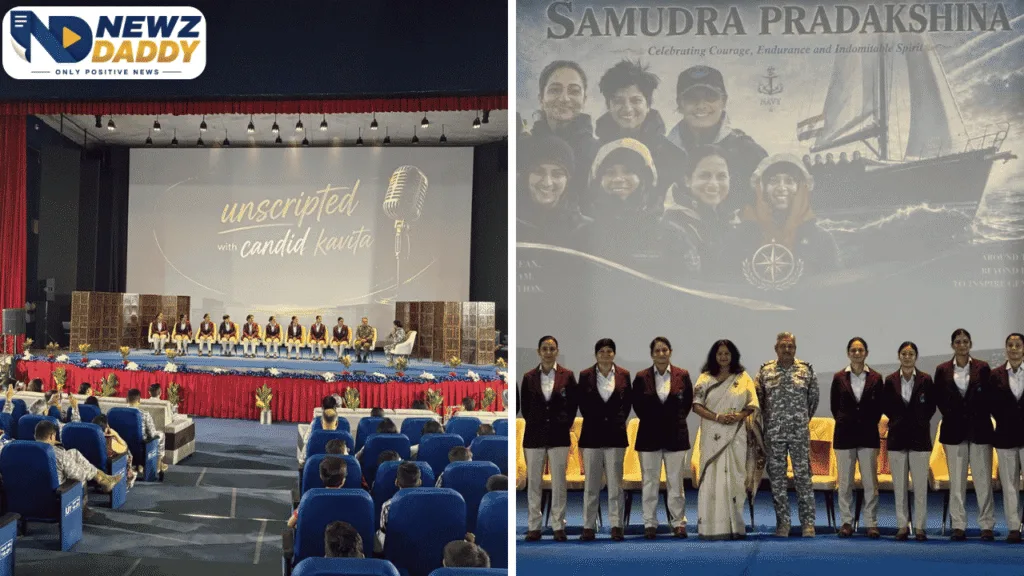
Nine women officers from the Indian Army, Indian Navy and Indian Air Force were felicitated at the headquarters of South Western Air Command (SWAC) in Ahmedabad on Friday after completing the first Tri-Services all-women circumnavigation sailing expedition, Samudra Pradakshina.
Air Marshal PV Shivanand, AVSM, VM, Air Officer Commanding-in-Chief of South Western Air Command, honoured the officers at the ceremony. Senior representatives of the Army, Navy, Indian Coast Guard, Central Reserve Police Force, Border Security Force and civil administration attended the event. Schoolchildren from several schools were also present.
The expedition was completed on board the Indian Army Sailing Vessel (IASV) Triveni after 314 days at sea. The crew covered nearly 25,500 nautical miles across four oceans. The voyage involved long periods at sea and exposed the officers to difficult weather, demanding navigation and the physical strain of life aboard a small sailing vessel.
The scale of the mission becomes clearer when its preparation is considered. The expedition was virtually flagged off by Defence Minister Rajnath Singh from Mumbai on September 11, 2025. At the time, the Defence Ministry said the team was expected to sail about 26,000 nautical miles and cross the Equator twice while rounding the three Great Capes: Cape Leeuwin, Cape Horn and the Cape of Good Hope. The route also included the Southern Ocean and the Drake Passage.
The final voyage met internationally recognised requirements for a global circumnavigation. The officers crossed all meridians of longitude, crossed the Equator twice and crossed the International Date Line. They also rounded the three Great Capes. Their passage through the Drake Passage and around Cape Horn earned the crew membership of the Cape Horner fraternity, an honour associated with sailors who complete one of the world’s most demanding ocean passages.
The mission also had a long training phase. Before the global voyage, the women underwent extensive sailing preparation and took part in progressively harder sea expeditions. In April 2025, a 12-member all-women tri-service team had sailed from Mumbai to the Seychelles and back on IASV Triveni, covering about 4,000 nautical miles in 55 days. That voyage was planned as preparation for the larger circumnavigation.
The composition of the final crew also changed from the original plan. Ten women officers were named for the September 2025 global expedition, including Expedition Leader Lieutenant Colonel Anuja Varudkar and Deputy Expedition Leader Squadron Leader Shraddha P Raju. The final voyage was completed by nine officers from the three Services.
IASV Triveni was central to the mission. The 50-foot yacht was built in Puducherry and was described by the Defence Ministry as an indigenous vessel. It had already completed thousands of nautical miles during training before being used for the global expedition. The vessel was designed for ocean sailing and carried navigation and communication equipment needed for a voyage of this length.
The expedition followed a series of Indian women-led sailing missions in recent years. Indian Navy officers Lieutenant Commander Dilna K and Lieutenant Commander Rupa A completed a separate global circumnavigation aboard INSV Tarini in double-handed sailing. Earlier, the Indian Navy’s Navika Sagar Parikrama in 2017-18 and Navika Sagar Parikrama-II in 2024-25 had also involved women officers sailing around the world.
At the Ahmedabad ceremony, Air Marshal PV Shivanand praised the officers for completing the demanding voyage. He described the mission as an example of Nari Shakti and cooperation among the three Services. He also pointed to the leadership and mental strength required to deal with the difficulties faced during the expedition.
The Air Marshal took charge of South Western Air Command on July 1, 2026, shortly before the Ahmedabad felicitation. A fighter pilot by background, he was commissioned into the Indian Air Force in December 1988 and has more than 2,800 hours of flying experience on the MiG-21 and IL-76 AWACS. Before taking charge of SWAC, he served as Senior Air Staff Officer at Headquarters Central Air Command.
The women officers spoke about their time at sea during the ceremony, sharing lessons from the voyage and the difficulties they had faced. Their accounts placed particular focus on teamwork, leadership and staying focused during long periods away from land.
The wider importance of Samudra Pradakshina lies in the way the mission brought personnel from the Army, Navy and Air Force together for a single operational task. The Defence Ministry said the crew lived, trained and sailed together for more than ten months. Such joint missions give officers experience of working with personnel from other Services and of managing responsibilities in a shared environment.
The voyage also had a diplomatic side. During international port visits, IASV Triveni carried Indian military personnel into contact with other countries and provided opportunities to present Indian culture and maritime traditions. The Defence Ministry described these visits as part of India’s wider military diplomacy.
For the schoolchildren who attended Friday’s ceremony in Ahmedabad, the event offered a direct meeting with officers who had spent nearly a year at sea. The message from the expedition was practical: women serving in India’s Armed Forces are taking on demanding roles that require specialist training, physical endurance, decision-making and the ability to work as part of a team.
The completion of Samudra Pradakshina has therefore added another chapter to India’s growing record of long-distance sailing missions by women in uniform. The Ahmedabad felicitation gave the nine officers a chance to reflect on a voyage that began in Mumbai, crossed four oceans and ended after nearly 25,500 nautical miles at sea.