


Samundrarakshan Boosts India’s Coastal Security Strength
Newzdaddy Education Updates
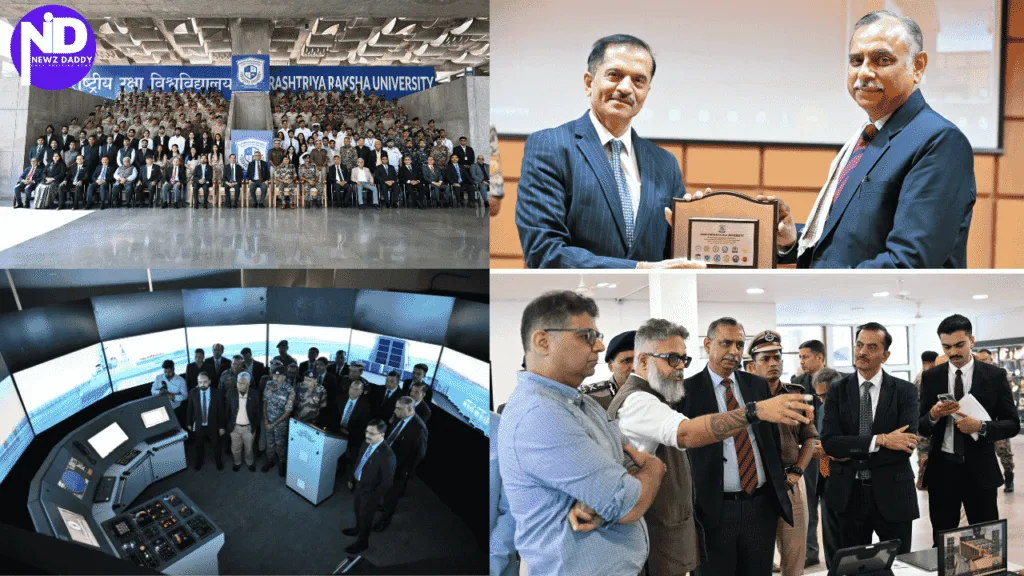
The School of Integrated Coastal and Maritime Security Studies (SICMSS) of Rashtriya Raksha University (RRU) concluded the second edition of its major programme, SAMUNDRARAKSHAN 2.0, on Indian Navy Day. The event acted as an important platform to bring experts together and strengthen India’s coastal and maritime security. It supported the long-term vision that guides India’s growth at sea, from SAGAR to MAHASAGAR, which focuses on security and friendly ties across regions. The event was held at the RRU campus in Lavad-Dahegam, Gandhinagar.
The conclave brought policymakers, security thinkers, academics, and field experts to one place. They discussed issues that affect India’s 7,500 km coastline and its large maritime zone. Many speakers shared that coastal security is now more important because of rising sea traffic, new trade routes, climate change, and threats such as smuggling and illegal fishing. Experts also said that strong teamwork among agencies is needed because many organisations protect the coastline, including the Navy, Coast Guard, Marine Police and port authorities. Research shows that India’s coastal areas support nearly 20% of its population and handle more than 90% of its trade by volume, making such coordination vital.
A major highlight this year was the introduction of India’s advanced Maritime Simulator Lab. This new training facility is expected to improve maritime training across the country. The simulator can train officers in ship boarding, fast chase operations, law enforcement, and rescue work at sea. It can also be used for navigation training and practising responses to oil spills and marine pollution. The lab supports the Indian Maritime Forces and those working under the Law of the Sea. It also welcomes officers from friendly countries who join India under the MEA ITEC training programme. Such simulators are becoming common worldwide as they help train officers safely without risking lives or vessels.
More than 200 participants attended the event. They came from Marine Police units across all 13 coastal states and union territories, the Indian Navy (IN), Indian Coast Guard (ICG), Central Industrial Security Force (CISF), Border Security Force (BSF), maritime boards, port authorities and maritime start-ups. Many global ports, including Singapore and Rotterdam, use similar training and cooperation models. Their success shows how shared learning can greatly improve coastal readiness. This event also showed RRU’s effort to raise maritime awareness in India and other regions.
The conclave touched upon several important themes. One key point was the use of modern technology in sea border protection. Many agencies have now begun using drones, coastal radars and satellite-based systems to watch over the coastline. The impact of climate change was also discussed. Rising sea levels and stronger storms can damage ports and coastal bases, so experts stressed the need for better planning and climate-resistant systems. Drug trafficking through ports and the coastline remains a major challenge worldwide, and India has increased joint operations to stop such networks. Many speakers agreed that exchanging best practices among forces through regular exercises and training brings faster and safer outcomes.
During the opening session, Vice Admiral Biswajit Dasgupta, National Maritime Security Coordinator, spoke through a virtual address. He highlighted why SAMUNDRARAKSHAN 2.0 is important for India’s security. He said the event helps officers share ideas and work together to solve maritime challenges. He noted that the new Maritime Simulator Lab at RRU will help officers get real-life training. He also said that India has seen “Blue Acceleration” in the last 25 years, with growth in maritime trade and infrastructure. But he warned that radical threats from the neighbourhood need constant attention.
Shri Praveer Ranjan, IPS, Director General of CISF, spoke about building a joint system for coastal security. He said CISF is ready to support port security with skilled officers trained at RRU. He mentioned new reforms, such as CISF being declared an RSO, changes in shipping laws, and security audits of EXIM ports. He asked for more use of technology, such as AI-based monitoring and Aadhaar-linked systems. He explained the hybrid model of port security, where CISF manages core tasks and works with state police and private security teams.
Prof. (Dr.) Bimal N. Patel, Vice-Chancellor of RRU, shared his happiness at the success of the programme. He said RRU remains committed to research, education and training in maritime security. He noted India’s shift away from old shipping laws and towards modern rules that improve trade and safety. He highlighted programmes like Maritime India Vision 2030 and Sagarmala, which are investing thousands of crores in ports and coastal infrastructure. He also praised RRU’s 70+ training programmes delivered by 125 global experts.
Shri Ashwini Kumar Singh, DIG of the National Academy of Coastal Policing (NACP), spoke about the special role of NACP. He said coastal policing needs different skills compared to land borders. NACP has already trained more than 1,600 personnel and is building a new world-class campus near Dwarka–Okha. With new training wings and a strong partnership with RRU, NACP hopes to shape India’s coastal safety for the future.
Must Read:
Puducherry Police and Rashtriya Raksha University Join Forces for Mission Karmayogi
Rashtriya Raksha University Shines Spotlight on Coastal Security at SAMUNDRARAKSHAN 2023