


Sanyukt Prashikshan Builds Powerful Civil–Military Unity
Newz Daddy Defence Updates
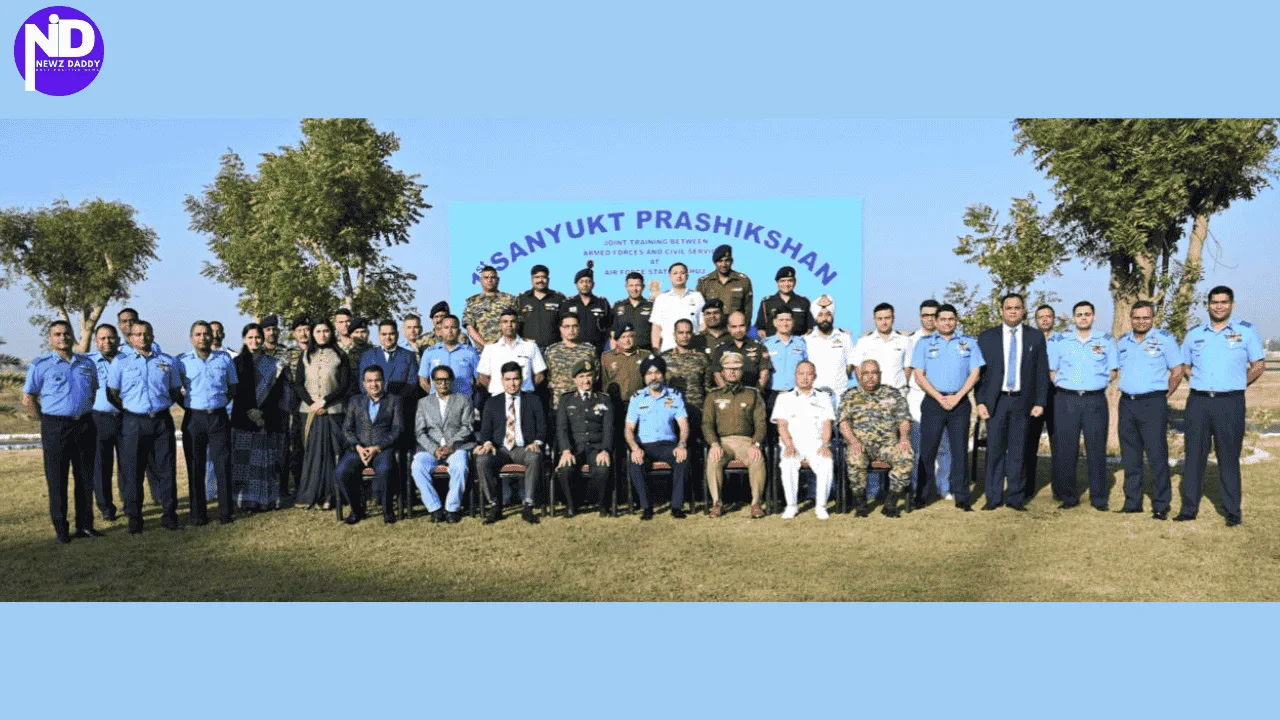
On the directions of Hon’ble Prime Minister, the Indian Air Force, under the aegis of South Western Air Command, is conducting the first Sanyukt Parshikshan at Air Force Station Bhuj, aptly known as the ‘Defenders of Kutch’.
This unique joint training initiative emphasises the whole-of-nation approach and is aimed at enhancing cooperation, understanding and operational integration between the armed forces and civil services.
The programme includes a series of lectures, tabletop exercises and practical field drills designed to encourage mutual understanding and Jointness. By training together in this manner, the Armed Forces and civil services will be better equipped to function as a cohesive team.
The launch of Sanyukt Prashikshan comes at a time when India is placing a strong focus on joint preparedness and coordinated response during both conflict and crises. Modern challenges such as natural disasters, border tensions, cyber threats and humanitarian emergencies often require quick decisions and close coordination between the military and civil administration. Past experiences during floods, earthquakes and cyclones across the country have shown that when different agencies work together from the start, relief and response become faster and more effective.
Air Force Station Bhuj holds deep strategic and historical importance. Located close to the India–Pakistan border, the region has seen key military operations, including during the 1965 and 1971 wars. The station played a critical role in maintaining air operations despite heavy damage during wartime, earning the area its proud title as the ‘Defenders of Kutch’. Conducting the first Sanyukt Prashikshan here sends a strong message about readiness, resilience and cooperation in sensitive border regions.
The involvement of the South Western Air Command highlights the Indian Air Force’s growing emphasis on integrated operations. This Command is responsible for air defence and operational readiness across a large and important area of western India. Its role in hosting this programme reflects the belief that air power is most effective when closely linked with ground agencies, state authorities and civil services who manage law, order and public safety.
The whole-of-nation approach mentioned in the programme is a concept increasingly used in national security planning. It means that defence is not only the responsibility of the armed forces but also involves civil services, local administration, emergency responders and even community leaders. When these groups understand each other’s roles and limits, confusion during emergencies is reduced, and trust is built before real situations arise.
The lectures included in the training are designed to share basic knowledge rather than technical jargon. Civil officers learn about military command structures, decision-making timelines and operational constraints. At the same time, armed forces personnel gain insight into civil laws, disaster management frameworks and administrative processes. This exchange helps both sides speak a common language during joint operations.
Tabletop exercises play a key role in preparing participants for real-life situations. These exercises use maps, models and scenarios to test planning and coordination without physical movement. Participants discuss responses to imagined crises such as airspace emergencies, evacuation of civilians, or large-scale relief operations. Such exercises help identify gaps in communication and planning in a safe environment.
Practical field drills take this learning a step further. By working side by side on the ground, participants experience the pressures of time, terrain and coordination. These drills help build personal connections, which are often as important as formal procedures during emergencies. Knowing who to call and how to work together can save crucial minutes.
Joint training of this kind also supports the broader goal of jointness within India’s defence structure. In recent years, India has moved towards better coordination among the Army, Navy and Air Force, along with civil agencies. Programmes like Sanyukt Prashikshan support this vision by creating habits of cooperation early and at multiple levels.
Another important outcome of this initiative is better public service delivery during crises. Civil services officers who understand military capabilities can plan better use of airlift, logistics and communication support. Similarly, the armed forces benefit from clear administrative support and local knowledge provided by civil authorities.
Overall, Sanyukt Prashikshan reflects a practical step towards stronger national preparedness. By learning together in peacetime, the armed forces and civil services build confidence and clarity for times when the nation needs them most. This joint effort at Bhuj sets a meaningful example of how shared training can lead to shared responsibility and stronger national security.