


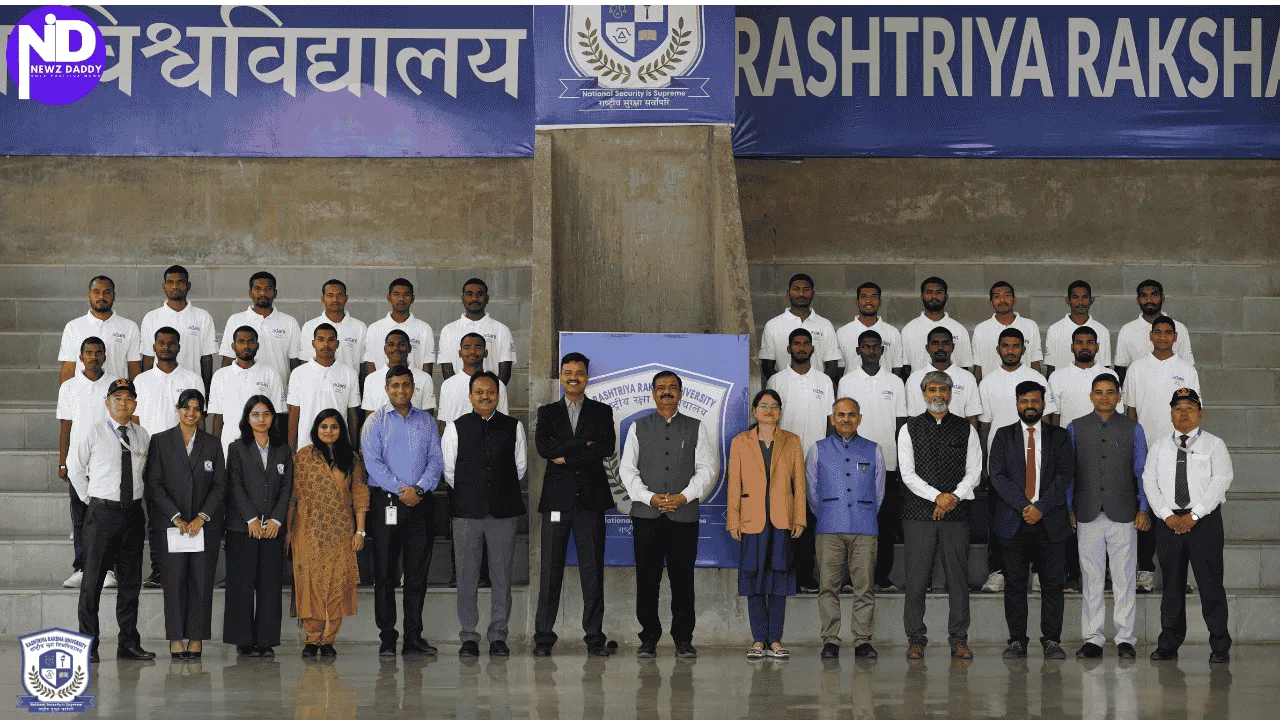
Rashtriya Raksha University (RRU) and Adani Natural Resources (ANR) inaugurated the first batch of the Shaurya Path Residential Belt Forces Programme, a 90-day defence-oriented training initiative launched under ANR’s CSR efforts for mining project–affected areas.
The pioneering cohort of 24 youth from Madhya Pradesh, Chhattisgarh, and Jharkhand will undergo structured physical training, academic preparation, PSARA certification, and cybersecurity modules—preparing them for careers in defence, paramilitary, and allied government services. The initiative aligns with the joint vision of Prof. (Dr.) Bimal N. Patel, Vice-Chancellor, RRU, and Mr Bacha Prasad, Chief of Mine Development, ANR, to create livelihood pathways for underserved communities.
The inaugural ceremony was attended by senior leaders from both institutions, including Prof. (Dr.) Kalpesh H. Wandra, Pro-Vice Chancellor, RRU, and Mr Bacha Prasad, ANR.
Key representatives from both institutions attended the Official Inaugural ceremony. From Rashtriya Raksha University, the attendees included Prof. (Dr.) Kalpesh H. Wandra, Pro-Vice Chancellor; Prof. (Dr.) Priyanka Sharma, Dean-EDLD; Mr Nimesh Dave, Director, SPICSM and Air Commodore Rajnish Verma, Centre Head (I/c), Suraksha Bal Prashikshan, SISDSS. Adani National Resources was represented by Mr Bacha Prasad, Chief of Mine Development; Mr Santosh Kumar, CSR Lead; Mr Nikhilesh Singh, Manager, Security; and Ms Vaishali Parikh, Deputy Manager, CSR.
Mr Wandra reaffirmed RRU’s commitment to a strong training ecosystem and encouraged cadets to make the most of this transformative opportunity.
Mr Bacha Prasad (Chief of Mine Development) emphasised Adani’s nation-building ethos and urged the pioneering batch to set high standards as ambassadors for future cohorts.
This collaboration marks a significant step towards empowering youth from mining-affected regions with skills for secure and dignified careers.
Rashtriya Raksha University, based in Gandhinagar, is known as India’s first national security and police university. It was set up by an Act of Parliament. The university focuses on internal security, policing, cyber safety and defence studies. Over the years, it has trained officers from different states and even from other countries. Its campus has modern training grounds, smart classrooms and simulation labs. Students often go through drills that build discipline, teamwork and mental strength. This makes the Shaurya Path programme a natural fit within the university’s wider mission.
Adani Natural Resources works in the mining and resource sector in India. In states such as Madhya Pradesh, Chhattisgarh and Jharkhand, mining projects often operate near rural and tribal communities. Many young people in these areas face limited job options. Corporate Social Responsibility, or CSR, is a way for companies to give back to society. Through CSR, firms invest in health, education and skills. In recent years, skill development has become a key focus across India. The Shaurya Path programme reflects this shift. Instead of short workshops, it offers a full 90-day residential course, which allows deep and steady learning.
The training design is practical. Structured physical training helps candidates meet the fitness standards required for the armed forces and paramilitary units. Many defence recruitment drives place a strong focus on stamina, speed and strength. Regular drills, running practice and group exercises improve both body and confidence. Living on campus also teaches discipline and time management, which are vital for uniformed services.
Academic preparation is another important part. Written exams for defence and paramilitary services test general knowledge, reasoning and basic maths. Many rural students do not get access to coaching centres. By adding academic support inside the programme, RRU helps bridge this gap.
PSARA certification refers to the Private Security Agencies Regulation Act. Under this law, security guards must receive proper training and certification. With PSARA training, even those who do not join the armed forces can work in the organised private security sector. India’s private security industry employs millions of people and continues to grow each year. This opens another safe career path.
The inclusion of cybersecurity modules shows forward thinking. Today, national security is not only about borders. It also includes digital safety. Cyber threats affect banks, government offices and even common citizens. Basic training in cyber awareness can help youth find roles in support services or pursue further study in this field.
For many families in mining-affected regions, stable employment means dignity and a steady income. Government and defence jobs are often seen as honourable and secure. When 24 young people from three states step forward as the first batch, they carry hopes from their villages. If they succeed, more families may feel inspired to send their children for similar training.
By joining hands, Rashtriya Raksha University and Adani Natural Resources have linked education with opportunity. The Shaurya Path programme is not just a course. It is a structured effort to guide young people towards discipline, service and self-reliance. If the model works well, it could become an example for other regions where industry and education can work together for the nation’s growth.
Must Read:
Indo-Swiss Blockchain Forum 2026 Boosts India’s Fintech Trust
Rashtriya Raksha University MoU with SSB Supaul Transforms Training