


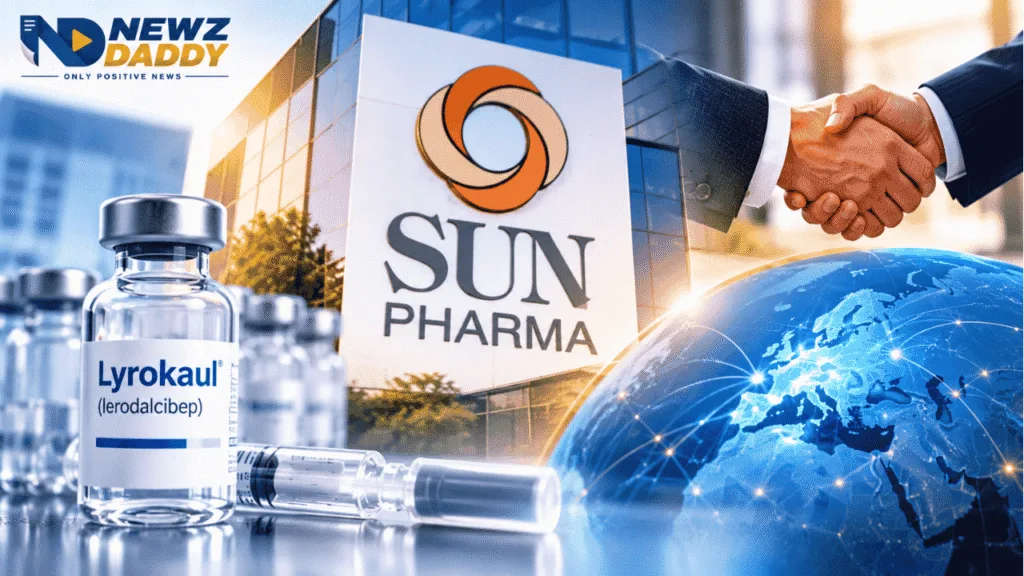
Sun Pharma Gets Lerodalcibep Rights Outside the US and China
Sun Pharma signs Global Deal for Cholesterol Drug Lerodalcibep After EU Approval
Sun Pharmaceutical Industries Ltd and US-based LIB Therapeutics Inc. have agreed on a licensing, manufacturing and commercialisation deal for lerodalcibep, a once-monthly medicine designed to lower LDL cholesterol.
Under the agreement, Sun Pharma will have exclusive rights to manufacture and sell the drug outside the United States and China. LIB Therapeutics will receive an upfront payment, future milestone payments and royalties linked to sales in the licensed markets. The companies have not disclosed the financial terms.
The agreement comes days after lerodalcibep received approval in the European Union under the brand name Lyrokaul. The medicine is intended for adults with hypercholesterolaemia and mixed dyslipidaemia. The European Medicines Agency says Lyrokaul is a 300 mg injection and may be used with a statin or other lipid-lowering treatment when patients do not reach their LDL cholesterol targets. It can also be used in some patients who cannot take statins.
The EU approval followed a positive opinion from the European Medicines Agency’s Committee for Medicinal Products for Human Use on July 23, 2026. The companies said the European approval was received on September 21.
Sun Pharma said the product can be stored at ambient temperature for six months. It is given once a month through a small-volume injection.
LDL cholesterol is often called “bad cholesterol” because high levels can contribute to the build-up of fatty deposits inside blood vessels. Over time, this can raise the risk of heart attacks and strokes.
The World Health Organisation says cardiovascular diseases remain the world’s leading cause of death. Its 2025 fact sheet estimates that 19.8 million people died from cardiovascular diseases in 2022, accounting for about 32% of deaths worldwide. Heart attacks and strokes made up 85% of those deaths.
For people at high cardiovascular risk, lowering LDL cholesterol is a major part of treatment. Statins remain the first choice in European guidance, but doctors can add other medicines when LDL cholesterol remains above the recommended level.
The 2025 focused update of the European Society of Cardiology and European Atherosclerosis Society guidelines continues to support the use of non-statin medicines, including PCSK9 inhibitors, when patients do not reach their LDL cholesterol goal with the maximum tolerated statin dose.
Lerodalcibep belongs to a group of medicines known as PCSK9 inhibitors. PCSK9 is a protein involved in the removal of LDL receptors in the liver. Blocking PCSK9 allows more LDL receptors to remain available to remove LDL cholesterol from the blood.
The drug has already passed regulatory review in the United States. The US Food and Drug Administration approved Lerochol, the US brand name for lerodalcibep, on December 12, 2025. The FDA approval covers adults with hypercholesterolaemia, including people with heterozygous familial hypercholesterolaemia, as an addition to diet and exercise. The medicine is given once every month.
Clinical trial results have provided evidence for its LDL-lowering effect. A Phase 3 trial involving 922 adults with cardiovascular disease or a high risk of cardiovascular disease found a placebo-adjusted LDL cholesterol reduction of 56.2% at week 52. In another analysis using the average results from weeks 50 and 52, the reduction was 62.7%.
A separate Phase 3 study involving 478 people with heterozygous familial hypercholesterolaemia reported a 58.61% difference in LDL cholesterol compared with placebo at week 24 and 65% based on the average of weeks 22 and 24.
The studies also reported injection-site reactions as a treatment-related issue. In the 922-patient trial, such reactions occurred in 6.9% of patients receiving lerodalcibep compared with 0.3% in the placebo group. The reactions were described as mild or moderate.
Another Phase 3 study examined lerodalcibep in people with the rare inherited condition homozygous familial hypercholesterolaemia. That trial compared monthly lerodalcibep with evolocumab. The researchers found that the LDL cholesterol response varied among patients, and the study did not establish non-inferiority against evolocumab at its pre-set margin.
The case for additional cholesterol-lowering treatment is also linked to how many patients reach recommended LDL levels.
The DA VINCI study examined 5,888 patients across 18 European countries. It found that only 33% reached their risk-based LDL cholesterol targets under the 2019 ESC/EAS guidelines. Among patients at very high cardiovascular risk, only 18% reached their LDL target.
Sun Pharma and LIB Therapeutics cited these findings when explaining the need for wider access to additional LDL-lowering medicines.
The commercial market is also growing. According to IQVIA figures cited by the companies, the PCSK9 inhibitor market outside the US and China was worth US$3.7 billion for the 12 months ending in the second quarter of 2026. The companies said the market grew at a 38% compound annual growth rate over the previous two years. Europe accounted for about US$2.9 billion during the same period. They also said the worldwide PCSK9 market was approaching US$7 billion in 2026.
For Sun Pharma, the agreement adds a cardiovascular medicine to its portfolio and gives it rights across markets that exclude the US and China. Sun Pharma will also take responsibility for seeking regulatory approval in countries where lerodalcibep has not yet been cleared.
“Once-monthly lerodalcibep dosing, with robust LDL-C reduction and the added benefits of a small-volume injection and six-month ambient storage, simplifies treatment for patients and offers greater convenience”, said Kirti W Ganorkar, Managing Director of Sun Pharma. “This agreement marks a significant step in strengthening our global Innovative Medicines portfolio, particularly in cardiovascular care. With exclusive rights outside the United States and China, we look forward to expanding access to this important treatment option for patients globally.”
Evan Stein, MD, PhD, Chief Operating and Scientific Officer and co-founder of LIB Therapeutics, said: “LIB is extremely pleased to partner with Sun Pharma, a well-established global pharmaceutical company with a growing focus on innovative medicines,” said Evan Stein, MD, PhD, Chief Operating and Scientific Officer and co-founder of LIB Therapeutics. “Sun Pharma’s international presence and experience in building global innovative brands make it an ideal partner to bring lerodalcibep to more patients. Together, we aim to expand access for patients with cardiovascular disease, or at high cardiovascular risk, who need substantial additional LDL-cholesterol reductions despite existing treatment.”
The next stage will depend on regulatory approvals in individual markets and the companies’ manufacturing and supply plans. For patients and doctors, the practical question will be how widely the once-monthly treatment becomes available and how it fits into existing cholesterol-lowering care.
Must Read: