


Viksit Bharat Promises Life-Changing Rural Security
Viksit Bharat Hands Emotional and Economic Might to Workers
A press conference was held at the city office on the “Viksit Bharat Rojgar and Ajeevika Mission (Gramin)” VB-G RAM-G scheme. Gujarat’s Energy and Petrochemicals Minister, Shri Rushikeshbhai Patel, was present as the chief guest and spoke in detail about the aims of the scheme and the wider development agenda. The event was part of a wider outreach effort to explain how the new rural employment law will work on the ground and how it connects with the idea of a developed India by 2047.

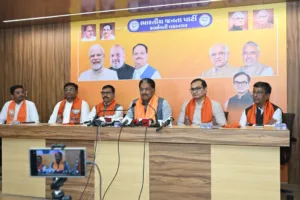
Addressing the press conference, Minister Shri Rushikeshbhai Patel said that the country’s respected Prime Minister, Shri Narendra Modi, has devoted his life to serving the nation and its people. He said that under the Prime Minister’s leadership, government schemes such as Viksit Bharat Rojgar and Ajeevika Mission are made with public welfare at the centre, so that help reaches ordinary families, especially those in rural and poor areas. The Minister also spoke about how the Prime Minister has focused on building a strong and self-reliant rural India through better housing, jobs and basic services by starting the schemes under Viksit Bharat Rojgar and Ajeevika Mission.
The Minister noted that the Prime Minister wants every citizen to have a proper home and that no one should sleep hungry at night. For this reason, schemes like Pradhan Mantri Awas Yojana and free ration under the food security system have been expanded to cover crores of people. He said these steps have given many poor families both dignity and basic security in their daily lives.
The Minister added that the government has created different schemes for women, children, young people, the poor and farmers, so that each group gets focused support. These include safety nets for income, health, education and housing, as well as support for farmers to improve their land, water and crop productivity. He said that by joining these schemes together in villages, the government wants to make rural life more stable and more hopeful for the future.
He also criticised past Congress governments, arguing that earlier schemes often failed to reach people living in remote and rural areas. He referred to long-standing complaints about leakages in welfare funds and weak delivery systems, which meant that only a small part of the money actually reached poor families. In his view, the new rural employment law has been shaped to fix these gaps by using better technology and stricter rules.
The Minister said that the “Viksit Bharat Rojgar and Ajeevika Mission (Gramin)” VB-G RAM-G scheme will give more work and better income security to rural workers across the country. The law increases the guaranteed wage employment from 100 days under MGNREGA to 125 days for each eligible rural household in a financial year. He said this extra security is meant to support families facing rising costs, uncertain farm income and climate-related risks.
He further explained that the scheme now includes a clear rule about the farming season. There is a legal provision for a 60-day pause in scheme work during peak sowing and harvesting periods, with state governments deciding and notifying these dates in advance. The Minister said that this has been designed so that farmers are not short of labour at crucial times in the crop cycle and so that both farm and non-farm work can be balanced in rural areas.
Taken together, this means that there is a 125-day work guarantee under the scheme, along with a 60-day notified farming pause, which sets the overall framework for a 185-day cycle across the year. Supporters of the scheme say this structure gives workers more days of paid work than before, while also protecting key periods for agriculture. Critics, however, have raised questions about whether the pause may narrow the window in which people can actually complete all 125 days of work.
The Minister also launched a political attack on the Congress party, saying that they had named many past schemes after members of one family. He claimed that the public now clearly understands this pattern and sees a contrast with the current approach, where schemes are linked more to national goals and cultural symbols than to individual leaders. In this context, he framed VB-G RAM-G as part of a wider change in how welfare programmes are branded and delivered.
He recalled that Congress leaders had earlier raised questions about the existence of Lord Shri Ram, which, he said, had hurt the sentiments of many people of faith. He argued that now, when a major scheme has been named using “RAM” as an acronym linked to Lord Ram, the opposition is uncomfortable and unhappy. Supporters of the government see this naming as a mix of development, cultural pride and political messaging aimed at rural voters.
The Minister went into more detail about how payments will work under the new scheme. Under MGNREGA, wages were normally paid within 15 days, but under Viksit Bharat Rojgar and Ajeevika Mission (VB-G RAM-G) there is a plan for weekly wage payments to workers. For rural families with tight cash flow, more frequent payment is expected to make it easier to manage daily expenses like food, school and health costs.
To increase transparency and reduce corruption, the scheme will use real-time data uploads, GPS and mobile-based monitoring, as well as biometric tools and artificial intelligence. Officials plan to track attendance and work progress digitally, create dashboards and hold regular village-level reviews so that people can see what work is being done and when payments are due. The use of biometric and Aadhaar-based verification is also meant to cut down on fake job cards and ghost workers in the system.
Along with central monitoring, states and local bodies are expected to play an active role in planning works that truly fit local needs, such as water harvesting, rural roads and small infrastructure for farms. Experts say that if village plans are made carefully, the assets created under Viksit Bharat Rojgar and Ajeevika Mission (VB-G RAM-G) can support higher farm incomes, reduce distress migration and strengthen the rural economy over time. This would link the daily wage support of the scheme with longer-term growth in rural areas.
At the press conference, the presence of local and party leaders underlined the political importance of the scheme for Gujarat. The city president, Shri Prerakbhai Shah, West Lok Sabha Member of Parliament Shri Dineshbhai Makwana, city general secretary, Shri Pareshbhai Lakhani and Shri Bhushanbhai Bhatt also attended the event and showed their support. Together, they presented VB-G RAM-G as a central part of the “Viksit Bharat” vision and as a key tool for giving rural families more stable work and hope for the future.
Also Read:
GST Savings Festival and Aatmanirbhar Bharat Sankalp Abhiyan