


Virat Hindu Sammelan Fills Faith and Pride
Virat Hindu Sammelan Highlights Powerful Hindu Culture And Social Harmony
A Virat Hindu Sammelan was organised by the workers of Shri Chandrashekhar Azad Hindu Samiti and Jai Shiva Prabhat Shakha, Azad Vasti, Ambawadi. Such gatherings are often arranged in many parts of India to bring people together around faith, culture, and social values. Across the country, Hindu sammelans are being organised during the centenary year of the Rashtriya Swayamsevak Sangh (RSS), which was founded in 1925 to promote cultural unity, discipline, and social service among citizens.
Date: Saturday, 7 March 2026
Time: 5:30 pm
Venue: Shri Sahajanand College Ground.
These programmes usually encourage people from different sections of society to meet, discuss shared values, and strengthen social harmony. Experts say that these conventions are not only religious gatherings but also platforms where community members reflect on cultural traditions and the future of society.

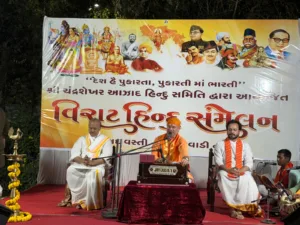
The Virat Hindu Sammelan began with the Sunderkand recitation by Shri Ketankumar Kaleji (Chhote Pathakji). In Hindu tradition, the Sunderkand is an important section of the Ramayana that tells the story of Lord Hanuman’s courage, devotion, and service. Many devotees believe that reciting it brings strength, hope, and faith in difficult times. It is often read at religious gatherings to create a spiritual atmosphere and remind people of the values of devotion and duty.
After this, the event formally started with the lighting of the lamp, blowing of the conch, and chanting of Vedic mantras. This was done by Pujya Shri Pranavkumarji Mahoday of Nandalay Haveli, Pujya Shri Karanrajaji, and the respected Sanghchalak of the division and main speaker, Shri Hareshbhai Thakkar. In many Indian ceremonies, lighting a lamp symbolises the victory of knowledge over darkness and ignorance. The sound of the conch is also considered sacred in Hindu rituals and is believed to spread positive energy. The chanting of Vedic mantras adds a traditional spiritual touch and connects the event with ancient Indian wisdom.
During the Virat Hindu Sammelan, the main speaker, Shri Hareshbhai Thakkar, shared inspiring guidance. He spoke about the centenary year of the Sangh, Panch Parivartan, and the resolve to pass the values of the Hindu way of life to the new Gen-Z generation. The RSS completed one hundred years in 2025, and many events are being organised across India to mark this milestone. These programmes aim to remind people of cultural traditions and encourage young citizens to take pride in their heritage.
The idea of Panch Parivartan, or five transformations, is an important message shared during these gatherings. It speaks about building a better society through social harmony, strong family values, care for the environment, pride in cultural identity, and responsibility towards the nation. Leaders say that these values should become part of daily life rather than remain only in speeches.
Pujya Shri Goshtishal Pranavkumarji Mahoday (Adhisthata – Nandalay Haveli, Ambawadi) gave his blessings at the Virat Hindu Sammelan. He spoke about the service work done by the Sangh during times of national disasters. Over the years, volunteers linked with the organisation have taken part in relief work after several natural disasters. Historical records show that volunteers helped people during events such as cyclones, earthquakes, and other crises by providing food, shelter, and medical help to affected families.
Such examples are often shared in public meetings to highlight the role of social services in nation-building. Community leaders say that helping people in times of difficulty strengthens trust and unity within society.
At the same time, Pujya Shri Karanraja Yuva Mahodayji delivered a powerful and inspiring speech for young people. He shared examples from the Bhagavad Gita and the Shrimad Bhagavat. These ancient scriptures are widely respected in Hindu philosophy and are often used to guide moral thinking and daily life. The Bhagavad Gita, in particular, teaches ideas about duty, courage, self-discipline, and devotion. Many spiritual teachers believe these lessons are useful for modern youth who face new social and personal challenges.
Many respected people from different fields were present on this occasion. They were welcomed with a saffron scarf and a tilak. The saffron colour has deep cultural meaning in India and is often linked with sacrifice, spirituality, and dedication to higher ideals. Offering a scarf and applying a tilak on the forehead is a traditional Indian way of honouring guests and showing respect.
At the end of the Virat Hindu Sammelan, Aarti of Shri Hanumanji and Bharat Mata was performed, followed by Mahaprasad. Aarti is a devotional ritual in which lamps are offered before a deity while prayers are sung. It is commonly performed in temples and religious gatherings across India. Sharing mahaprasad, or blessed food, is another important tradition that symbolises equality and community bonding. People sit together, receive the sacred offering, and leave the event with a sense of spiritual fulfilment.
With this, the grand Virat Hindu Sammelan came to a close. Such gatherings continue to play an important role in bringing people together, encouraging cultural awareness, and reminding communities of shared traditions and values.