


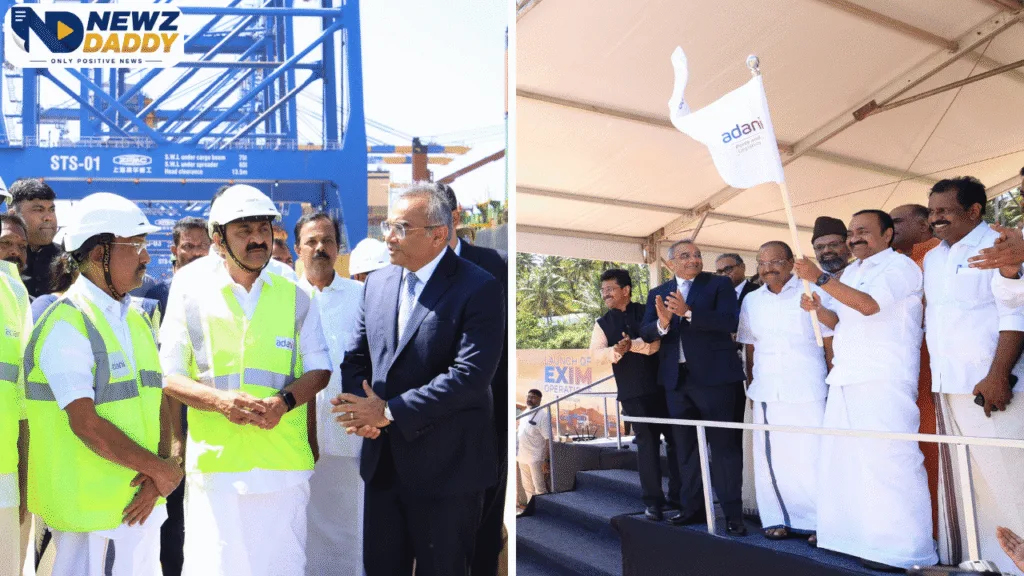
Vizhinjam Port EXIM Operations Start on August 18
Vizhinjam Port Begins EXIM Operations, Expanding India’s Trade Gateway
Vizhinjam International Seaport has begun full Export-Import (EXIM) operations, allowing cargo meant for Indian exporters and importers to move directly through the port. The change marks a new phase for the Thiruvananthapuram port, which began commercial operations in December 2024 mainly as a transhipment facility.
Chief Minister V.D. Satheesan attended the launch along with Industries Minister P.K. Kunhalikutty, MLA M. Vincent, Shyam Jagannathan, IAS, Director General of Maritime Administration, Government of India, maritime industry representatives and other officials.
For businesses, the change is important because EXIM cargo can now be handled at Vizhinjam itself. Until now, the port’s main role was transhipment, where containers arriving on large international vessels were transferred to other ships for movement to another port.
The state government has linked the launch with its wider Mission Samudra programme, which seeks to strengthen Kerala’s ports, transport links and maritime industries. Satheesan said the state would allocate ₹3,200 crore for land acquisition connected with the Ring Road and that discussions had begun on private investment.
“It is a proud moment for us, and Vizhinjam is now a gateway to the world. The challenge before us is to make the most of this opportunity through Mission Samudra, with Vizhinjam as its base, stronger road and rail connectivity and greater private investment. The government will allocate ₹3,200 crore for land acquisition for the Ring Road, while discussions have already begun to bring in private investment.”
Ashwani Gupta, CEO and Whole-time Director of Adani Ports and Special Economic Zone Ltd. (APSEZ), said, “It is the opening of a new gateway connecting Kerala’s talent, India’s enterprise and the aspirations of millions to global markets.”
The port is operated under a public-private partnership involving the Government of Kerala and Adani Vizhinjam Port Private Limited. A concession agreement was signed in August 2015 for the development and operation of the deep-water port. The project was planned around Vizhinjam’s location close to the main international East-West shipping route.
The site is about 10 nautical miles from that route and has a natural draft of around 18 to 20 metres. This allows the port to receive very large container ships without the extensive dredging that some ports require. The port has also been built to handle Ultra Large Container Vessels, or ULCVs
Vizhinjam has already recorded rapid growth since commercial operations began on 3 December 2024. According to APSEZ, the port handled 1.3 million TEUs during its first year and crossed the 2 million TEU mark within 18 months. It also passed 1 million TEUs in 10 months, making it the fastest Indian port to reach that level.
By June 2026, the port had received its 1,000th vessel. It has handled more than 70 ULCVs, according to APSEZ. One of the largest ships to call at Vizhinjam was MSC Irina, a 399.99-metre container vessel with a capacity of 24,346 TEUs.
The scale of the ships using Vizhinjam matters because container shipping depends heavily on large vessels operating on major international routes. A port that can receive such ships can attract direct calls and connect cargo owners with established shipping networks.
The EXIM service also changes the way cargo from southern India can reach overseas markets. The initial catchment area covers Kerala, Tamil Nadu and Karnataka. Companies in manufacturing and trading centres such as Bengaluru, Coimbatore and Tiruppur are among those that could use the port for international cargo.
A direct gateway can reduce the need to move containers through other Indian or overseas ports before they reach their final shipping route. That can cut handling steps and, depending on the route and cargo, reduce both time and transport costs.
India still sends a large share of its container transhipment cargo through foreign ports. The original project background identified Colombo and other overseas ports as important transhipment points for Indian cargo. Reducing dependence on such hubs has been one of the reasons for developing large deep-water transhipment capacity in India.
Vizhinjam’s development is also moving into a much larger construction phase. APSEZ has begun work on Phase 2, involving an estimated investment of ₹16,000 crore. The expansion is planned to take annual capacity to 5.7 million TEUs by December 2028.
The project will add about 1,200 metres of container berth and provide permanent rail connectivity. Further road links, logistics parks, warehouses and other support facilities are also planned.
With Phase 2, the cumulative investment by the Adani Group in the Vizhinjam project is expected to reach ₹30,000 crore. The company has described this as its largest investment commitment in Kerala.
The port’s growth is also drawing international shipping interest. In June 2026, APSEZ and Mediterranean Shipping Company Group’s terminal arm, Terminal Investment Limited, announced an agreement under which TiL would acquire a 49 per cent interest in Adani Vizhinjam Port Private Limited. The overall deal value was stated at US$2.85 billion, subject to regulatory and other approvals.
The wider effect of EXIM operations will depend on how quickly road, rail, warehousing and freight services grow around the port. More cargo passing through Vizhinjam could increase demand for container transport, customs services, freight forwarding, storage and related businesses.
The expansion is expected to create more than 5,000 additional direct and indirect jobs. It could also encourage companies to consider manufacturing, storage and distribution facilities closer to the port.
For Kerala, the immediate test is whether the new EXIM facility can attract enough export and import cargo to justify the infrastructure being built around it. For India, Vizhinjam offers another route for keeping a larger share of international container traffic within the country’s own port network.
The port’s next phase will therefore be measured by more than the number of ships it receives. Its ability to connect Indian producers with overseas buyers, provide reliable cargo services and build strong road, rail and logistics links will determine how much of that potential becomes regular trade.
Must Read:
Vizhinjam Makes History: India’s First Automated Port Begins Operations
Vizhinjam International Seaport Expansion Puts Kerala on World Map