


What Is Infusion Nursing and Why Does It Matter in India?
The Two-Day Ahmedabad Event By Infusion Nursing Society Focuses On Safer Infusion Nursing And Better Patient Care.
Every Drop Matters: Why Infusion Nursing Is Taking Centre Stage in Ahmedabad
Walk into any hospital ward in India, and seeing an intravenous (IV) line is completely normal. Whether a patient needs antibiotics, fluids, or cancer treatment, placing a line into a vein is usually the first step of hospital care. Yet, this everyday task is actually a complex medical skill. One small mistake in placing or watching a line can cause serious harm.
To put a spotlight on this vital work, the Infusion Nurses Society (INS) India kicked off its two-day ‘INS Gujarat 2026 – 14th National Annual Conference in Ahmedabad today. Under the theme “Every Drop Matters: Elevated Patient-Centred Infusion Care,” the event has brought together nursing leaders, teachers, doctors, working nurses, and students from across India. For the first time in Gujarat, nursing leaders are sharing one stage to trade ideas, bridge the gap between classroom study and hospital work, and push for safer patient care.

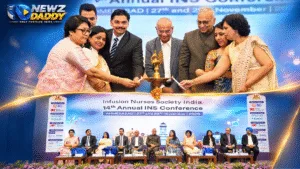
INS India was set up in 2010 as an official international affiliate chapter of the Infusion Nurses Society (INS) in the United States. Through this close tie, Indian hospitals gain direct access to globally trusted, evidence-based safety standards and research. Senior INS India leaders, including the President, CEO, and National Secretary, also hold active memberships with INS US. This allows them to study the latest international research papers and proven medical practices, and bring those global insights straight to Indian nurses through national conferences and localised guidelines.
The Human Skill Robots Still Cannot Replace
Infusion nursing therapy covers many types of medical care. In emergency rooms, nurses must quickly place IV lines for patients in shock or losing blood. In Intensive Care Units (ICUs), they handle much harder central lines in the neck and arterial lines.
Consider a three-day-old baby who needs IV fluids. Finding a newborn’s tiny vein is very hard, even for senior doctors and nurses. Without special tools like vein finders and close watching, fluid can leak out of the vein, a problem called extravasation. If it is not caught in time, it can cause severe swelling and, in the worst cases, even lead to losing a limb.
Nurses also face tough cases known as Difficult IV Cannulation Access (DIVA). Elderly patients with weak veins, very thin or overweight patients, dialysis patients, and cancer patients often need special long-term lines like PICC lines, chemoports, or Hickman catheters.
Even with modern tools like vein finders that use special light to show hidden veins, technology cannot do this job alone. “Robots, as of now, do not have the skill to insert a line,” says Colonel Binu Sharma, Founder Member, former President, and CEO of INS India. While future machines might help watch lines and warn nurses about infections, putting the line in still needs a skilled human hand.
Global Standards Built for India
Started in 2010 as a partner of INS US, INS India now has 5,000 members across 20 state chapters, including Gujarat, Delhi-NCR, Maharashtra, Rajasthan, and Karnataka.
A key part of their work is the INS Standard of Practice, a nine-chapter guidebook updated every three to four years by INS US. Instead of copying it blindly, a six-member Indian scientific board reviews the book to make sure it fits India’s patients, diseases, and local medical tools. Hospitals across the country use these rules to build their own safety checklists. To boost local research, INS India also launched the Journal of Infusion Nurses Society (JINS), which will be published twice a year.
Fixing the Training and Staff Gap
India’s hospitals face a big hurdle: new nursing graduates rarely get to practise placing IV lines on real patients in college. Once they join a hospital, they need at least three months of guided training with a mentor before they can work alone. However, after private hospitals spend time training these nurses, many leave for government jobs, better pay, or work abroad.
Also Read:
Ahmedabad Foundation Reports First-of-its-Kind Dental Surgery
To solve this, INS India is pushing two main plans across Indian hospitals:
Training “IV Champions”: Hospitals are encouraged to train a dedicated team of expert infusion nurses based on their patient numbers. These experts handle tough cases and guide other nurses, ensuring safe care around the clock even if a staff member leaves.
INFUSE Certification: Much like NABH or JCI hospital ratings, the eight-chapter INFUSE audit checks and certifies hospitals that follow strict infusion nursing safety rules. Already, 122 hospitals in India have earned this certification.
A Shared Push for Better Care
Beyond hospital audits, INS India runs monthly online classes and hands-on workshops called Skillathons. With help from industry partners like 3M, BD, Polymed, and B. Braun, the society brings new smart pumps and safer needles directly to nurses.
At the Ahmedabad event, Colonel Binu Sharma, INS India President Captain Madhukarya Ray, and the Governing Council shared a clear message: nurses are at the heart of safe and kind healthcare. By bringing students, working nurses, and senior leaders together, they aim to build a stronger healthcare system. Organising Chairperson Ms Sharmishtha Nayi also stressed that constant learning helps young nurses gain the skills and confidence to become tomorrow’s leaders.
As Indian healthcare grows, the takeaway from INS Gujarat 2026 is simple: patient safety starts at the bedside. Treating infusion nursing therapy as a specialised, respected skill is no longer a choice; it is a must for better care.