


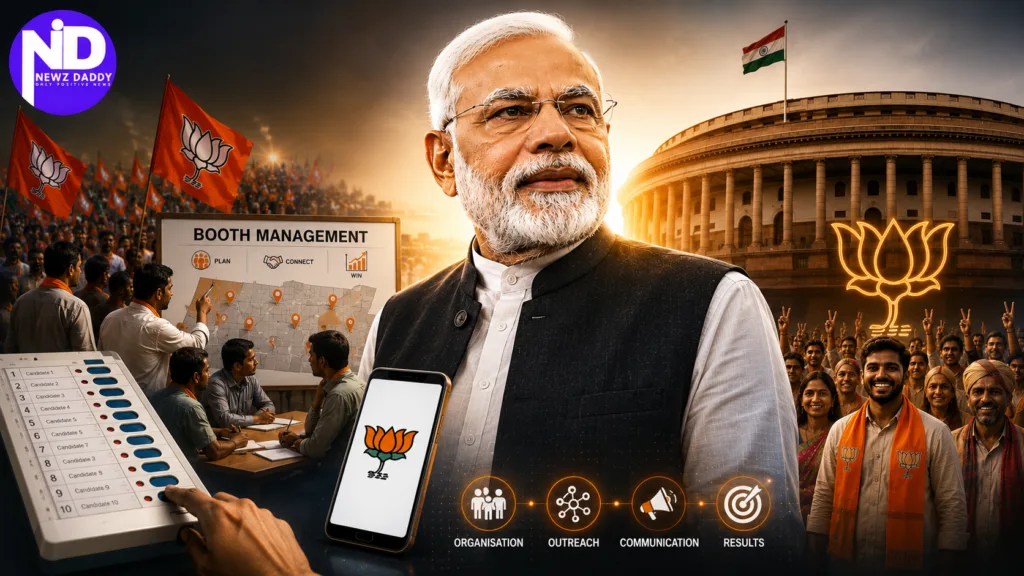
Why BJP Wins Elections Again and Again
From 2 Seats in 1984 To National Dominance, The BJP Story Explained
The Bharatiya Janata Party (BJP) has become the most powerful political organisation in India. Over the past decade, it has transformed from a major national party into a political force that shapes elections, government policy, public debate, and opposition strategy across the country.
Many people today ask the same question: Why BJP win elections so consistently compared to its rivals? The answer goes far beyond campaign speeches or election slogans. The BJP’s success is rooted in organisation, leadership, ideology, technology, welfare delivery, and long-term political planning.
Supporters see the BJP as a disciplined party with strong leadership and a clear vision. Critics argue that its growing dominance has reduced political competition and concentrated power in one organisation.
To understand how the BJP became India’s strongest political machine, it is important to examine the party’s growth, election strategy, grassroots network, and the changing political landscape of India.
From a Small Party to a National Force
The BJP was founded in 1980 and emerged from the Bharatiya Jana Sangh. For many years, it remained a relatively small political party.
In the 1984 Lok Sabha election, the BJP won only two seats.
Its growth accelerated during the late 1980s and 1990s through campaigns focused on governance, national identity, and Hindu nationalism. The party formed its first government under Prime Minister Atal Bihari Vajpayee in the late 1990s.
However, the BJP’s biggest breakthrough came in 2014.
BJP Growth Since 2014: The Turning Point
The story of BJP’s growth since 2014 is one of the most important developments in modern Indian politics.
In the 2014 Lok Sabha election, the BJP won 282 seats on its own and became the first party in 30 years to secure a majority without coalition support.
The party expanded rapidly into new states and social groups. It strengthened its presence in eastern India, improved its organisation in many regions, and attracted millions of new supporters.
In 2019, the BJP increased its tally to 303 Lok Sabha seats.
Although the party lost its standalone majority in the 2024 Lok Sabha election, it remained India’s largest political party and continued leading the National Democratic Alliance (NDA).
Many political analysts view BJP’s growth since 2014 as the period during which the party became India’s most dominant political force.
Narendra Modi’s Role in BJP Success
No discussion about the BJP’s success is complete without Narendra Modi.
Many analysts believe Narendra Modi’s role in BJP’s success has been decisive.
As Chief Minister of Gujarat and later Prime Minister, Modi built an image around development, strong governance, welfare delivery, and national leadership.
Election campaigns are increasingly centred on Modi’s popularity and communication skills. For many voters, support for the BJP became closely linked with support for Modi.
Supporters argue that Modi helped the BJP connect with first-time voters, women, welfare beneficiaries, and young Indians.
Critics argue that the party has become too dependent on one leader.
Even so, Modi remains one of the most influential political figures in India and continues to play a central role in the BJP’s political strategy.
Why BJP Wins Elections
One of the most searched questions in Indian politics is: Why BJP win elections repeatedly?
There is no single reason.
The BJP’s electoral success comes from a combination of factors:
- Strong organisational structure
- Popular national leadership
- Effective BJP election strategy
- Welfare schemes
- Nationalist messaging
- Digital outreach
- Strong grassroots workers
- Continuous voter engagement
Unlike many parties that become active mainly during elections, the BJP maintains year-round political activity.
Party workers regularly engage with local communities, organise programmes, and build relationships with voters. This constant engagement often provides an advantage during elections.
BJP vs Congress Organisation: A Key Difference
The debate over the BJP vs the Congress organisation helps explain why Indian politics has changed so dramatically.
Congress dominated Indian politics for decades. However, many political observers believe the BJP gradually developed a stronger and more disciplined organisational model.
The BJP operates through a structured system that reaches from the national level down to individual polling booths.
Congress has often faced challenges such as:
- Organisational weakness
- Internal factionalism
- Leadership disputes
- Electoral setbacks
- Difficulty building a consistent national narrative
The BJP focuses heavily on training workers, expanding membership, and maintaining local networks.
Many opposition leaders now acknowledge that BJP vs Congress organisation remains one of the biggest differences between the two parties.
RSS and BJP Relationship
The RSS and BJP relationship has played a major role in the party’s rise.
The Rashtriya Swayamsevak Sangh (RSS), founded in 1925, has a vast network of volunteers across India.
Although the RSS and BJP are separate organisations, they share ideological roots and often cooperate during election campaigns and organisational activities.
Many BJP leaders started their public careers within the RSS network.
Supporters argue that the RSS and BJP relationship provides discipline, trained workers, and long-term organisational strength.
Critics argue that the relationship raises questions about the role of non-elected organisations in politics.
Regardless of political opinion, the RSS connection remains one of the foundations of the BJP’s organisational success.
BJP Membership Growth and Organisational Expansion
Another major reason behind the BJP’s rise is the BJP’s membership growth.
Over the past decade, the party has launched large-scale membership campaigns across India.
The BJP claims membership figures of more than 100 million people, making it one of the largest political parties in the world.
BJP membership growth has helped the party build:
- Larger volunteer networks
- Stronger local organisations
- Better voter outreach
- Greater visibility in communities
- Faster campaign mobilisation
Even critics who question membership figures acknowledge that the BJP has built a vast organisational network.
BJP Election Strategy: Planning Beyond Election Day
A major factor behind BJP’s success is its long-term election planning.
The BJP election strategy goes far beyond speeches and rallies.
The party invests heavily in:
- Voter data analysis
- Social media campaigns
- Welfare scheme communication
- Candidate selection
- Community outreach
- Digital engagement
- Local issue tracking
Political analysts often note that the BJP treats elections as a year-round process rather than a short campaign.
This approach allows the party to stay connected with voters between elections and respond quickly to changing political conditions.
BJP Booth Management System: The Foundation of Success
Many political experts believe the BJP booth management system is one of the strongest in India.
The party invests heavily in booth-level organisation because elections are ultimately decided by individual votes.
One of the BJP booth management system’s best-known features is the “Panna Pramukh” model.
Under this system, party workers are assigned small groups of voters and maintain regular contact with them.
This helps the BJP:
- Understand local concerns
- Improve voter communication
- Increase turnout
- Track support levels
- Strengthen grassroots engagement
The BJP booth management system has become so influential that several opposition parties have attempted to replicate it.
Many analysts believe this booth-level approach is one of the BJP’s greatest electoral advantages.
Welfare Politics and Direct Benefits
The BJP’s success is not based only on organisation and leadership.
Government welfare programmes have also become a major political asset.
Schemes linked to housing, cooking gas connections, bank accounts, toilets, healthcare, food support, and rural infrastructure have reached millions of people.
Supporters argue that these programmes have improved living standards and strengthened trust in government.
Opposition parties argue that welfare schemes should not be viewed as achievements of any single political party.
Even so, welfare delivery remains an important part of BJP election strategy.
Challenges Ahead
Despite its dominance, the BJP faces several challenges.
These include:
- Economic pressures
- Unemployment concerns
- Inflation
- Regional political resistance
- Leadership transition after the Modi era
- Maintaining grassroots energy
The party also faces continued criticism from opponents regarding democratic institutions, political competition, and concentration of power.
What Happens Next?
The BJP remains India’s strongest political organisation, but politics is constantly changing.
The party will seek to strengthen its position ahead of future state elections and the next Lok Sabha election.
At the same time, opposition parties will attempt to improve coordination, rebuild local networks, and challenge BJP dominance.
The bigger question is no longer whether the BJP is India’s most powerful political party.
The real question is whether the party can maintain its dominance over the next decade while adapting to changing voter expectations, economic challenges, and the demands of a rapidly evolving democracy.
Also Read:
The Rise And The Fall of Trinamool Congress (TMC) And Mamata Banerjee