


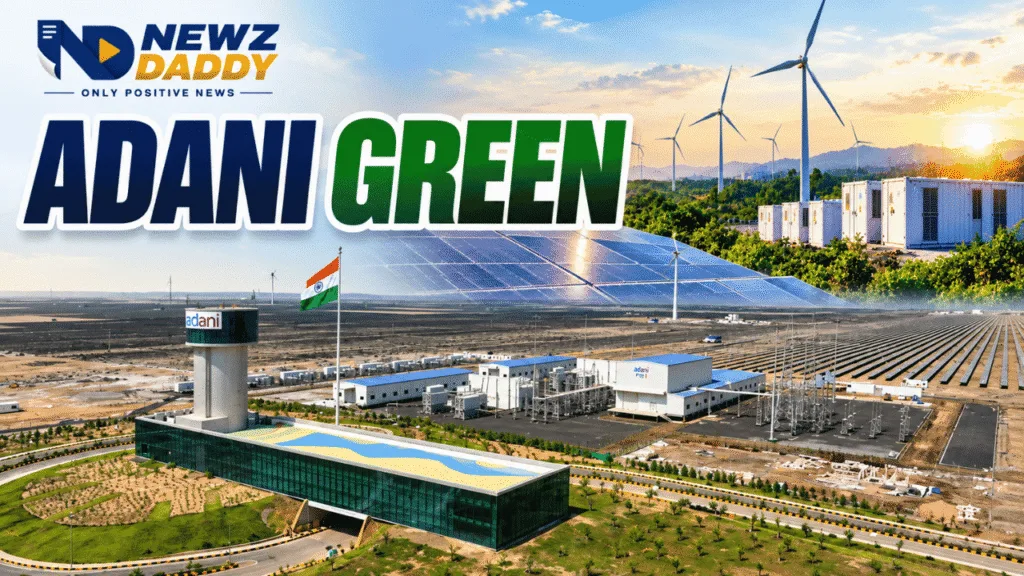
Adani Green Targets 30 GW at Gujarat’s Khavda Site By 2029
Adani Green Energy reports 41% rise in half-year EBITDA as renewable capacity reaches 20.8 GW
Adani Green Energy Ltd (AGEL) reported a 41% year-on-year rise in earnings before interest, tax, depreciation and amortisation (EBITDA) from power supply to Rs. 7,957 crore for the first half of the 2026-27 financial year. Energy sales rose 32% to 25,747 million units, while the company’s operational renewable energy capacity reached 20.8 gigawatts (GW).
The results, covering the six months ended 30 September 2026, reflect the company’s expanding solar, wind and hybrid power operations. Revenue from power supply increased 36% to Rs. 8,299 crore, compared with Rs. 6,088 crore in the same period a year earlier.
For the July to September quarter, known as Q2 FY27, revenue from power supply rose 45% year on year to Rs. 4,019 crore. EBITDA from power supply increased 51% to Rs. 3,835 crore. Energy sales for the quarter grew 33% to 12,090 million units.
Cash profit for the first half rose 35% to Rs. 4,176 crore, while the quarterly figure increased 45% to Rs. 1,951 crore. The reported EBITDA margin from power supply reached 92.9% for the half-year, up from 91.8% in the corresponding period last year.
The figures were released by the Ahmedabad-based company on 21 October.
AGEL added 4,083 megawatts (MW) of renewable energy capacity on a year-on-year basis during the first half. Its operational portfolio grew 24% to 20.8 GW.
Solar power accounted for the largest share of the additions, with 2,957 MW commissioned. This included 2,568 MW at Khavda in Gujarat and 389 MW in Rajasthan. The company also added 805 MW of wind power, comprising 666 MW at Khavda and 139 MW at Mundra, Gujarat. A further 321 MW came from solar-wind hybrid projects at Khavda.
These additions support AGEL’s target of reaching 50 GW of renewable energy capacity by 2030.
India is expanding its renewable electricity supply as part of its wider energy plans. The Union government reported that the country’s installed non-fossil fuel electricity capacity crossed 300 GW in July 2026, representing more than 54% of total installed capacity. The national target is 500 GW of non-fossil fuel capacity by 2030.
Battery storage is a major part of AGEL’s expansion plans. During Q2 FY27, the company added 3,081 megawatt-hours (MWh) of battery energy storage system (BESS) capacity at Khavda, taking its total installed battery storage capacity there to 6,632 MWh, or 6.63 gigawatt-hours (GWh).
AGEL says this accounts for more than half of India’s operational battery storage capacity. The Khavda installation is also described by the company as the world’s largest battery storage system at a single location.
The company expects its battery storage capacity to exceed 10 GWh during FY27, although the pace of further additions will depend in part on the availability of transmission infrastructure.
India’s Ministry of New and Renewable Energy has cited a Central Electricity Authority estimate that the country will need 34.72 GWh of battery storage capacity in 2026-27. The projected requirement rises to 236.22 GWh by 2031-32. These estimates show the scale of the storage capacity needed as more solar and wind power enters the electricity system.
AGEL is developing a 30 GW renewable energy project at Khavda, spread across 538 square kilometres of land in Gujarat. The company says the area is almost five times the size of Paris.
Operational capacity at the site has reached 10.8 GW, compared with 7.1 GW a year earlier. The reported portfolio stands at 10,752 MW across solar, wind and hybrid projects. This includes 10,002 MW of AGEL’s own generation capacity and 750 MW established for other Adani Group companies.
Robotic solar module installation and a local supply chain form part of the construction process. The company aims to reach 30 GW of renewable energy capacity at Khavda by 2029.
AGEL spent Rs. 17,160 crore on capital expenditure during the first half of FY27, up 38% from a year earlier. The spending supports the addition of renewable generation capacity and battery storage facilities.
The company reported a net debt-to-run-rate EBITDA ratio of 5.6 times. This measure compares debt with annualised earnings and helps investors assess how much borrowing a business carries against its operating earnings.
The high level of investment reflects the cost of building large renewable energy projects. It also makes future cash generation, project delivery and access to transmission networks important factors for the company’s growth plans.
AGEL uses an Energy Network Operation Centre to monitor renewable power plants across India in real time. It says this system helps maintain plant availability and control operating costs. Its reported EBITDA margin from power supply was 92.9% in H1 FY27.
Ashish Khanna, CEO of Adani Green Energy, said the company’s operating capacity and electricity sales had risen during the first half. He also referred to the increase in battery storage at Khavda and the need to monitor transmission infrastructure.
“As India’s largest renewable energy company, we take pride in driving the sector’s momentum. This is reflected in our strong execution in H1 FY27, with our operational renewable energy portfolio growing 24% year-on-year to 20.8 GW and energy sales increasing 32%, supporting robust operating performance across our solar, wind and hybrid assets. Performance during the quarter was equally strong, with energy sales increasing 33% year-on-year and revenue from power supply increasing 45% year-on-year to Rs. 4,019 crore, while EBITDA from power supply grew 51% YoY. We also achieved a significant milestone in energy storage, expanding our operational BESS capacity at Khavda to 6.63 GWh, the world’s largest single-location battery storage installation. This makes AGEL India’s largest BESS operator, accounting for more than half of the country’s operational capacity. We remain focused on scaling up storage deployment while closely monitoring the availability of transmission infrastructure.”
AGEL also reported several sustainability-related ratings and awards. Its Khavda battery storage project received the Largest Project of the Year Award at India Energy Storage Week 2026.
The company said it ranked among the world’s top 10 companies in assessments by seven environmental, social and governance (ESG) rating agencies. It was ranked first in the utility sector by NSE Sustainability Ratings and Analytics for the second consecutive year, and first globally in the alternative electricity subsector by FTSE Russell for the same period.
Other recognitions included the Clean Power Generation Award at the Reuters Energy Industry Awards 2026 in New York. AGEL received a CareEdge-ESG 1+ rating with a score of 87.3, which it said was the highest score assigned across sectors for the second consecutive year. CRISIL ranked the company first in the power generation sector for the fifth consecutive year.
The half-year results show that AGEL is adding generation and storage capacity while increasing electricity sales. Its next test will be to deliver its planned projects on schedule, manage borrowing and ensure that the growing volume of renewable power can reach the electricity grid when needed.