


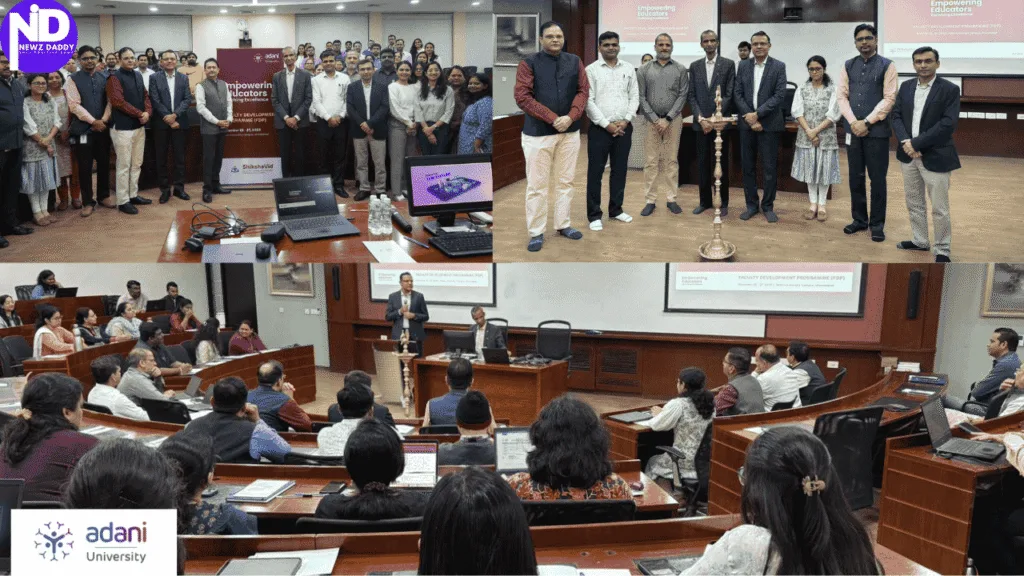
Adani University boosts education with Faculty Development Programme
Adani University concludes ‘ShikshaVid’ programme focused on teaching excellence
A five-day faculty development programme at Adani University underscored the growing emphasis on pedagogical innovation, leadership and industry relevance in Indian higher education.
As universities across India respond to the evolving academic framework shaped by the National Education Policy (NEP) 2020, strengthening faculty capability has emerged as a key priority. Across the country, higher education institutions are being encouraged to move away from rote learning and focus more on skills, flexibility and student-centred teaching. Faculty development programmes like ShikshaVid are increasingly seen as a practical way to support this shift, helping teachers align classroom practices with national goals for education reform.
Against this backdrop, Adani University concluded ShikshaVid, a five-day intensive Faculty Development Programme (FDP) aimed at enhancing pedagogical effectiveness, academic leadership and classroom engagement. Such programmes are becoming common in leading universities as they help educators keep pace with changes in curriculum design, assessment methods and student expectations, especially at a time when classrooms are more diverse and digitally connected than ever before.
Held from December 22 to 27 at the university’s campus in Shantigram, the programme brought together faculty members from across disciplines for structured engagement with contemporary teaching practices. Interdisciplinary learning is gaining importance in higher education, as it allows teachers to understand different viewpoints and apply ideas beyond their own subjects. This approach also reflects NEP 2020’s emphasis on breaking rigid academic silos.
The initiative was designed to equip educators with practical tools and perspectives to address changing student needs, emerging technologies and increasing expectations from higher education institutions. Today’s students often expect learning to be interactive, relevant to real-world problems and supported by technology. Faculty members are therefore required to balance subject knowledge with digital skills and emotional understanding of learners.
The programme opened with an inaugural address by Vasant Gadhavi, Executive Director, Adani Foundation—the social development and community engagement arm of the Adani Group. In his remarks, Gadhavi highlighted the role of empowered teachers in nation-building and sustainable development, emphasising continuous learning, adaptability and leadership as essential qualities for educators navigating a rapidly changing academic environment. Education experts often point out that teachers play a direct role in shaping responsible citizens, making faculty training a long-term investment in society.
Provost Dr Dhaval Pujara reflected on the evolving role of the “Guru” in today’s education ecosystem. He described a teacher as one who guides students, understands their challenges, continually updates their knowledge, and uplifts learners beyond academic instruction. His address reflected a broader shift in education, where teachers are expected to support students’ personal growth, career planning, and ethical values, not just exam performance.
His address underscored the growing expectation for faculty members to act as mentors and facilitators of holistic development, rather than limiting their role to content delivery. Research in education shows that students perform better when teachers take an active interest in their overall well-being and learning journey, which makes mentoring skills increasingly important.
Over the five days, ShikshaVid covered a wide range of themes, including pedagogical innovation, active and project-based learning, leadership and mentoring, emotional well-being in academic workplaces, communication skills and the effective implementation of NEP 2020. These topics reflect common challenges faced by teachers, such as managing classroom stress, engaging students with different learning styles and adapting to policy changes.
Sessions also explored the use of Information and Communication Technologies (ICT), Generative Artificial Intelligence (GenAI) in teaching, case writing and strengthening industry–academia collaboration. With digital tools and AI becoming part of everyday life, universities are exploring how these technologies can support learning without replacing the human role of teachers. Industry collaboration, meanwhile, helps align academic teaching with workplace needs, improving student employability.
Interactive workshops, hands-on activities and participant-led presentations encouraged peer learning and reflective practice. Such methods are widely recognised as effective because they allow teachers to share experiences, learn from each other and apply new ideas directly to their own classrooms.
With the conclusion of ShikshaVid, the programme highlighted the increasing emphasis being placed on faculty development as a cornerstone of higher education reform. Many education analysts believe that policies alone cannot transform education unless teachers are well-prepared to implement them on the ground.
The initiative reflected a broader recognition that sustained investment in teacher capacity-building is critical to improving classroom outcomes, student engagement and institutional readiness for the next phase of India’s higher education journey. As universities continue to adapt to national reforms and global trends, programmes like ShikshaVid signal a growing commitment to quality teaching and meaningful learning experiences.