


Adani University Convocation: AI’s Promise and Its Risks
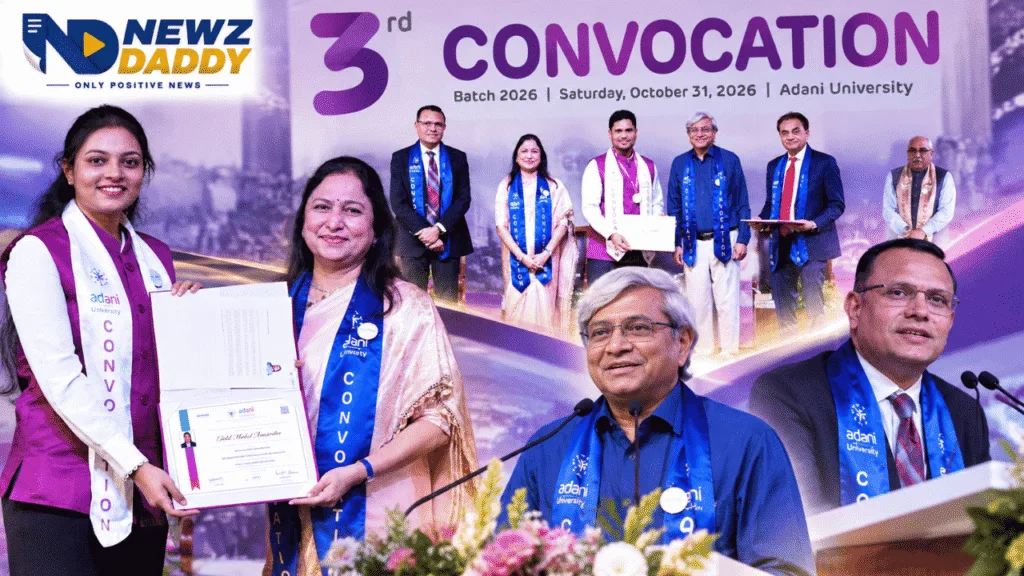
Adani University Graduates 374 Students as IISc Director Warns of AI’s Risks
Artificial intelligence is changing how people learn, carry out research and share information. But as AI tools become more common, questions about truth, trust and human relationships need greater attention, Indian Institute of Science (IISc) Director Prof. Govindan Rangarajan said at Adani University’s third convocation on Saturday.
The university awarded 374 degrees to students from the Class of 2026. Ten students received medals for academic excellence, including five gold, three silver and two bronze medals.
Prof. Rangarajan, the chief guest at the ceremony, spoke about the growing use of AI in education and scientific research. He said the technology could help researchers solve difficult problems and speed up scientific work, while warning that its growing reach could create new risks for society.
“AI offers tremendous possibilities in education and research. It can help us solve complex problems and accelerate scientific discovery. But we must also be mindful of its consequences. When images, videos and information can be generated so convincingly, how do we know what is true? And while technology is bringing us closer digitally, are we becoming more distant from one another? We must embrace what AI can do, but also think carefully about what we stand to lose.”
His remarks came as universities across the world face questions about how students should use AI tools in their studies, research and written work.
Generative AI tools can help students explain difficult subjects, prepare study material and explore ideas. Researchers can use them to assist with tasks such as reviewing large amounts of information and writing computer code.
However, these tools can also produce incorrect information and convincing false images or videos. Students who rely on AI without checking its answers may submit work that contains mistakes or does not reflect their own understanding.
The Indian Institute of Science has published a report on the use of emerging AI tools in education and research. The report examines the subject from the point of view of the institute and its academic policies.
The questions raised by Prof. Rangarajan also concern the value of human contact in education. Students depend on teachers, classmates and personal discussions to learn how to question information and understand different views. The growing use of digital tools has led to concerns about whether people may spend less time in direct contact with one another.
Dr Priti Adani, President of Adani University, presided over the convocation and welcomed the chief guest.
“We are fortunate to have Prof. Rangarajan as our Chief Guest. His distinguished contributions to mathematics, research and academic leadership are a powerful beacon for our graduating class, and for all of us, as we work towards making Adani University a leading research-driven university,” she said.
Dr Adani also spoke about the role of universities in working with industry. She said companies and academic institutions could learn from each other when they worked on real-world problems.
“The promise is not that industry will simply tell a university what to study. It is that exposure to demanding real-world conditions can bring up questions – that neither industry nor academia would have framed alone.”
The relationship between universities and industry has become a key subject in higher education. Companies need people with skills that match changing business and technology needs. Universities, in turn, can use real problems faced by businesses to shape research and practical learning.
For students, such work can offer a chance to understand how classroom knowledge applies to jobs and projects. For researchers, it can bring access to problems that need further study.
Dr Adani also referred to India’s infrastructure development and called on students to help the country build its ability to develop new ideas and products.
“India has built infrastructure on a remarkable scale. Now we must learn to innovate and incubate at scale,” she said.
She urged students to work on new solutions that could reach people from marginalised communities. Her remarks placed the focus on how research and new technology could serve people who often have limited access to services and resources.
Adani University Provost Prof. (Dr.) Dhaval Pujara presented the annual report during the ceremony. He spoke about the work of faculty members, staff, students and industry partners.
The report covered the university’s efforts to strengthen its academic base, develop research and increase its links with industry and society. The university aims to grow into a multidisciplinary institution for education and research, with a role in India’s development.
Adani University was established in 2022. It focuses on industry-related education, practical learning and research.
The institution held its first convocation in October 2024, when 69 postgraduate students received degrees. Four students were awarded gold medals. The ceremony was addressed by Padma Shri Kartikeya Vikram Sarabhai, founder and director of the Centre for Environment Education.
The third convocation marks another stage in the university’s growth, with 374 students graduating in 2026.
For the graduating students, the ceremony marks the end of their university studies and the start of their next step, whether in employment, further education or research.
Prof. Rangarajan’s address placed AI among the questions they may face in their working lives. As the technology becomes more common in offices, laboratories and classrooms, students will need to know how to use it while checking the information it produces.
The ceremony also brought attention to the role universities can play in connecting research with public needs. The challenge for the next generation will be to apply their knowledge in ways that are useful, reliable and accessible to people across society.
Must Read:
Adani University MBA Infrastructure Management Begins New Journey
Adani University Induction Programme 2026 Prepares Future Engineers