


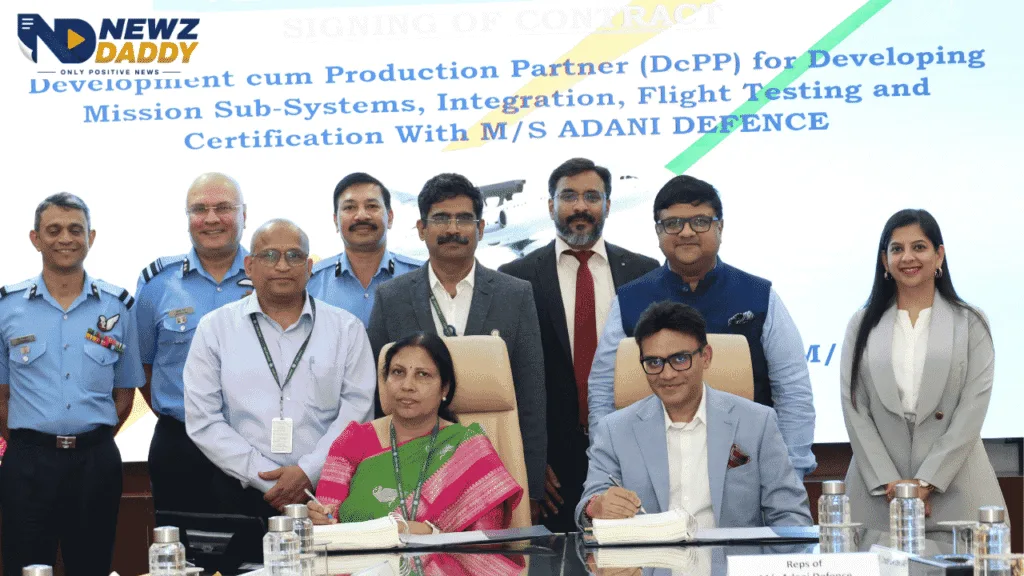
AEW&C MKII Programme Strengthens Indian Air Force Fleet
Adani Defence and DRDO Join Hands for India’s Next Airborne Surveillance Aircraft Programme
India has taken another step towards expanding its indigenous defence capability after the Defence Research and Development Organisation (DRDO) and Adani Defence & Aerospace signed an agreement to jointly develop the Airborne Early Warning and Control Mark II (AEW&C-MKII) programme for the Indian Air Force (IAF).
The agreement, announced on 22 July 2026, covers the design, manufacturing and integration of advanced airborne mission systems on six modified Airbus A321 aircraft. The aircraft are expected to enter service with the Indian Air Force during 2032 and 2033.
The project also includes long-term logistics, maintenance, repair, overhaul and technical support for as long as 30 years after induction. According to the announcement, the programme marks the first time that a private Indian company has been given responsibility for the development, systems integration and lifetime support of an airborne mission platform of this size.
Airborne Early Warning and Control aircraft play a central role in modern military operations. Flying at high altitude, they use powerful radar and communication systems to detect aircraft, missiles and other aerial threats hundreds of kilometres away. They also serve as airborne command centres by collecting information from different sensors and directing friendly aircraft during military operations.
Military analysts often describe such aircraft as essential force multipliers because they allow commanders to detect threats earlier than ground-based radar alone. This extra warning time can improve air defence, guide fighter aircraft towards targets and strengthen coordination across the battlefield.
India has been building this capability for more than two decades. DRDO developed the country’s first indigenous AEW&C system, known as “Netra”, which is mounted on the Embraer ERJ-145 platform. The Indian Air Force currently operates a limited number of these aircraft. It also operates the larger Israeli-developed Phalcon Airborne Warning and Control System mounted on Russian Il-76 aircraft. Defence experts have long argued that India needs a larger fleet to monitor its vast airspace and support operations along both the western and northern borders.
The AEW&C-MKII programme is expected to fill part of that requirement by introducing a larger aircraft with greater endurance, increased onboard space for mission equipment and the ability to carry more advanced radar and communication systems.
Under the new agreement, DRDO will contribute its experience in defence research and mission system development. Adani Defence & Aerospace will work on manufacturing, systems integration and long-term support for the fleet.
The mission systems will be installed on six Airbus A321 aircraft that will be modified specifically for military use. Airbus A321 is a widely used commercial passenger aircraft, and several countries have adapted civilian airliners into airborne surveillance platforms because of their range, payload capacity and operating efficiency.
Once operational, the aircraft will become part of the Indian Air Force’s Integrated Air Command and Control System (IACCS). This nationwide network links radar stations, surveillance platforms, air defence systems and operational units, allowing commanders to receive real-time information and coordinate responses more quickly.
Integration with IACCS is expected to improve India’s ability to monitor its airspace, identify potential threats at an earlier stage, and coordinate military assets during routine operations and emergencies.
If completed as planned, the programme will place India among a small group of countries that have developed indigenous Airborne Early Warning and Control capability. At present, such systems have been developed by only five countries: the United States, France, Israel, China and Sweden.
Building these aircraft requires expertise across several disciplines, including advanced radar technology, electronic warfare, secure communications, software integration, aircraft modification and systems engineering. Developing these technologies within India has been one of the long-term objectives of the government’s Aatmanirbhar Bharat initiative, which seeks to reduce dependence on imported defence equipment while expanding domestic manufacturing.
In recent years, India has increased private sector participation in defence production. Companies such as Tata Advanced Systems, Larsen & Toubro, Bharat Forge, Mahindra Defence and Adani Defence have secured larger roles in manufacturing military equipment, working alongside established public sector organisations including Hindustan Aeronautics Limited, Bharat Electronics Limited and Bharat Dynamics Limited.
The Ministry of Defence has introduced several policy measures to encourage domestic production, including higher indigenous procurement targets, simplified acquisition procedures and positive indigenisation lists that restrict imports of selected defence equipment. These policies aim to strengthen India’s defence industrial base while encouraging collaboration between government laboratories and private companies.
The AEW&C-MKII programme reflects this approach by combining DRDO’s research capability with private sector manufacturing and long-term support services. Beyond supplying aircraft to the Indian Air Force, the project is expected to create opportunities for Indian suppliers involved in electronics, aerospace components, precision manufacturing and maintenance services.
Although the aircraft are not expected to enter operational service until 2032 and 2033, defence planners see airborne surveillance as an increasingly important capability as regional security challenges continue to evolve. Early warning aircraft help armed forces detect threats sooner, coordinate air operations more effectively and improve decision-making during complex military missions.
For India, the programme represents another milestone in its effort to expand indigenous defence technology while strengthening the Indian Air Force’s surveillance and command capabilities for the coming decades.
Must Read:
A Milestone for Indian Defence: Adani’s Groundbreaking Initiative
Adani Defence & Aerospace Unveils Indigenous UAV ‘Drishti 10’ for Indian Navy