


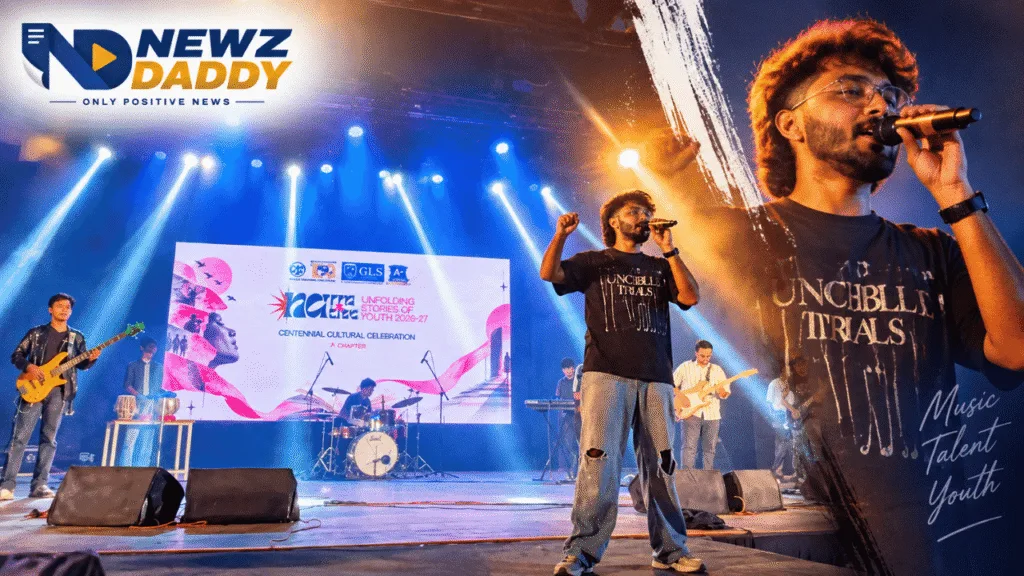
Ahmedabad: GLS Youth Fest Concludes After Three Days of Events
GLS University Youth Fest NARRATIVE 2026-27 Ends Three-Day Run with Dance, Music, Theatre and Digital Art
Students at GLS University spent the final day of the Youth Fest NARRATIVE 2026-27 moving between dance, music, theatre, fashion, digital design and short-form video as the three-day event reached its closing stage.
The festival, titled ‘NARRATIVE – Unfolding Stories of Youth 2026-27’, is the eighth chapter of the university’s Centennial Cultural Celebration. The programme was held under the leadership of GLS University President Shri Sudhir Nanavati and Executive Director Dr Chandni Kapadia, who are listed in those positions on the university’s official records.
The final day brought together nine major competitions. Students used different forms of performance and visual media to present ideas about family, nature, society, personal struggle, Indian culture and changing technology.
The scale of the programme also follows GLS University’s recent focus on student-led cultural activities. The university’s 2025 edition of NARRATIVE was a three-day Inter-GLS Youth Festival that involved more than 900 students in competitions covering dance, music, fashion, fine arts, literature, digital arts and techno games.
The Creative Choreography Competition was among the main attractions of the concluding day. Nine teams performed pieces built around subjects such as the life of a doctor, Indian Army K9 warriors, humans and nature, women’s strength, relationships, mythology, the human mind and the stages of life.
The performances combined movement, music and acting to present stories without depending on a conventional stage play. For students, the format also required them to fit a complete idea into a limited performance, making choreography, music selection and group coordination important parts of the exercise.
The Digital Poster Making Competition shifted the focus from live performance to screen-based design.
Students worked on subjects connected with technology, human creativity, aspirations, heritage and the changing relationship between people and digital technology. The event offered a glimpse of how student competitions are adapting to tools and media that are now part of everyday communication.
This interest also fits with wider academic activity at GLS University. The institution has added programmes connected with creative media and technology, including a Global B.Design programme with SAE Institute covering areas such as animation, games, design, film, audio, music, IT and visual effects.
The Mr. & Miss GLS competition brought students from across the university into a series of rounds. These included individual talent presentations, audio-visual introductions, a question-and-answer round and a group ramp walk.
The format placed communication alongside appearance and performance. Students had to introduce themselves, respond to questions and present their abilities before an audience.
Such competitions are now a familiar part of university festivals, where students get an opportunity to practise public speaking and stage performance outside their regular classroom work.
Indian music featured strongly during the final day through the Indian Group Singing and Indian Vocal Solo competitions. The two formats allowed students to perform as groups and individuals while drawing on Indian musical traditions.
The Band Competition brought a different sound to the programme, with students performing together using instruments and vocals.
The Mime Competition removed spoken dialogue from the performance. Students relied on facial expressions, gestures and movement to communicate situations and emotions. The form remains a demanding test of timing because performers have to make an audience understand the subject without spoken words.
The Drape Styling Competition added a fashion component to the festival. Participants experimented with different ways of presenting traditional draping styles while working on their own visual designs.
The competition connected clothing with presentation and design, giving students room to work with colour, form and styling while retaining the basic idea of draped attire.
The final competition, Reel Making Submission, moved the Youth Fest into short-form digital video.
Students created reels based on the theme and atmosphere of NARRATIVE, giving them a way to record and interpret the festival through mobile-friendly video. The format reflects the growing place of short videos in student communication and digital content.
GLS University has also used digital and creative formats in other recent student activities. In May 2026, for example, the university held a painting competition called ‘A Street, A Soul, A Story’, which brought nearly 180 students into a programme focused on stray animals and visual expression.
NARRATIVE 2026-27 is taking place during the wider centenary year of the Gujarat Law Society (GLS). The organisation was established in 1927 and began its 100th-year celebrations on February 23, 2026. The centenary programme includes academic, cultural, research and community events leading up to 2027.
For GLS University, the Youth Fest therefore sits within a larger year of institutional events. For students, the three-day programme has provided a space outside regular academic work where performance, design, music and digital media could be tested before an audience.
The competitions ended on September 22, but the festival itself is due to formally close on September 23, 2026, with the valedictory function. Winners of the various competitions are scheduled to be announced at that ceremony.
The final results will decide the competition awards. The three-day programme has already put hundreds of student performances and creative works at the centre of the university’s centenary celebrations.
Must Read:
GLS University Hosts Magali McDuffie on Creative Careers
Anil Bhardwaj Speaks on India’s Space Journey at GLS University