


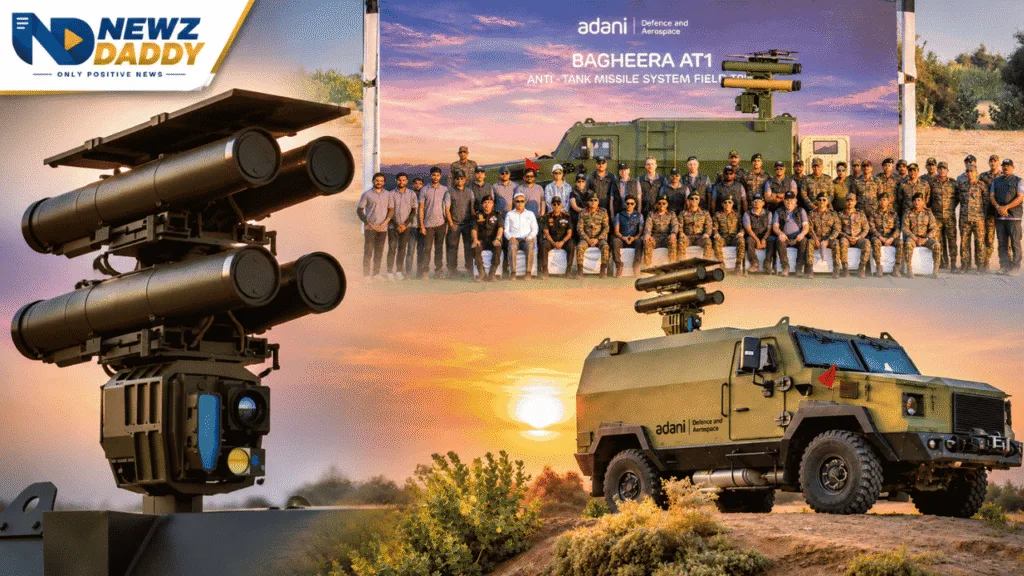
Bagheera AT1: Adani Fires Four Anti-Tank Missiles at Pokhran
Adani Defence Tests Four Bagheera AT1 Anti-Tank Missiles at Pokhran, Targets Indian Army Requirements
India’s private defence industry has taken another step towards developing home-grown anti-tank weapons, with Adani Defence & Aerospace reporting the successful firing of four Bagheera AT1 guided missiles at the Pokhran Field Firing Ranges in Rajasthan.
The vehicle-mounted missile system was demonstrated on 20 November during a No Cost No Commitment (NCNC) programme attended by senior representatives of the Indian Army, the Department of Military Affairs and the Ministry of Defence (MoD).
The demonstration included day and night firing, a two-missile salvo directed at a target representing an armoured vehicle, and an engagement involving an aerial target at an extended range. A static display of the complete weapon system followed the firing programme.
The company said the Bagheera AT1 could engage armoured targets at distances of up to 8 km. Its wider missile architecture can support guided engagements of up to 10 km. This gives the Army another vehicle-mounted option for attacking enemy tanks and armoured vehicles from a distance.
The demonstration comes as India continues to improve its anti-tank weapons and expand domestic defence manufacturing. The Army needs weapons that can operate across different terrains and remain useful when enemy forces employ electronic warfare equipment.
Bagheera AT1 has taken 18 months of design and development work by Adani Defence & Aerospace. During this period, the company customised the complete system to meet Indian terrain, climate and military requirements.
The weapon system combines a guided missile, an automated launcher, day television sights and thermal-imaging equipment. These components are mounted on a 4×4 high-mobility armoured vehicle designed by Adani Defence.
The launcher carries four ready-to-fire missiles. Another eight missiles are stored onboard for reloading, taking the vehicle’s total ammunition capacity to 12 missiles.
One of the system’s main features is its laser beam-riding guidance technology. The missile follows a laser beam directed towards the target rather than depending on a radio command link. This makes it harder for enemy electronic warfare equipment to disrupt its guidance.
Electronic jamming has become a major concern for modern armed forces. Military operations increasingly involve drones, electronic sensors and equipment designed to interfere with communications and weapon control systems. A missile that does not depend on a conventional radio command link can offer an advantage in such conditions.
The company has also described a two-missile firing method intended to deal with tanks fitted with an Active Protection System (APS). Such systems detect incoming missiles and try to destroy or divert them before they strike the vehicle.
Under the Bagheera AT1 firing method, the first missile is intended to engage the tank’s protective system. A second missile follows along the same laser beam and is designed to strike the tank after its defences have been engaged.
The vehicle also has automated target tracking, allowing its crew to engage targets during daytime and at night. Its shoot-and-move arrangement is designed to let soldiers fire from a protected position and relocate quickly. The company also reported the system’s ability to engage aerial targets at extended range.
India has operated several generations of anti-tank guided missiles. The Milan-2T and Konkurs-M remain part of the Army’s existing inventory. Israeli-made Spike missiles have also been inducted to meet operational requirements.
The Army is working towards a larger modernisation programme as older weapons need replacement and newer threats demand better range and accuracy. The acquisition of Javelin systems is also mentioned in the company’s announcement.
India’s own Defence Research and Development Organisation (DRDO) has been working on new anti-tank weapons. Its Nag Mk 2 missile completed field evaluation trials at Pokhran in January 2025. The Ministry of Defence reported that the missile destroyed its targets at both maximum and minimum ranges. The complete weapon system was declared ready for induction into the Indian Army.
The DRDO has also tested its Man-Portable Anti-Tank Guided Missile (MPATGM). In January 2026, the missile successfully hit a moving target during a test in Maharashtra. It uses an imaging infrared seeker and a tandem warhead designed to deal with modern tank armour.
In March 2025, the Ministry of Defence signed a contract worth approximately ₹1,801.34 crore for the Nag Missile System (NAMIS), tracked version. The system was developed by DRDO’s Defence Research and Development Laboratory.
These programmes show that India is pursuing several types of anti-tank weapons. They include missiles carried by individual soldiers, vehicle-mounted launchers and weapons launched from helicopters.
Bagheera AT1 enters this field as a vehicle-mounted system with a stated anti-tank engagement range of 8 km. Its place in the Army’s future inventory will depend on technical assessment, user trials, procurement decisions and the military’s operational requirements.
The Pokhran demonstration also comes at a time when private companies are taking a bigger share of India’s defence manufacturing work.
According to figures released by the Ministry of Defence, India’s defence production reached a record ₹1.78 lakh crore in the financial year 2025-26. This was a 15.6 per cent increase over the previous year’s production of ₹1.54 lakh crore.
Private companies accounted for 24 per cent of total defence production, compared with 22 per cent in 2024-25. Their contribution was approximately ₹42,000 crore. Public sector defence companies and other public sector units accounted for the remaining 76 per cent.
Defence exports also reached a record ₹38,424 crore in 2025-26, marking a 62.66 per cent rise over the previous year’s ₹23,622 crore.
These figures reflect the expanding role of Indian manufacturers in supplying equipment to the country’s armed forces and overseas customers. The government has set targets of ₹3 lakh crore in annual defence production and ₹50,000 crore in defence exports by 2029.
Adani Defence & Aerospace is among the private companies seeking a larger presence in this market. Its activities cover defence and aerospace equipment, including unmanned systems, arms and ammunition, electronic warfare and aircraft-related technologies.
A successful firing demonstration does not automatically mean that a weapon will enter military service. The Indian Army must assess whether the system meets its technical and operational requirements before any procurement decision.
For Bagheera AT1, this would include checks on missile accuracy, performance at different distances, reliability during day and night operations, resistance to electronic interference and its ability to operate under difficult battlefield conditions.
The NCNC demonstration allows military representatives to observe the equipment without an immediate purchase commitment. It allows the company to present its system for assessment while the Army examines whether it meets its needs.
The two-missile firing method will also require careful examination. Modern tanks increasingly use protective equipment to detect and counter incoming weapons. The ability to overcome such defences is an important consideration in the development of anti-tank missiles.
India has made considerable progress in domestic missile development through DRDO and its industry partners. The development of Bagheera AT1 adds another privately developed system to the country’s growing range of anti-armour weapons.
The next stage will determine whether the system can meet the Army’s requirements and move towards formal trials and possible procurement. For Adani Defence & Aerospace, the Pokhran demonstration marks the completion of an 18-month development programme and an opportunity to present its vehicle-mounted missile system to the Indian military.