


Bimal Patel Takes Oath as ITLOS Judge in Hamburg for 9 Years
Dr Bimal N. Patel Takes Oath as ITLOS Judge in Germany for Nine-Year Term
Indian international law expert assumes office at Hamburg headquarters as maritime disputes, ocean governance and international law gain importance
Hamburg, Germany / Gandhinagar, 1 October 2026: Dr Bimal N. Patel took the oath as a judge of the International Tribunal for the Law of the Sea (ITLOS) at its headquarters in Hamburg, Germany, on Thursday. His nine-year term began on 1 October 2026.

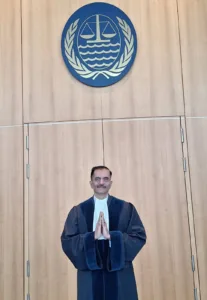
Dr Patel’s appointment places an Indian legal expert on the international court that deals with disputes involving the law of the sea. The tribunal plays a role in resolving disagreements between countries over maritime boundaries, ocean resources, shipping rights and other matters covered by the United Nations Convention on the Law of the Sea (UNCLOS).
Dr Patel was elected on 18 June 2026 during the 36th Meeting of States Parties to UNCLOS at the United Nations Headquarters in New York. Seven members were elected to the tribunal during the meeting.
His election followed years of work in international law, legal research, maritime policy and education. He has also held responsibilities linked to India’s national security, Antarctic governance and international legal cooperation.
ITLOS is an independent international judicial body established under UNCLOS, which came into force in 1994. The convention sets out the legal rules governing the world’s oceans, including the rights and duties of coastal countries and other nations using the seas.
The tribunal has 21 members elected by the countries that have joined UNCLOS. Judges serve nine-year terms, with elections held in groups to maintain continuity. Members must have a strong reputation for fairness and integrity, along with recognised knowledge of the law of the sea.
The court’s work covers disputes involving the interpretation and application of UNCLOS. It can also deal with urgent cases, including requests for the release of detained vessels and their crews, and measures needed to protect marine environments while a dispute is being considered.
Maritime disputes can affect fishing communities, international trade, energy projects and shipping routes. With much of the world’s goods transported by sea, disagreements over access, boundaries and resources can have consequences well beyond the countries directly involved.
India’s position as a country with a long coastline and major interests in the Indian Ocean makes international maritime law an important part of its foreign policy and security discussions.
The United Nations Convention on the Law of the Sea was opened for signature in Montego Bay, Jamaica, on 10 December 1982. It came into force on 16 November 1994 after years of international negotiations. The agreement covers territorial waters, exclusive economic zones, continental shelves, the high seas and the use of seabed resources.
Dr Bimal Patel has served as a member of the United Nations International Law Commission (ILC), which works on the development and codification of international law. He also chaired the ILC Working Group on Succession of States in respect of State Responsibility.
His work has included legal questions concerning the duties of countries, maritime boundaries and the rules that apply when states face disputes over international obligations.
Dr Patel has also held several national and international positions. These include membership of India’s National Security Advisory Board and the Committee on Antarctic Governance. He is Co-Chair of the Law of the Sea Interest Group of the American Society of International Law and a member of the High-Level Advisory Board of the International Committee of the Red Cross.
He also served as Lead Academic Adviser during India’s term on the United Nations Security Council in 2021–22.
Dr Bimal Patel work has covered Indian laws and regulations linked to maritime anti-piracy measures, Antarctic governance, merchant shipping, private maritime security, deep seabed activities and admiralty jurisdiction. These areas deal with the safety of ships, the use of marine resources and the legal powers of courts over maritime matters.
India’s maritime laws have become an important part of its efforts to protect shipping routes and manage its interests at sea. Legal rules also affect how countries respond to piracy, manage marine activities and settle disagreements involving vessels and coastal waters.
At Rashtriya Raksha University, his work connects education with subjects such as national security, international relations, maritime law and policing. His earlier work at international organisations, including the United Nations and the Organisation for the Prohibition of Chemical Weapons in The Hague, gave him experience in international institutions.
Dr Bimal Patel academic work includes more than 25 books as author or editor, along with research papers and other publications. His subjects include international litigation, India’s role in international law, maritime security, international organisations and legal systems.
His published work on India’s legal position in international affairs examines how the country’s foreign policy and legal decisions relate to one another. Such research provides material for students, legal experts and officials working on international agreements and disputes.
Dr Bimal Patel begins his judicial term at a time when countries face growing legal questions over the use of the oceans. Maritime boundaries, marine pollution, fishing rights, shipping access and the use of seabed minerals remain subjects of international discussion.
India has major interests in the Indian Ocean, where commercial shipping and maritime security are important to regional trade. The country also works with other nations on maritime safety, training and cooperation.
In March 2025, Prime Minister Narendra Modi announced Vision MAHASAGAR during his visit to Mauritius. The name stands for “Mutual and Holistic Advancement for Security and Growth Across Regions”. It builds on the earlier SAGAR vision, which stands for “Security and Growth for All in the Region”.
The MAHASAGAR policy places attention on trade, capacity-building and shared security, including cooperation with countries in the Global South. India’s maritime engagement also includes naval exercises, information-sharing and support for other countries in the Indian Ocean region.
International maritime law provides the legal basis for many of these activities. ITLOS decisions can help explain how UNCLOS applies when countries disagree over their rights and responsibilities.
For Dr Patel, the start of his nine-year term brings a new judicial responsibility after years of legal research, public service and academic leadership. His work at the Hamburg-based tribunal will take place within an international system where countries use legal procedures to settle disputes over the world’s oceans.