


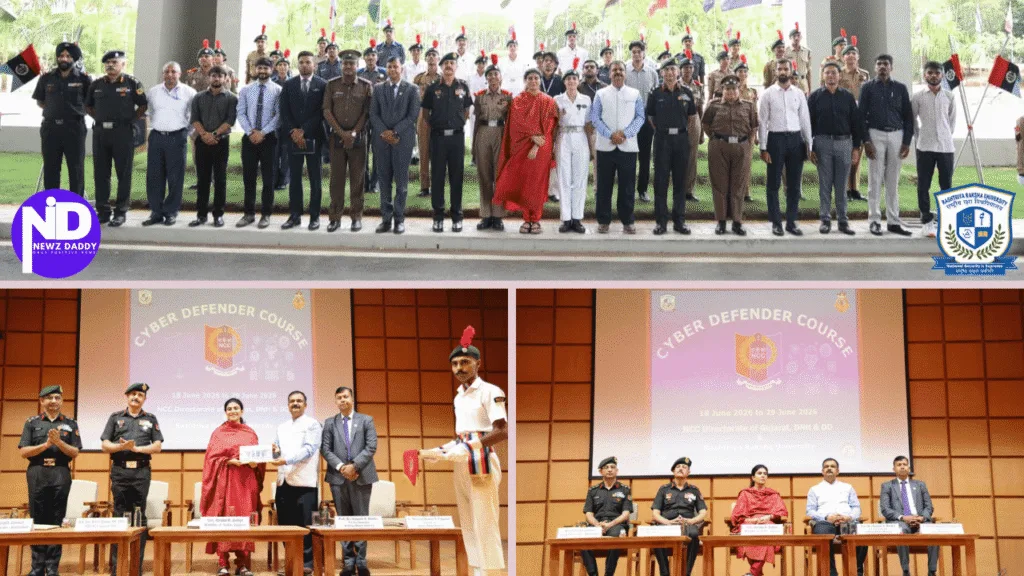
Cyber Defender Course Trains 160 NCC Cadets at RRU
Cyber Security Training at Rashtriya Raksha University Brings NCC Cadets Into India’s Digital Defence Effort
More than 160 National Cadet Corps (NCC) cadets from Gujarat, Maharashtra and Rajasthan are taking part in a specialised cyber security training programme at Rashtriya Raksha University (RRU) in Gandhinagar, reflecting a growing national focus on preparing young people for threats in the digital world.
The 12-day Cyber Defender Course (CDC), running from 18 to 29 June 2026, has been organised by the NCC Gujarat Directorate in collaboration with the National Institute of Electronics and Information Technology (NIELIT). The programme brings together Senior Division (SD) and Senior Wing (SW) cadets for 60 hours of classroom learning, practical exercises, and cybersecurity awareness training.
The course comes at a time when cyber attacks, online fraud and data breaches are affecting governments, businesses and ordinary citizens across the world. India has also seen a steady rise in cybercrime complaints in recent years, making digital awareness and cyber hygiene an increasingly important skill for young people.
According to organisers, the programme is being conducted under the guidance of Maj: Gen. Bimal Monga, SM, VSM, Additional Director General of the NCC Gujarat Directorate. Expert trainers and faculty members from NIELIT are delivering the sessions.
Participants are receiving instruction in cybersecurity fundamentals, Linux operating systems, the CIA Triad of confidentiality, integrity and availability, ethical hacking, penetration testing, cyber laws, reporting procedures, smartphone security, cyber fraud prevention and safe digital banking practices. The course also includes simulation exercises designed to help cadets identify and respond to cyber incidents.
Cybersecurity has become a major area of concern for governments worldwide. Attacks on public institutions, financial systems and critical infrastructure have increased the demand for trained professionals who understand both technology and security. While specialised cyber professionals are essential, experts increasingly argue that broad public awareness is equally important because many attacks begin with simple mistakes such as weak passwords, phishing emails or fraudulent messages.
The NCC, one of the largest uniformed youth organisations in the world, has been expanding opportunities for cadets beyond traditional military-style training. Programmes covering technology, disaster management, environmental protection and community service have become an important part of its activities. The Cyber Defender Course reflects that wider effort to equip cadets with skills relevant to present-day security challenges.
NIELIT, which functions under the Ministry of Electronics and Information Technology, has played a significant role in technology education and digital skills training across India. The organisation operates centres across the country and has been involved in several government initiatives aimed at improving digital literacy and information technology skills. Its participation in the course brings technical expertise to a programme that combines cyber awareness with youth development.
The venue for the training is Rashtriya Raksha University, a national institution located in Gandhinagar. Established originally as Raksha Shakti University and later upgraded through an Act of Parliament, RRU focuses on national security, policing, cyber security, forensic sciences and internal security studies. Over the past few years, the university has expanded its role in training security professionals, researchers and students in emerging fields linked to public safety and national security.
University officials provided campus facilities, classrooms, infrastructure and logistical support for the programme. The institution’s leadership said the initiative aligns with its broader educational mission of preparing future professionals for security-related challenges.
The course was formally inaugurated by Smt. Rivaba Ravindrasinh Jajeja, Minister of State for Primary, Secondary and Adult Education, Government of Gujarat.
The inaugural event was attended by several senior officials and university representatives, including Maj. Gen. Bimal Monga, SM, VSM, Additional Director General, NCC Gujarat Directorate; Brig. S. S. Jamwal, Group Commander, NCC Group Headquarters, Ahmedabad; Col. Muneesh Jasotia, Commanding Officer, 37 Gujarat Battalion NCC; Prof. (Dr) Kalpesh H. Wandra, Pro Vice-Chancellor, Rashtriya Raksha University; Dr Dharmesh Kumar Prajapati, Registrar, Rashtriya Raksha University; and Lt. (Dr.) Gaurav Singh Kushwah, Director, School of NCC and Police Martial Music Band, Rashtriya Raksha University.
At the university level, coordination responsibilities have been handled by the School of NCC and the Police Martial Music Band. The team is led by Lt. (Dr.) Gaurav Singh Kushwah, supported by faculty members, Lt. (Dr.) Ruchika Singla, CTO, Mr Yash Sharma and other members of the school.
Training exercises are intended to help cadets understand both the technical and social aspects of cyber threats. Organisers say participants are being encouraged to think about responsible online behaviour, ethical conduct and the protection of digital resources. Such topics have gained importance as more daily activities, including education, banking, communication and government services, move online.
Cyber fraud remains one of the fastest-growing forms of crime in India. Fraudsters frequently target people through fake investment schemes, phishing messages, impersonation calls and fraudulent payment requests. Awareness programmes are increasingly viewed as a first line of defence, particularly for young people who spend significant time on digital platforms.
The inclusion of cyber laws and reporting mechanisms in the curriculum is also notable. Security experts often point out that many cybercrime victims either do not know where to report incidents or fail to act quickly enough after becoming targets. Training in these areas can help participants recognise threats and respond appropriately.
Another important aspect of the programme is its regional participation. Cadets from three states are learning together, creating opportunities to exchange experiences and develop networks that may prove valuable in future educational, professional or public service roles.
India’s growing digital economy has increased demand for cybersecurity knowledge across sectors. Government agencies, financial institutions, technology companies and educational organisations are investing heavily in cyber awareness and cyber defence capabilities. Programmes such as the Cyber Defender Course are part of a wider effort to build a workforce and citizen base that can operate safely in an increasingly connected environment.
For the NCC cadets attending the programme, the lessons extend beyond technical skills. The training introduces them to a field that is becoming central to national security and public safety. As cyber threats continue to evolve, organisers hope the participants will carry these lessons back to their communities, helping others recognise risks and use digital technologies more safely.
By combining youth training, technology education and security awareness, the Cyber Defender Course illustrates how educational institutions, government agencies and national organisations are working together to address challenges that did not exist a generation ago. In a country where digital services are expanding rapidly, such efforts are likely to become a larger part of preparing young citizens for the future.
Must Read:
RRU West Bengal Police MoU to Strengthen Police Training
RRU AI Training for Punjab Police Covers Claude and AI Tools