


Defence Secretary Bhuj Visit Highlights India’s Border Power
Defence Secretary visits Forward Areas in Bhuj – witnesses Jointness, Infrastructure Development and Capability Building Initiatives
Defence Secretary Shri Rajesh Kumar Singh visited forward areas in the Creek Sector in Bhuj, Gujarat, on 04-05 February 2026. He interacted with Lt. General Dhiraj Seth, General Officer Commanding-in-Chief, Southern Command and other senior officers of the Konark Corps. He was briefed on various initiatives being undertaken in line with the Indian Army’s Decade of Transformation Roadmap, transforming the Indian Army into a technologically advanced, combat-ready force capable of undertaking multi-domain operations.
Such visits by the Defence Secretary, Rajesh Kumar Singh, play a key role in connecting national policy with ground reality. The Creek Sector near Bhuj is one of the most sensitive border regions in the country, with a mix of marshland, coastline and desert terrain. This geography demands constant readiness and smart use of technology. The interaction with Lt. General Dhiraj Seth and senior officers of Southern Command and Konark Corps reflects the importance of leadership-level coordination in modern warfare. The Decade of Transformation Roadmap of the Indian Army focuses on faster decision-making, better use of drones and sensors, and stronger coordination between land, sea, air, space and cyber domains.
The Defence Secretary visited the Joint Control Centre, jointly manned by the Tri-Services, Indian Coast Guard, BSF and other security agencies. The centre aims at synergising the multi-source sensor inputs in the region to deliver a unified surveillance picture and enhance situational awareness for ground commanders.
Joint Control Centres are becoming the backbone of border and coastal security in India. By bringing together personnel from the Army, Navy, Air Force, Indian Coast Guard and Border Security Force, such centres reduce delays and confusion during fast-moving situations. In regions like the Creek Sector, threats can come from land, sea or air within minutes. A shared surveillance picture helps commanders see the same information at the same time, leading to quicker and safer responses. This system also supports disaster response, search and rescue missions, and tracking of illegal activities along the coast.
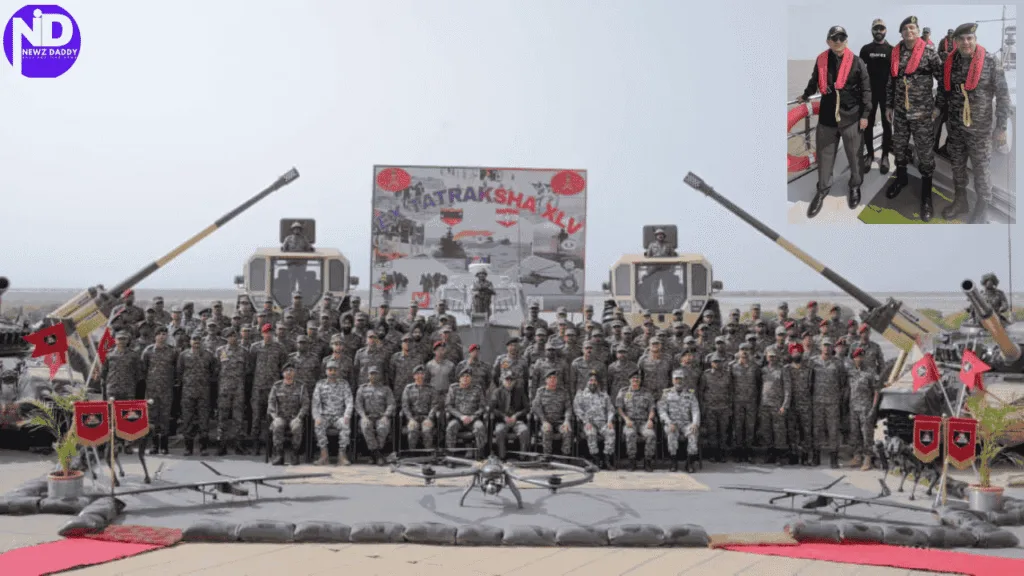
Shri Rajesh Kumar Singh witnessed the multi-agency capability Exercise ‘TATRAKSHA’, showcasing seamless integration of the Indian Army, Indian Navy, Indian Air Force, Indian Coast Guard, BSF, and allied security agencies in coastal and amphibious operations. The exercise displayed real-time surveillance, precision strikes, joint logistics and rapid response capabilities to handle emerging maritime and border threats, validating decisive integrated capability for a full spectrum of operations.
Exercises like TATRAKSHA are designed to test how well different forces work together under pressure. The participation of the Indian Navy and Indian Air Force, along with land and coastal forces, highlights India’s focus on joint warfare. Real-time surveillance often involves satellites, drones and coastal radars, while precision strikes rely on accurate intelligence and modern weapon systems. Joint logistics ensures that fuel, food, ammunition and medical support reach the right place on time. These drills also help younger officers and soldiers understand each other’s roles, which is vital during real operations.
The Defence Secretary inaugurated the Monumental Flag, symbolising national pride and unity in the border region, and also witnessed a comprehensive operational display of new-generation weapon systems.
Large national flags in border areas serve as strong symbols for both troops and local communities. They remind people living in remote regions that the nation stands firmly with them. For soldiers posted in harsh conditions, such symbols boost morale and a sense of purpose. The display of new-generation weapon systems shows the steady shift towards modern, lighter and more accurate equipment. Many of these systems are designed to work with digital networks, allowing better coordination and reducing risks to soldiers during operations.
The visit reaffirmed the Government’s continued focus on strengthening jointness, enhancing infrastructure, promoting indigenisation and developing future-ready, resilient and technologically advanced Armed Forces.
This message aligns closely with the long-term defence vision of the Government of India. Strengthening jointness reduces duplication and improves efficiency across services. Infrastructure development in forward areas includes better roads, communication networks, living facilities and medical support, which directly affect operational readiness. Indigenisation supports Indian industry, creates jobs and reduces dependence on imports. Together, these efforts aim to build Armed Forces that can respond quickly, adapt to new threats and protect national interests in a changing security environment.