


Farmer Protest Over Transmission Lines Sparks Debate in Gujarat
Congress is Framing The Issue As A Farmer Rights Fight, Not Only a Local Protest
Gujarat’s Kisan Congress is preparing a new phase of protest over transmission lines crossing farmland, with leaders saying they will begin a foot march from Vrajvani in Kutch on 26 June and end at Dwarkadhish in Dwarka. The move follows last week’s tractor rally, which the organisers described as a major show of support for farmers affected by power projects and land rules.
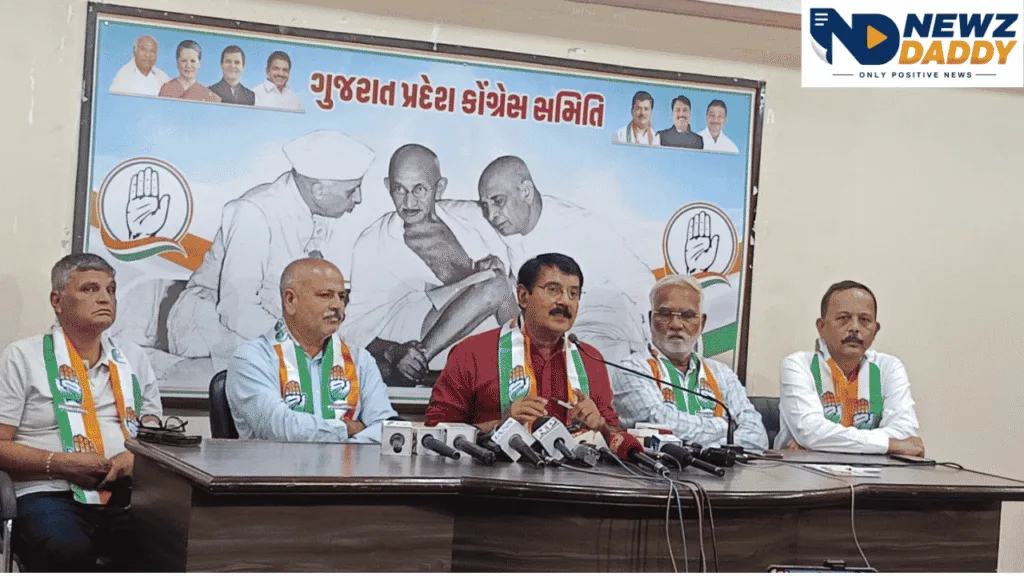
At a press conference in Ahmedabad, Kisan Congress leaders Palbhai Ambaliya, Mahesh Rajkotia, Seva Dal national president Laljibhai Desai and Gujarat Pradesh Kisan Congress president Jayesh Patel set out their next steps. They said the march is meant to press for changes in how the state handles transmission lines, compensation and land use, and they said the campaign will continue until farmers get what they call fair treatment.
The dispute centres on power lines running across fields in Kutch, Jamnagar, Morbi and nearby districts. According to the leaders, notices have been issued to farmers in 14 districts, while work has started in six districts, pushing many cultivators to return to Gandhinagar to press their case. They say the government should use desert or barren routes where possible, rather than taking lines through fertile land.
Vrajvani, the starting point of the march, is in Kutch and sits near the village of Movana. A 1200 kV substation has been built there, and the current line runs through Lakadiya, Samkhiyali and Maliya. The organisers say that route affects productive farmland and that alternative paths through desert areas were available but not used.
They have raised a similar objection to two Reliance lines of 765 kV and 800 kV. The proposed route, they say, runs from Maliya through Nani Barar and Keshia to Balpura across fertile land. They argue that another route could be taken from Maliya to Navlakhi, then Jodia, and along the seashore to Sikka, using barren land instead. They say this alternative route was sent to the collectors of Jamnagar, Kutch and Morbi six months ago, and to the Jamnagar collector two months ago, but no change has been made.
The issue is not new in Gujarat. The state government revised its Right of Way compensation rules in 2024, with power corridor land compensated at 200% of the jantri rate and corridor area compensation later described as applying to 25% of the land area instead of 15%. Earlier reports also noted that affected farmers had been getting compensation linked to 7.5% of land value before the rise to 15%, showing that the policy has changed more than once in recent years.
That background matters because the 2013 Land Acquisition law, which the leaders cite, is built around stronger compensation and rehabilitation rules than the older law it replaced. Official summaries of the law say rural landowners are generally entitled to four times market value, with added provisions for consent, rehabilitation and resettlement. The leaders are using that legal benchmark to argue that any power project taking farmland should pay a much higher amount than they believe is currently offered.
The demands they listed are specific. They want four times the market price under the 2013 Land Acquisition Act, a monthly rent of 50,000 per power pole and a one-time settlement of 2 crore per pole. They say the fight will continue until those demands are met. In their view, the question is not only about money but also about whether farmers should carry the full burden of large infrastructure projects.
Laljibhai Desai said the next phase, called Kisan Yatra Part 2, will involve walking to Dwarkadhish and offering a flag as part of a prayer that the government be given good sense. He said more than 100 lines are being laid, carrying 1 to 2 gigawatts of power, and asked how many lines would be needed if 130 gigawatts had to pass through the system. He also said that if there are more than 100 power lines, the route could stretch to 500 km and involve 1.50 lakh electric poles in the fields.
Jayesh Patel added that Gujarat will produce many times more electricity than it needs and that some of it will leave the state. He said 85 to 100 lines will pass through farms and that the purpose of the campaign is to explain the law to villages as the yatra moves forward. He said the group will hold discussions in every village it passes through, focusing on the damage power poles can cause to farming land and livelihoods.
The planned march adds a fresh political layer to a long-running land debate. The Congress is presenting it as a farmers’ rights campaign, while the state is likely to defend the projects as part of power transmission and energy planning. For farmers in Kutch and other districts, the immediate concern is practical: whether the route, compensation and consultation process can be changed before more fields are affected.
A large convention in Dwarka will mark the end of the march, after which the organisers say they will offer the flag to Lord Dwarkadhish and pause the yatra. The movement’s next steps now depend on how far the state is willing to negotiate over route changes, compensation and the wider impact of transmission lines on farmland.
Also Read:
AAP Gujarat Launches Mission 2027
Gujarat Youth Congress Holds Torch Rally Over NEET Paper Leak