


GIFT City hosts India Aircraft Leasing & Financing Summit 2.0
GIFT City Aircraft Leasing Gains Strong Push With Bold Policy And Growth Vision
Union Civil Aviation Minister Rammohan Naidu Kinjarapu says the number of aircraft being leased from GIFT City to double in two years
Gandhinagar: The Ministry of Civil Aviation, Government of India (MoCA), in association with FICCI and with the support of International Financial Services Centres Authority (IFSCA), on Friday organised the India Aircraft Leasing & Financing Summit 2.0 at GIFT City, reinforcing India’s ambitions to emerge as a global aviation leasing and financing hub.

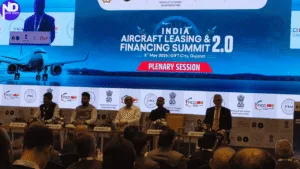
The summit came at a time when many countries like Ireland and Singapore, dominate aircraft leasing. India has been trying to reduce its dependence on such foreign hubs. Experts believe that if India builds its own leasing ecosystem, airlines can save costs and reduce currency risks.
The summit aimed to strengthen GIFT IFSC’s position in aircraft leasing and aviation finance by facilitating dialogue among policymakers, investors, financial institutions, airlines, lessors and global aviation stakeholders. The event also focused on leveraging global best practices to accelerate capital participation and develop GIFT IFSC into a globally competitive aviation financing jurisdiction.
In recent years, GIFT IFSC has already attracted several leasing firms. Industry data shows over 25 leasing entities have set up operations there. This is still small compared to global leaders, but the growth is steady and encouraging.
Addressing the summit, Gujarat Chief Minister Shri Bhupendra Patel said India’s aviation sector was witnessing unprecedented growth under Prime Minister Narendra Modi’s leadership.
India’s domestic air travel has grown sharply in the past decade. Passenger numbers have more than doubled since 2014, and airports across the country are being expanded to handle rising demand.
“Under PM Modi’s leadership, India is flying with a new confidence. GIFT City has established a distinct identity in India’s fast-growing global fintech segment. The summit will further boost the growth of India’s aviation sector,” Patel said.
He said Gujarat was emerging as a key hub for aviation-linked growth opportunities, including aircraft manufacturing, pilot training, advanced mobility and aircraft leasing.
Many aviation training schools and drone technology companies are also coming up in Gujarat. This shows that the state is not focusing only on leasing but building a full aviation ecosystem.
“GIFT City is playing a central role in aircraft leasing. In this year’s Union Budget, the Prime Minister extended the tax holiday for aircraft leasing companies in GIFT IFSC to 20 years. A majority of India’s aviation fleets are currently leased from overseas. For an Atmanirbhar Bharat, we have to ensure that this leasing happens from GIFT City,” he said.
Experts say tax benefits are key to attracting global players. Countries like Ireland became leaders in leasing mainly because of strong tax policies. India is now following a similar path.
Chief Minister Shri Bhupendra Patel said more than 370 assets worth USD 5.8 billion had already been leased through GIFT City and highlighted Gujarat’s expanding airport infrastructure, including the Dholera Greenfield Airport project.
The Dholera airport is expected to support cargo and passenger traffic in the future. It will also help industries in the region grow faster.
Union Civil Aviation Minister Shri Rammohan Naidu Kinjarapu said India had emerged as the world’s third-largest domestic aviation market and leasing would play a critical role in sustaining future growth.
Globally, India is one of the fastest-growing aviation markets. Reports suggest that by 2030, India could become the third-largest overall aviation market, not just domestic.
“Today, around 85% of the aircraft in our scheduled fleet are on lease. With aviation demand in India increasing rapidly, we want to ensure that this leasing activity happens within India itself, especially from GIFT City,” he said.
This high leasing percentage shows how dependent Indian airlines are on foreign companies. Bringing leasing to India can help airlines save millions in the long run.
The minister noted that the Government of India had undertaken several reforms to strengthen the leasing ecosystem, including ratification of the Cape Town Convention and related legislative reforms.
The Cape Town Convention gives legal protection to lessors. It makes it easier to recover aircraft in case of payment defaults. This step has improved investor confidence in India.
Highlighting the government’s long-term aviation vision, the minister announced that the UDAN regional connectivity scheme would be extended for another 10 years with an investment of around Rs. 29,000 crore, including the development of nearly 200 heliports across the country.
UDAN has already connected many small towns to air travel. With expansion, more people in remote areas will get access to flights, increasing demand for aircraft.
Shri Jürgen Westermeier, Chairman of FICCI Civil Aviation Committee, President & MD, Airbus India and South Asia, said India’s aviation and aerospace sector was poised for significant long-term expansion, driven by strong passenger growth and record aircraft orders.
Airbus and Boeing together have received record orders from Indian airlines in recent years. IndiGo and Air India alone have ordered over 1,000 aircraft combined.
“Developing a robust indigenous leasing and financing infrastructure is playing a significant role in helping India emerge as an integrated aviation destination not only for the region but also for the world,” he said.
He noted that India’s air passenger traffic was expected to grow at a CAGR of nearly 9% over the next decade, while aircraft financing requirements could reach USD 170–200 billion over the next 10 years.
Such large funding needs cannot depend only on foreign markets. This is why building local financing systems is important.
“India’s order backlog currently stands at over 1,600 aircraft, more than double the existing flying fleet. Clearly, the scale of opportunity is immense for both Indian and international lessors and financiers,” Westermeier said.
He welcomed India’s ratification of the Cape Town Convention, calling it a significant step towards modernising aviation financing in the country.
During the summit, multiple announcements and MoUs involving IndiGo, Air India, Star Air, Akasa Air, Bank of India and IFSCA were signed, signalling growing momentum in India’s aircraft leasing ecosystem.
Such partnerships show that both airlines and financial institutions are ready to support the shift towards domestic leasing.
The event also featured sessions on “Establishing Aircraft Lessor Ecosystem in GIFT IFSC” and “Bridging Financial Gaps: Unlocking Growth in Aviation Financing through Policy & Investment”.
Industry experts often point out that access to low-cost finance is still a challenge in India. These discussions aim to solve that issue.
Shri K Rajaraman, Chairperson, IFSCA, Shri Samir Kumar Sinha, Secretary, Ministry of Civil Aviation and Amit Ray, Senior Economic Advisor, Ministry of Civil Aviation, also spoke at the summit.
Also Read:
India Aviation Security Testing Centre: A Big Step in New Delhi
SVPIA Embarks on Aviation Security Culture Week to Honour Dedicated Guardians