


Govardhan Puja Draws Devotees to Bhadaj Temple in Ahmedabad
Govardhan Puja at Bhadaj Temple Draws Devotees for Annakuta Offering and Cow Worship
Hare Krishna Mandir in Bhadaj, Ahmedabad, celebrated Govardhan Puja and Annakuta Mahotsav on Tuesday, November 10, as part of its month-long Kartik Deepotsav celebrations. The festival brought devotees together for religious ceremonies based on the story of Lord Sri Krishna lifting Govardhan Hill to protect the people and cows of Vrindavana from heavy rainfall sent by Indra.
The celebrations included an elaborate Annakuta food offering, worship of cows, devotional singing and a procession carrying the deities of Sri Sri Radha Madhav on a golden chariot. A specially prepared replica of Govardhan Hill, surrounded by a large collection of vegetarian food preparations, formed the main attraction of the religious gathering.

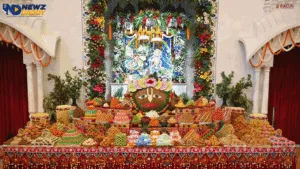
More than 150 kinds of food items were offered during the ceremony, while the arrangements also included cakes, cookies and sweets prepared in the temple bakery. According to the temple, these preparations included more than 1,008 varieties and were made entirely from vegetarian ingredients.
Swami Sri Jaganmohan Krishna Das, President of Hare Krishna Mandir, Bhadaj, explained the religious background of the festival while addressing devotees.
He said, “When the Supreme Lord Sri Krishna saw the residents of Vrindavana preparing for Indra-yajna, He suggested that they should forgo the worship of Indra and instead worship the Govardhana Hill. Knowing this, Indra became angry and sent a devastating rainfall over Vrindavana. Krishna picked up the Govardhan Hill held it up on the little finger of His left hand like an umbrella for 7 days and gave shelter to all the inhabitants of Vrindavana. Indra became conscious of his offense and begged for forgiveness from Krishna. Thus, the Supreme Lord established that a devotee who is surrendered to the Supreme Lord and engaged in devotional service is free from all obligations and need not worship any demigods for material favor.”
The story is known as Govardhana Lila and is described in the Tenth Canto of the Srimad Bhagavatam, particularly Chapters 24 and 25. According to the religious account, the residents of Vrindavana had been preparing a traditional sacrifice for Indra, who was associated with rainfall. Krishna questioned the need for the ceremony and asked the villagers to honour Govardhan Hill, the cows and the natural surroundings that supported their lives.
The residents followed Krishna’s advice and prepared food offerings. Indra became angry after learning that the traditional worship had been stopped. He sent powerful rain clouds over the region, causing heavy rainfall and threatening the residents and their cattle.
Krishna then lifted Govardhan Hill with the little finger of His left hand. The people and their animals took shelter beneath it for seven days. When Indra realised his mistake, he stopped the rainfall and sought Krishna’s forgiveness.
Within the Vaishnava tradition, this account forms the religious basis of Govardhan Puja. The festival is observed during the Kartik month, following Diwali, and is also known as Annakuta. The word Annakuta refers to a mountain or large collection of food offered to the Lord.
At Hare Krishna Mandir, the festival began with the recreation of Govardhan Hill on the temple premises. Devotees arranged the food preparations around the replica, creating a representation of the offerings described in the traditional account. The temple’s collection of cakes, cookies and sweets attracted attention, particularly because devotees prepared these items in the temple bakery.
The Annakuta offerings were presented to the deities of Sri Sri Radha Madhav and Sri Govardhanji. A Maha Arati followed the offering ceremony. During the prayers, devotees sang Sri Govardhanashtakam, a collection of eight verses praising Govardhan Hill.
Another part of the celebrations focused on the worship of cows. In the Krishna tradition, the Lord is also known as Gopala, the protector of cows. Cattle hold an important place in the religious and cultural traditions associated with Vrindavana, where cow rearing and dairy products form part of the traditional way of life described in the scriptures.
The temple organised Go-Puja as part of the programme. The cows were decorated with silk garments and offered jaggery and bananas according to traditional practice. Devotees then walked around the replica of Govardhan Hill, keeping the cows at the front of the procession. This ritual is known as parikrama, a practice in which worshippers walk around a sacred place as an act of devotion.
The celebrations also featured a procession of Their Lordships Sri Sri Radha Madhav on a Swarnratha, or golden chariot. Devotees accompanied the procession with Sankirtana, the collective chanting of Lord Krishna’s holy names. The procession added a public devotional element to the temple programme, with music and prayers forming part of the religious observance.
Food distribution followed the worship ceremonies. The cakes, cookies, sweets and other preparations offered during Annakuta were distributed among devotees as prasadam. In the Vaishnava tradition, prasadam refers to food that has first been offered to the Lord and is then shared among worshippers.
The programme ended with a Deepotsav Arati for the deities. The ceremony formed part of the temple’s Kartik Deepotsav, which is observed throughout the month of Kartik.
The annual celebration at Hare Krishna Mandir, Bhadaj, brought together several familiar elements of Vaishnava worship. The Govardhan Hill replica recalled the story of Krishna’s protection of Vrindavana, while Annakuta, Go-Puja, parikrama and prasadam distribution connected the religious account with established temple practices. The participation of devotees in preparing the food and conducting the ceremonies also remained an important part of the occasion.