


Gujarat Leads Emotional Shift in Correctional Administration
Correctional Administration Partnership Brings Powerful Reform and Hope Ahead
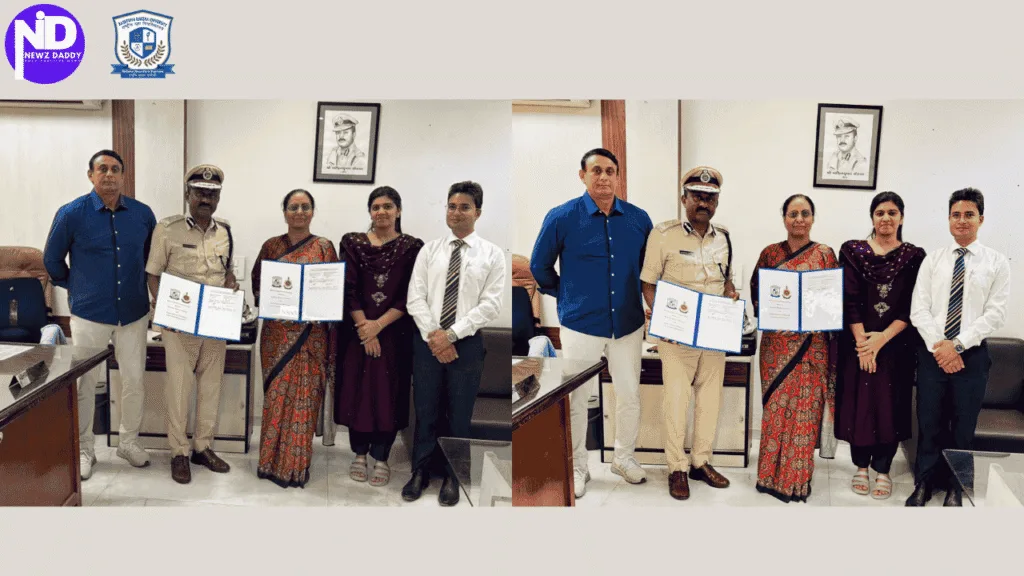
Rashtriya Raksha University and Gujarat Institute of Prisons & Correctional Administration Sign MoU to Transform Correctional Administration. In a significant step toward modernising correctional administration, Rashtriya Raksha University (RRU) and the Institute of Prisons & Correctional Administration (GIPCA), Gujarat, signed a Memorandum of Understanding (MoU) on 16th February 2026. In line with the Hon’ble Prime Minister’s mandate for Rashtriya Raksha University to emerge as a global leader in Correctional Administration during the Amrit Kaal, the MoU was signed under the leadership of Prof. (Dr.) Bimal N. Patel, Vice Chancellor, RRU and Dr K.L.N. Rao, IPS, Director General of Police, Prisons & Correctional Administration & CID, Gujarat State.
This agreement comes at a time when India is working hard to improve its prison system. Across the country, prisons have faced many challenges for years. According to recent government data, many prisons are overcrowded, and a large number of inmates are under trial, which means their cases are still in court. This creates pressure on prison staff and makes daily management difficult. Experts believe that better training, education, and research can help improve prison conditions and support both staff and inmates.
Rashtriya Raksha University has been given a special national role to work in areas such as policing, internal security, and correctional services. The university, which was recognised as an Institution of National Importance by the Government of India, was created to train future leaders in security and criminal justice. It already offers courses in criminology, forensic science, and behavioural studies. These subjects help people understand criminal behaviour, mental health, and rehabilitation. This is important because modern correctional systems focus not just on punishment, but also on helping inmates return to society as responsible citizens.
The MoU was formalised at the office of the Director General of Prisons & Correctional Administration, Ahmedabad, in presence of Shri A. G. Chauhan, IPS, IGP (Prison), Ahmedabad, and Shri Jitendra Mahipal Yadav, ACP & Principal, GIPCA and from RRU, Dr. Jasbirkaur Thadani, Dean, University; Dr. Noorin Chaudhary, Director, School of Behavioural Sciences and Forensic Investigations and Dr. Geetesh Kumar Singh, Project Director, Global Correctional Administrative Studies.
The presence of senior police and academic leaders shows how serious this effort is. Correctional administration is not only about security. It also includes mental health care, counselling, education, and skill development. Around the world, many countries are improving their prisons by using trained professionals, psychologists, and social workers. India is also moving in this direction. Gujarat, in particular, has taken steps such as skill training programmes for inmates, including carpentry, tailoring, and handicrafts. These programmes help inmates learn skills that can help them find work after release.
This MoU was signed to establish a comprehensive framework for collaboration in academic, research, training and extension activities to achieve correctional excellence. This involves affiliating and accrediting existing programmes, developing specialised academic and training programmes for correctional staff, conducting joint research on technology and innovative rehabilitation to inform policy reforms, and organising conferences and workshops for continuous learning to address emerging challenges in correctional practices.
Training prison staff is very important because their role has become more complex over time. In the past, prison staff mainly focused on guarding inmates. Today, they also need to understand human behaviour, stress management, and conflict resolution. Many inmates come from difficult backgrounds, and proper handling can help reduce violence and improve prison life. Studies have shown that trained staff can better manage inmates and support rehabilitation.
Technology is also becoming a key part of prison reform. Modern prisons are using digital records, CCTV systems, and data tools to improve safety and management. Some prisons in India have started using video calls to help inmates stay connected with their families. This helps reduce stress and supports mental health. Research partnerships like this MoU can help bring new ideas and better systems into correctional services.
Research and workshops will also help in policy reform. When experts study prison systems, they can find problems and suggest solutions. This helps governments make better laws and policies. In recent years, there has been more focus on rehabilitation rather than only punishment. Programmes such as education, yoga, counselling, and vocational training have shown positive results in helping inmates change their lives.
By combining RRU’s academic and research strengths with GIPCA’s on-ground expertise and administrative experience, this partnership is set to significantly impact correctional reform in Gujarat and serve as a model nationally.
This partnership is important because it connects theory with real-life experience. Universities bring research and knowledge, while prison departments bring practical understanding. Together, they can create better training, better policies, and better outcomes.
Experts believe that such partnerships can shape the future of correctional administration in India. With proper training, research, and innovation, prisons can become places of reform and positive change, rather than only places of punishment. Gujarat’s move may inspire other states to take similar steps.
As India moves forward in the Amrit Kaal period, efforts like this show the country’s focus on building modern, humane, and effective correctional systems. This MoU is not just an agreement between two institutions. It is part of a larger vision to improve the justice system and create safer and stronger communities.
Must Read:
Rashtriya Raksha University MoU with SSB Supaul Transforms Training