


Rashtriya Raksha University MoU with SSB Supaul Transforms Training
Newz Daddy Educational Updates
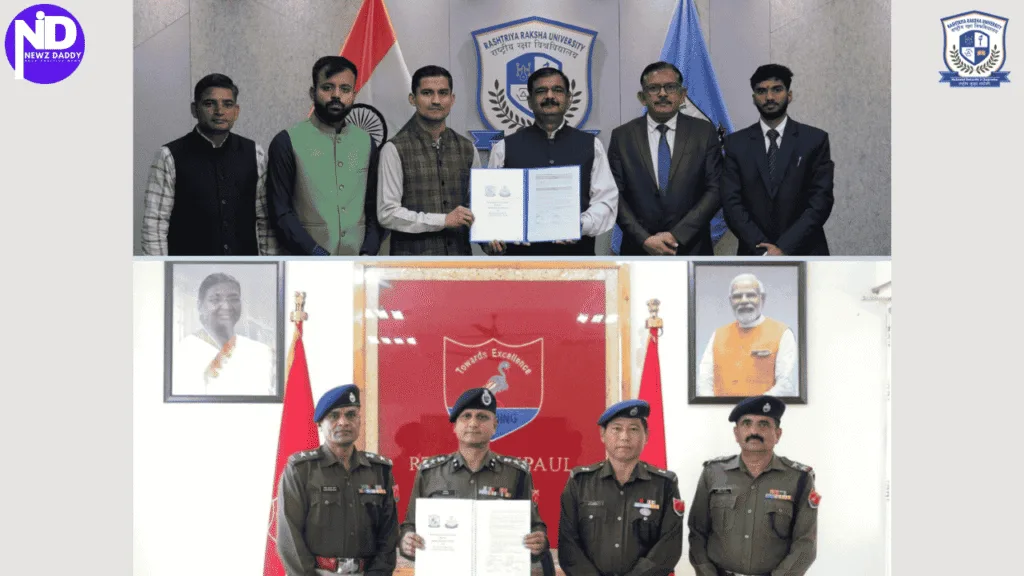
Rashtriya Raksha University and RTC, Sashastra Seema Bal, Supaul, Bihar Sign MoU To Strengthen Training and Academic Collaboration In National Security
In a landmark development for police education and capacity building, Rashtriya Raksha University (RRU), Gandhinagar, Gujarat, has executed two significant agreements with the Recruit Training Centre (RTC), Sashastra Seema Bal (SSB), Supaul, Bihar.
This move is important because training in the security forces is often practical and field-based. By linking it with academic credits, the learning now gets formal value. Across the world, many police and border forces are moving towards blended models, where classroom study and field drills go hand in hand. With this agreement, the training done at RTC Supaul can now be matched with university standards. This will help recruits if they wish to study further in the future or apply for higher roles.
RTC SSB, Supaul, undertakes recruitment and promotional courses for cadres. The affiliation will not only provide trainees with exposure to cutting-edge academic and professional modules but also enhance their preparedness to meet the evolving challenges of internal security, border management, and law enforcement with greater efficiency.
The Sashastra Seema Bal plays a key role in guarding India’s borders, especially along Nepal and Bhutan. Apart from border duty, the force also supports internal security and helps during elections and natural disasters. Training at centres like Supaul includes physical drills, weapon handling, law, human rights awareness, and border intelligence basics. With university support, these modules can now include research-based knowledge, case studies, and updated security strategies. This is vital at a time when threats are not just physical but also digital and cross-border in nature.
This agreement extends the successful model established at RTC SSB Alwar, which saw 391 recruits earn Diplomas in Internal Security and Border Management, alongside our strategic work with the CI&JW School in Gwaldam on Training Needs Assessments. By bringing these standards to Supaul, RRU is reinforcing its commitment to professionalising the force through unified academic rigour and accredited certification.
The Alwar model showed that structured academic input improves confidence and performance among recruits. When trainees receive a diploma, it gives them both pride and proof of their skills. The CI&JW School in Gwaldam, known for its focus on jungle warfare training, also worked on identifying what kind of skills modern forces need. Training Needs Assessments help security bodies update their syllabus based on real field demands. Bringing similar standards to Supaul means the training will stay current and not outdated.
Speaking on the occasion, Shri Sanjay Kumar Sharma, Deputy Inspector General, SSB, Supaul, emphasised the importance of this collaboration, highlighting that it will enable the initiation of joint training programmes, research, and development activities with RRU. Shri Manish Kumar Meena, 2nd-In-Command, and Shri Pappu Chakma, Dy. Commandants were present from the RTC SSB.
Joint programmes between a university and a security force can open many doors. Research in areas like border crime patterns, community policing, and the use of technology in surveillance can directly support field officers. It also allows officers to share real-life experience with students and researchers. This two-way learning often leads to better policies and smarter action on the ground.
Pro Vice Chancellor of RRU, Prof. (Dr.) Kalpesh H. Wandra, in his address, underlined the rapid growth of RRU in training, research, and extension activities. He stated that the partnership with SSB through this MoU is a remarkable step forward, strengthening the university’s mission of fostering knowledge-driven and practice-oriented learning. He further added that RRU and SSB will now be able to conduct more specialised and advanced training programmes together, nurturing leadership, innovation, and professionalism in security forces.
Since its establishment, RRU has focused on creating a strong link between academics and field practice. It offers courses in policing, cyber security, forensic science, and internal security. The idea is simple. Officers must not only be brave but also well-informed. Leadership in modern forces depends on understanding law, ethics, technology, and public relations. Specialised courses can prepare officers for roles in cybercrime units, intelligence wings, and border strategy teams.
Rashtriya Raksha University, an Institution of National Importance of India, Pioneering National Security and Police University of India under the Ministry of Home Affairs, Government of India, was established by the Parliament of India through Act No. 31 of 2020. The University aims to become an academic-research-training ecosystem for national security and the police. Its endeavours focus on highly professional national security, police education, research, and training through its qualified civilian and security faculty, committed human resources, motivated participants and students, intellectually stimulating and professionally disciplined environment, and worldwide network, sharing, and exchange.
As an Institution of National Importance, RRU holds a special status in India’s higher education system. This gives it the authority to design courses that meet national security needs. Being under the Ministry of Home Affairs ensures that its programmes align with real policy and operational priorities. With global partnerships and exchange programmes, the university also learns from international best practices.
The MoU with RTC SSB Supaul is not just a formal agreement. It signals a shift in how India views police and border training. By combining discipline, field skill, and academic strength, the country is building a smarter and more professional security force for the future.
Must Read:
SSB Guidance Workshop at RRU Shapes India’s Future Officers
International Olympic Research Conference Signals New Sports Era