


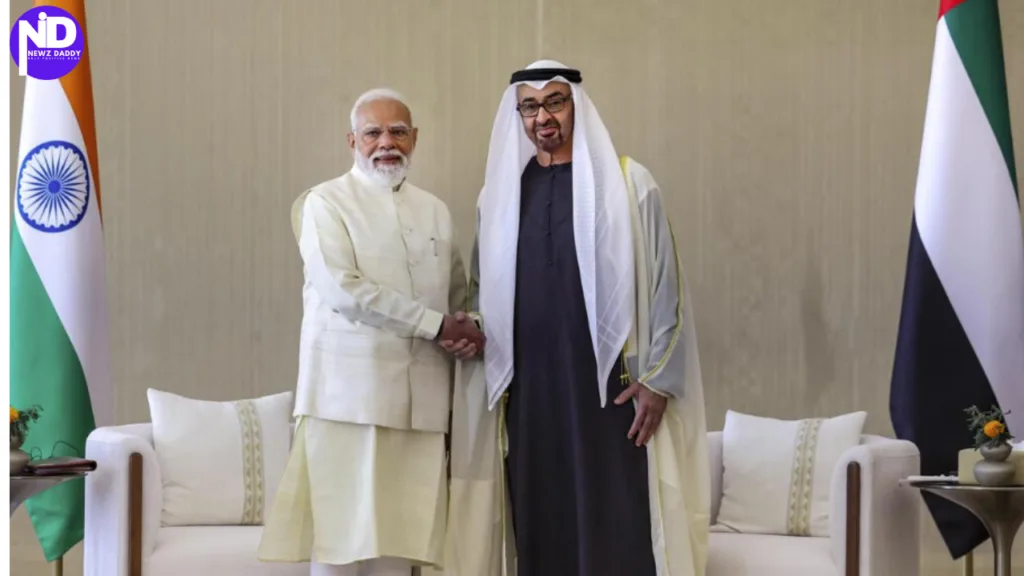
Historic India-UAE Partnership Wins Hearts Across UAE
Narendra Modi’s UAE Visit Sparks Emotional and Massive Investment Deals
Prime Minister Narendra Modi paid an official visit to the United Arab Emirates on Thursday, where he was welcomed by UAE President His Highness Sheikh Mohammed bin Zayed Al Nahyan at the airport. The visit came at a very important time for the region, especially with growing tension in West Asia and concerns over global energy supply and trade routes. During the talks, both leaders discussed security, trade, defence, investment and people-to-people ties, showing how the India-UAE relationship has grown stronger over the last few years.

Prime Minister Modi strongly condemned the recent attacks on the UAE and assured full support from India. He also stressed the need for safe and open shipping routes through the Strait of Hormuz. This narrow sea route is one of the world’s most important oil transport paths. A large amount of crude oil and gas used by India passes through this route every day. Experts believe that any disruption in the Strait of Hormuz can affect fuel prices, food supply and global trade. Recent reports from Reuters and other international media have also pointed out that rising tensions in the region are increasing pressure on energy-importing countries like India.
The two leaders reviewed the full range of bilateral ties and welcomed the growing Comprehensive Strategic Partnership between both countries. India and the UAE now work closely in energy, fintech, defence, infrastructure, education, culture and trade. The India-UAE Comprehensive Economic Partnership Agreement, known as CEPA, has become one of the strongest pillars of this relationship. Since the agreement came into force in 2022, trade between the two nations has crossed the 100 billion US dollar mark. Business groups and trade experts say the deal has helped Indian exporters, farmers, jewellers and small businesses get better access to UAE markets.
Trade growth between the two countries has been especially strong in sectors such as gems and jewellery, engineering goods, electronics and agriculture. Dubai has also become a major hub for Indian gold imports after lower tariffs under CEPA made trade easier. Industry reports show that Dubai’s share in India’s gold imports has risen sharply in recent years.
Energy security remained one of the biggest focus areas during the visit. India depends heavily on oil and gas imports, and the UAE continues to be one of India’s most trusted energy partners. Both countries agreed to deepen cooperation in crude oil, LNG and LPG supplies. The leaders welcomed the new Strategic Cooperation Agreement between Indian Strategic Petroleum Reserves Limited and Abu Dhabi National Oil Company. Under the deal, the UAE will increase its participation in India’s strategic petroleum reserves to 30 million barrels. Experts say this will help India during global oil supply crises and reduce the risk of fuel shortages.
This partnership is not new. The UAE was the first country allowed to store crude oil in India’s underground strategic storage facilities. Earlier agreements between ADNOC and Indian authorities helped store millions of barrels of oil in Karnataka. These reserves act like emergency savings for the country during times of crisis.
Another major outcome of the visit was the announcement of 5 billion US dollars in UAE investment into India. The investment includes support for infrastructure, banking and strategic projects. Analysts believe this shows long-term trust in India’s fast-growing economy. Over the past few years, the UAE has steadily increased investments in Indian roads, logistics, renewable energy and digital services. Economic experts say India and the UAE are now moving from a simple buyer-seller relationship to a wider partnership built on finance, technology and innovation.
Defence cooperation also received major attention during the talks. Both countries signed a framework for a comprehensive defence partnership. The agreement covers defence manufacturing, advanced technology, cyber defence, secure communication, training and maritime security. Security experts believe the growing partnership is important because both countries face similar challenges related to regional stability, sea route safety and cyber threats.
The visit also saw agreements related to shipbuilding and maritime skill development. Cochin Shipyard Limited and Drydocks World Dubai signed agreements to create a ship repair cluster at Wadinar. Another agreement focused on training skilled workers for the marine and ship repair sector. Industry leaders say India has the manpower and technical ability to become a major global hub for shipbuilding and ship repair in the coming years.
Technology and digital trade also formed an important part of the discussions. Both leaders welcomed the operation of the virtual trade corridor under the MAITRI platform. This system connects customs and port authorities digitally and helps reduce paperwork, transport delays and business costs. Experts say such digital systems can improve trade speed and make exports smoother for businesses in both countries. Reports from trade and business publications have described the India-UAE digital partnership as one of the fastest-growing economic corridors in the region.
Prime Minister Modi thanked President Sheikh Mohammed bin Zayed Al Nahyan for the warm welcome and hospitality. He also invited the UAE President to visit India soon. The visit once again showed how India and the UAE are building a strong partnership based on trust, trade, security and shared growth for the future.