


IAF Roadmap Guides Future Drone Needs At New Delhi Meeting
Indian Air Force Shares Long-Term Drone Requirements with 100 Industry Representatives
The Indian Air Force (IAF) met around 100 representatives from drone companies, start-ups, Micro, Small and Medium Enterprises (MSMEs) and other industry partners at Vigyan Bhawan in New Delhi on 21 October 2026, as it outlined its future needs for unmanned and autonomous systems. The meeting, chaired by Air Marshal Premkumar K, VM, VSM, Director General (Weapon Systems), Air Headquarters, gave the defence industry a clearer view of the technologies the Air Force expects to need in the coming years.

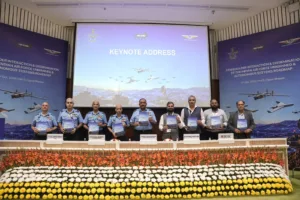
The programme also saw the distribution of the ‘IAF Roadmap booklet’ to industry representatives. The document sets out the Air Force’s long-term requirements in unmanned and autonomous systems, giving Indian manufacturers and technology developers a reference point for their future work.
The meeting followed the release of the ‘IAF Unmanned and Autonomous Systems Roadmap’ during IAF Dronathon 2026 at Pokhran on 14 September 2026. By taking the document directly to industry representatives, the Air Force has continued its effort to connect military needs with the work of Indian companies developing drone technology.
The meeting matters because modern air operations increasingly involve unmanned aircraft alongside conventional aircraft. Drones can carry out surveillance, gather information, support operations and perform tasks that may be difficult or risky for human crews. Autonomous systems can also carry out certain functions with less direct human control, depending on their design and the task assigned to them.
The IAF has not announced specific procurement contracts, budgets or delivery dates as part of the 21 October programme. Its stated purpose was to explain long-term capability requirements and share the roadmap with companies that may contribute to meeting them.
The roadmap envisages a layered, networked family of unmanned systems that can work alongside existing and future crewed aircraft. Such an approach allows different types of aircraft and drones to perform tasks suited to their size, equipment and operational role. The Air Force has stressed the need for reliable systems that can withstand difficult operating conditions and can work together as part of a wider network.
Indian companies will need expertise in several areas to meet these requirements. Indigenous propulsion systems, autonomous software, reliable navigation and standardised interfaces are among the technology fields identified by the IAF. These components matter because a drone’s usefulness depends on more than its airframe. Its engine or motor, sensors, communication equipment and software must work together under demanding conditions.
Reducing dependence on foreign suppliers is another stated aim. Domestic production can give the armed forces greater control over repairs, upgrades and the supply of important components. However, companies will need to meet military standards for performance, safety and reliability before their products can be used in operational service.
The 21 October meeting follows the first IAF Dronathon, held at the Pokhran Field Firing Range in Jaisalmer, Rajasthan, from 14 to 16 September 2026. Air Marshal Ashutosh Dixit, Vice Chief of the Air Staff, inaugurated the three-day event. More than 20 defence companies, start-ups, MSMEs, Defence Public Sector Undertakings and other innovators took part.
The Dronathon included demonstrations of unmanned aircraft systems, commonly known as UAS, and counter-unmanned aircraft systems, or CUAS. The tests covered surveillance, reconnaissance, autonomous operations, drone swarms, electronic warfare and technologies designed to detect or deal with hostile drones. The IAF said it wanted to assess how these systems performed in demanding conditions, rather than judge them on demonstrations alone.
During the event, the Air Force also demonstrated Vayu UTtaM, its indigenously developed multi-mode Unmanned Traffic Management system. The system detected and tracked military and civilian drones during a live demonstration at Pokhran. Its intended role includes helping manage drone movements in busy airspace and identifying unauthorised aircraft.
The wider Indian drone sector has also seen changes in civilian regulation and manufacturing policy. The Ministry of Civil Aviation introduced the Drone Rules, 2021, and later measures covering drone certification, training and operations. As of 17 October 2026, the ministry reported 44,577 registered drones and 178 type-certified drone models in India. These figures cover the wider civil drone sector and should not be treated as a count of military systems.
Defence research programmes also offer support to smaller manufacturers. The Defence Research and Development Organisation’s Technology Development Fund supports the development of defence and dual-use technologies by Indian firms, including start-ups and MSMEs. Such programmes can help smaller businesses work on equipment that may otherwise require large research budgets.
For companies attending the New Delhi meeting, the roadmap provides information about the Air Force’s future needs. It may help them decide which technologies to develop and where their skills could match military requirements. For the IAF, direct discussions with manufacturers offer a way to explain operational problems and understand what Indian industry can deliver.
The next test will be whether these discussions lead to systems that meet the Air Force’s needs in actual service. The 21 October programme set out priorities and distributed the roadmap, but the announcement did not identify selected suppliers, approved purchases or contract values. Those details will be needed to measure how the roadmap translates into equipment for India’s air defence and military operations.
Must Read:
IAF Dronathon 2026 Tests New Drone Systems at Pokhran Range