


IITRAM Seminar in Ahmedabad Covers AI and Fusion Research
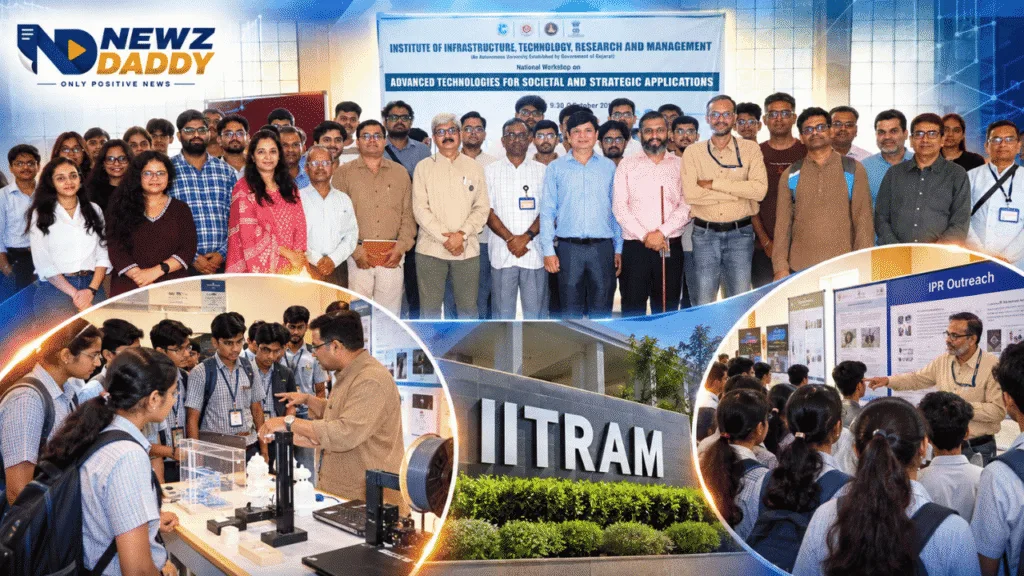
IITRAM Ahmedabad Holds National Seminar on Advanced Technologies; Around 150 School Students Visit IPR Exhibition
The Institute of Infrastructure, Technology, Research and Management (IITRAM), Ahmedabad, brought researchers, academics, industry professionals and school students together for a national programme on advanced technologies, with discussions covering artificial intelligence (AI), medical devices, electric drives, fusion research and defence materials.
The programmes were organised under the National Workshop on “Advanced Technologies for Societal and Strategic Applications” as part of Vikas Saptah 2026, an initiative of the Government of Gujarat, with support from the Knowledge Consortium of Gujarat (KCG).
Around 100 students, faculty members, researchers and professionals took part in two parallel one-day programmes, titled “Research, Innovation and Commercialisation” and “Plasma Science, Fusion Technology and IPR Outreach”. An exhibition on intellectual property rights (IPR) also drew around 150 school students from nearby schools to the IITRAM campus.
The programmes were held under the patronage of Dilip Kumar Rana, IAS, Commissioner of Higher and Technical Education, Government of Gujarat, and Chief Executive Officer of KCG; Dr Yogesh Yadav, Joint CEO of KCG; and Professor P. K. Jain, Director General of IITRAM.
The Research, Innovation and Commercialisation programme examined how research in engineering, computing and healthcare can move towards practical use.
Sessions covered computational intelligence in electric drives, the commercial use of research, medical devices, trustworthy and explainable AI, innovation and entrepreneurship in academic institutions, and the use of 3D printing, augmented reality (AR) and virtual reality (VR) in orthopaedic oncology.
Electric drives are used in machines that convert electrical energy into movement. Improvements in their control systems can help industries operate motors with better precision and energy use. Computational intelligence, which includes methods such as machine learning, can help engineers improve how these systems work.
The sessions on trustworthy and explainable AI addressed another area of growing interest. AI systems are increasingly used to process information and support decisions. In fields such as healthcare, users need to understand how a system reaches its conclusions, particularly when those conclusions may affect patient care.
Medical devices and orthopaedic oncology also featured in the discussions. Orthopaedic oncology deals with cancers affecting bones and soft tissues. Technologies such as 3D printing can help produce models and customised medical components, while AR and VR can support medical planning, training and visualisation.
The programme also examined research commercialisation, which involves taking a research result beyond the laboratory and developing it into a product, service or process that can be used in the market. The subject connects academic work with businesses, manufacturers and potential users.
For universities and research institutions, this process raises practical questions about funding, intellectual property, product development and industry partnerships. The IITRAM sessions brought these issues into discussions with researchers and professionals.
Plasma is a state of matter in which a gas contains charged particles. It is found in stars, including the Sun, and is used in several scientific and industrial processes. Scientists study plasma to understand how it behaves under different conditions and how it can be used in future energy systems.
Fusion research examines ways to produce energy by joining light atomic nuclei. The Sun generates energy through natural fusion reactions. Scientists are studying how to control similar reactions on Earth, with the long-term aim of developing another source of electricity.
Tokamaks are machines designed to confine very hot plasma using powerful magnetic fields. Research in this area involves several engineering challenges, including controlling plasma, managing extreme temperatures and developing equipment that can operate under difficult conditions.
Cryogenic systems, which work at extremely low temperatures, are used in some fusion technologies, particularly to cool superconducting magnets. Remote handling systems help workers operate or maintain equipment in places where direct access may be difficult.
The programme also included discussions on inverse heat transfer, which involves estimating heat conditions from measured data, and sustainable machining, which looks at ways to reduce waste, energy use and environmental harm during manufacturing.
Advanced materials for defence applications formed another part of the programme. Materials used in defence equipment must meet demanding requirements, including strength, heat resistance and durability. Research in this area can support the development of equipment for challenging operating conditions.
The IPR Outreach Exhibition gave school students an opportunity to see scientific models and demonstrations at IITRAM and its IPR Gallery.
Around 150 students from nearby schools visited the exhibition, where they were introduced to intellectual property, scientific research and technological developments.
Intellectual property rights protect creations of the mind, including inventions, designs, written works and certain forms of business identity. Patents, copyrights, trademarks and industrial design rights are among the legal protections available to creators and inventors.
For young students, learning about IPR can help explain how an idea becomes an invention and how inventors can protect their work. Demonstrations and working models can also make scientific subjects easier to understand.
The exhibition was intended to encourage interest in science, technology, research and innovation among schoolchildren. It also introduced them to the role of research institutions in developing new ideas and technical solutions.
Established by the Government of Gujarat in 2013, IITRAM is an autonomous university based in Ahmedabad. It offers undergraduate and postgraduate courses in engineering, along with doctoral programmes in engineering, basic sciences, humanities and social sciences.
Its academic work covers areas such as civil engineering, mechanical engineering, electrical engineering and computer engineering. The institute also has research facilities and laboratories for activities linked to manufacturing, materials, robotics, electrical systems and other technical fields.
The October programmes reflected the range of subjects studied across academic and research institutions. The discussions included topics relevant to manufacturing, healthcare, energy research, artificial intelligence and defence technology.
The participation of researchers, faculty members, professionals and students created opportunities for exchanges between people working in different fields. Research institutions often depend on such interaction to identify practical problems, discuss technical methods and explore possible applications of scientific work.
For Ahmedabad’s academic community, the programmes also offered a platform to discuss research areas that extend beyond traditional classroom teaching. The presence of school students added an educational element to the event.
The two programmes concluded with discussions and activities focused on research, technology and their possible uses in society and strategic sectors. Their subjects ranged from industrial applications and medical technology to plasma physics and intellectual property, reflecting the variety of work taking place in modern engineering and scientific research.
Must Read:
Repertus 2K26 IITRAM Powers Future Civil Engineers
IITRAM-CIPET MoU Opens New Academic and Research Opportunities