


India Feels Proud As Raja Subramani Takes CDS Charge
General NS Raja Subramani Boosts the Aatmanirbhar Defence Dream
General NS Raja Subramani, PVSM, AVSM, SM, VSM, assumed charge as the third Chief of Defence Staff (CDS) and Secretary, Department of Military Affairs on May 31, 2026. He acknowledged the exemplary leadership and contribution of his predecessors and pledged to build upon their achievements. Expressing gratitude to the country for the trust reposed in the Defence Forces, General NS Raja Subramani asserted that they would work in unison with all stakeholders as part of the Whole-of-Nation approach to further strengthen national security. He emphasised that he would work towards enhancing jointness, integration and synergy in the Defence Forces and focus on accelerated development, induction and integration of indigenous weapons to achieve Aatmanirbharta.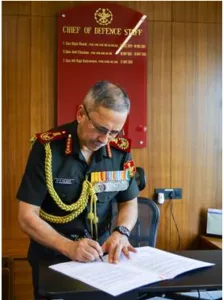

The CDS called for innovation in thought and action and greater collaboration among all stakeholders to drive capability development and modernisation. Defence experts have often pointed out that future wars will depend heavily on technology, artificial intelligence, cybersecurity and unmanned systems. Military analysts believe that India’s armed forces must continue adapting to these fast-changing challenges. General Subramani’s focus on innovation comes at a time when India is investing heavily in defence research, home-grown military equipment and advanced battlefield technologies. His emphasis on indigenous weapons also matches the Government’s long-term push to reduce dependence on foreign defence imports and strengthen Indian defence manufacturing.
He complimented the members of the Defence Forces on their professionalism and operational readiness and reiterated his commitment to their training, while ensuring the welfare of veterans and Veer Naris. Over the past few years, military welfare has remained a key area of discussion within defence circles. Veterans’ groups have consistently highlighted the importance of healthcare, pension support and rehabilitation programmes for retired soldiers and their families. Defence observers say that maintaining high morale among serving personnel and veterans is essential for a strong military structure. General Subramani’s remarks are likely to be welcomed by many former servicemen who have long advocated better welfare measures and support systems.
He urged all ranks to embrace change, uphold the military ethos and relentlessly strive towards achieving excellence in all spheres. Senior military officers often stress that modern armed forces must remain flexible and prepared for new forms of warfare. Security experts note that today’s military environment is very different from that of even a decade ago. The growing use of drones, satellite surveillance and cyber operations has changed how armed forces prepare for conflicts. His message reflects the wider effort within the Indian military to modernise training and improve operational efficiency.
General NS Raja Subramani laid a wreath at the National War Memorial, New Delhi, and paid homage to the soldiers who made the supreme sacrifice in service to the nation. The National War Memorial remains one of India’s most important military landmarks and stands as a tribute to thousands of soldiers who lost their lives while serving the country. Such ceremonies carry deep meaning within the armed forces and reinforce the tradition of honouring those who made the ultimate sacrifice.
The CDS was also presented with a Tri-Service Guard of Honour at the South Block lawns. The ceremonial event marked the formal transfer of one of the country’s highest military responsibilities. Defence officials view such traditions as important symbols of unity among the Army, Navy and Air Force, particularly as India continues efforts to improve joint operations between the three services.
A highly decorated officer with over four decades of service, General Subramani was commissioned into the Garhwal Rifles in December 1985. His military career has included operational experience in some of India’s most sensitive regions, including Jammu and Kashmir and areas along the northern borders. Officers who have worked with him have often described him as a calm and strategic leader with extensive operational knowledge. His long experience in command, intelligence and military planning is considered one of the major strengths he brings to the post.
His distinguished career includes many key Command and Staff appointments, including General Officer Commanding, 2 Corps, General Officer Commanding-in-Chief, Central Command, and the Vice Chief of the Army Staff. Before assuming the appointment of CDS, he served as Military Adviser at the National Security Council Secretariat. Defence analysts note that this combination of field command and strategic policy experience gives him a broad understanding of both military operations and national security planning. His previous role at the National Security Council Secretariat allowed him to work closely on matters linked to defence strategy and security coordination.
General Subramani takes charge at a significant time for India’s defence establishment. One of the biggest tasks before him will be strengthening jointness among the Army, Navy and Air Force and pushing forward long-pending theatre command reforms. These reforms aim to improve coordination between the three services and make military operations faster and more effective. Defence experts believe that successful integration will play a major role in shaping India’s future military capabilities. His commitment to modernisation, self-reliance and stronger tri-service cooperation signals continuity in the broader reforms already underway within the armed forces.
Must Read:
India Singapore Defence Dialogue Raises Fresh Indo-Pacific Hope