


International Law and Security Programme Opens at RRU
International Law and Security Programme Brings Officials from 17 Countries to Rashtriya Raksha University
A two-week international capacity-building programme on international law and security has begun at Rashtriya Raksha University (RRU) in Gandhinagar, bringing together 30 senior government officials from 17 countries to discuss some of the most pressing global security challenges of the modern era.
The Fourth Global Capacity Building Programme on Fundamentals of International Law and Security commenced on 8 June 2026 at the university’s School of Integrated Coastal and Maritime Security Studies (SICMSS). The programme is being organised under the Indian Technical and Economic Cooperation (ITEC) initiative of the Ministry of External Affairs, Government of India.
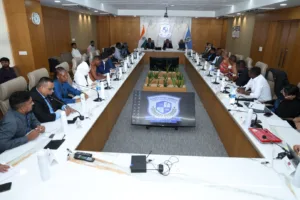

The latest programme at RRU focuses on the growing relationship between international law and global security, two fields that have become increasingly interconnected as nations face complex challenges that often extend beyond national borders.
Welcoming the participants, Mr Ankur Sharma, Director of SICMSS, said international law and security are frequently treated as separate areas of study, despite the fact that many modern threats require both legal and security responses.
Referring to terrorism, cybercrime, human trafficking, organised crime and maritime piracy, Sharma noted that such threats often operate across borders and cannot be effectively addressed by individual countries acting alone. He said international law provides a common framework through which nations can cooperate in tackling shared security concerns.
His remarks come at a time when governments worldwide are dealing with increasingly sophisticated transnational threats. Cyberattacks now target critical infrastructure, financial systems and government networks across multiple countries. International agencies have also warned about the growing influence of organised criminal networks involved in trafficking, smuggling and online fraud. Maritime piracy, although reduced in some regions compared with previous decades, remains a concern in several strategic sea routes that are vital for global trade.
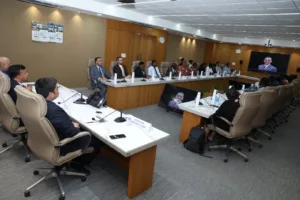
The maritime dimension is particularly relevant to SICMSS, one of the specialised schools within Rashtriya Raksha University. The school focuses on coastal security, maritime governance, maritime law and strategic issues affecting the world’s oceans. Maritime security has gained increasing importance globally as more than 80 per cent of world trade by volume is transported by sea, making secure shipping routes essential for economic stability.
In his inaugural address, RRU Vice Chancellor Prof. Bimal N. Patel emphasised the continued importance of international law in addressing contemporary global challenges.
Recalling the United Nations Secretary-General’s call for strengthening the international legal order and creating a more effective multilateral system, Prof. Patel highlighted the role of international law in areas ranging from human security and climate justice to ocean governance, technological change, dignity and peace.
He stressed that a rules-based international order remains essential for building a secure and sustainable future.
The concept of a rules-based international order has become a central topic in international diplomacy in recent years. The phrase generally refers to a system in which states conduct their affairs according to agreed international laws, treaties and norms rather than relying solely on power or unilateral action. Supporters argue that such a framework helps reduce conflicts, promote cooperation and provide smaller nations with protections under international law.
The discussion is especially relevant as the world faces a range of interconnected challenges. Climate change is creating new legal and security questions relating to migration, resource management and environmental protection. Advances in artificial intelligence, cyber technologies and digital communications are raising fresh concerns about privacy, regulation, cyber warfare and the use of emerging technologies in conflict situations. At the same time, disputes over maritime boundaries, natural resources and navigation rights continue to shape international relations in several regions.
RRU itself has emerged as an important institution in India’s security education landscape. Located in Gandhinagar, the university was granted the status of an Institution of National Importance by an Act of Parliament in 2020. Operating under the Ministry of Home Affairs, it focuses on education, research and training in areas including national security, policing, cyber security, forensic sciences, strategic studies and international cooperation.
The university regularly hosts international programmes aimed at strengthening professional networks and promoting cooperation between India and partner countries. Such initiatives align with India’s broader diplomatic approach of sharing expertise and capacity-building support with developing nations through programmes such as ITEC.
For many participants, the programme offers an opportunity to exchange experiences with counterparts from different regions facing similar security concerns. International training programmes of this nature often serve as platforms for building long-term professional relationships that can support cooperation on issues such as law enforcement, maritime security, counter-terrorism and cyber governance.
Experts note that international law has become increasingly important in responding to challenges that no single country can solve independently. Whether dealing with cybercrime networks operating across multiple jurisdictions, maritime piracy in international waters, or climate-related issues that affect entire regions, cooperation based on shared legal frameworks is often necessary for effective action.
The programme is expected to include discussions on key principles of international law, contemporary security issues, multilateral cooperation mechanisms and emerging challenges affecting global governance.
The vote of thanks was delivered by programme coordinator Mr Yash Vardhan, who expressed gratitude to Prof. Bimal N. Patel, Registrar Dr Dharmesh Prajapati, SICMSS Director Mr Ankur Sharma and ICRB Head Mr Ravish Shah for addressing the participants. He also thanked the Ministry of External Affairs, distinguished experts, participants and other stakeholders involved in organising the programme.
As international security challenges continue to evolve, initiatives such as the Global Capacity Building Programme seek to strengthen understanding, cooperation and dialogue among nations, reinforcing the role of law and multilateral engagement in addressing shared global concerns.
Must Read:
RRU Hosts National Armwrestling Championship
Rashtriya Raksha University Tree Plantation Drive Targets 10K Trees