


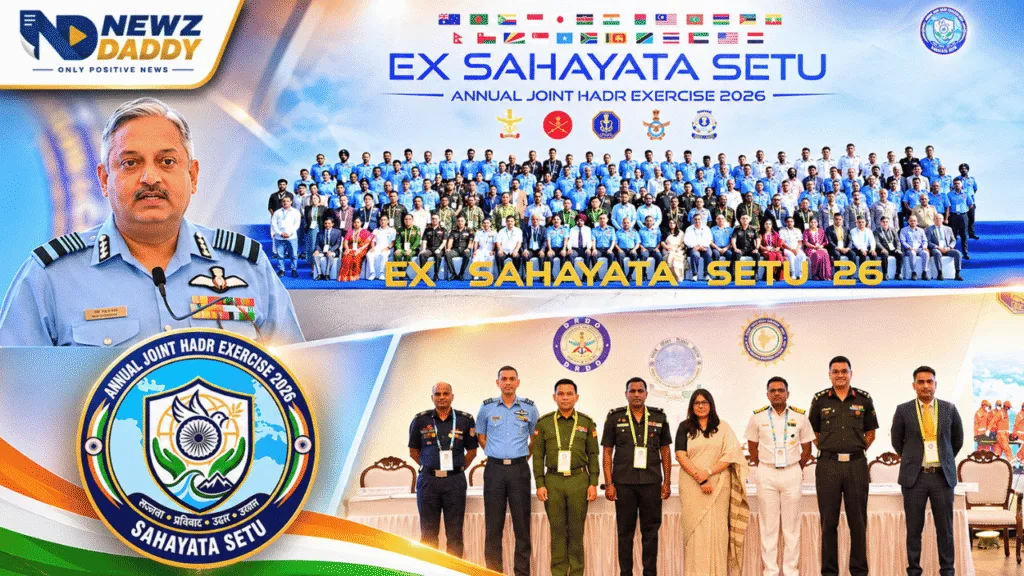
Jamnagar Hosts Sahayata Setu Exercise from 17 to 19 November
Indian Air Force Begins Multinational Disaster Relief Exercise at Jamnagar
Exercise Sahayata Setu brings 24 countries together in Gujarat to discuss emergency response, military cooperation and India’s role in disaster relief.
The Indian Air Force has begun a three-day international disaster relief exercise at Air Force Station Jamnagar, bringing together representatives from 24 countries to discuss how nations can work together during major natural disasters and humanitarian emergencies.
Called Exercise Sahayata Setu, the programme will run from 17 to 19 November 2026. It is being organised by the Indian Defence Forces under Headquarters Integrated Defence Staff (HQ IDS) and Headquarters South Western Air Command (HQ SWAC), with participation from Indian government agencies and Friendly Foreign Countries (FFCs).
The exercise comes at a time when countries in the Indian Ocean and the wider Asian region face recurring threats from cyclones, floods, earthquakes and other natural disasters. Such emergencies can affect several countries at once, making cooperation between governments, armed forces and rescue agencies important.
The opening day began with a seminar attended by representatives of countries linked to three regional groupings: the Indian Ocean Rim Association (IORA), the Bay of Bengal Initiative for Multi-Sectoral Technical and Economic Cooperation (BIMSTEC) and the Quadrilateral Security Dialogue (QUAD).
The 24 participating countries are Australia, Bangladesh, Comoros, Indonesia, Kenya, Madagascar, Malaysia, Maldives, Mauritius, Mozambique, Oman, Seychelles, Singapore, Somalia, South Africa, Sri Lanka, Tanzania, Thailand, the United Arab Emirates, Yemen, Japan, the United States of America, Myanmar and Nepal.
Their presence reflects the wide geographical reach of the exercise. Several participating countries have coastlines along the Indian Ocean or the Bay of Bengal, where cyclones, flooding and other emergencies can disrupt transport, damage homes and affect large numbers of people.
Air Marshal PV Shivanand, Air Officer Commanding-in-Chief of South Western Air Command, delivered the keynote address. He spoke about the need for joint planning, the development of shared military capabilities and close coordination between organisations during emergencies.
Representatives from the Ministry of External Affairs (MEA), Indian Army, Indian Navy, Indian Air Force, National Disaster Response Force (NDRF), disaster management agencies and Defence Research and Development Organisation (DRDO) also took part in the discussions.
One of the main subjects was India’s expanding role in international disaster relief. Participants examined three Indian relief missions: Operation Amistad, Operation Brahma and Operation Sagar Bandhu. These operations provided examples of how India has used military aircraft, medical teams, naval ships and relief supplies to assist countries affected by disasters.
Operation Amistad was launched in June 2026 after devastating earthquakes struck Venezuela. India sent two Indian Air Force C-17 Globemaster aircraft carrying a 41-member rescue and medical team, an Indian Army field hospital unit, 30 tonnes of relief supplies, six tonnes of medicines and medical equipment, and two BHISHM Cube portable hospitals.
The mission showed how India’s military transport aircraft could carry medical teams and emergency equipment over a long distance to assist another country.
Another example was Operation Brahma, launched in March 2025 after a powerful earthquake struck Myanmar. India sent six aircraft and five Indian Navy ships carrying around 750 tonnes of humanitarian assistance and disaster relief material. An Indian Army field hospital with 60 beds treated more than 2,500 injured people within two weeks.
Operation Sagar Bandhu followed Cyclone Ditwah in Sri Lanka in 2025. Indian assistance included the delivery of 1,058 tonnes of relief material, the evacuation of more than 2,500 people and efforts to restore transport links. The Indian Air Force also evacuated 264 survivors, including foreign nationals.
These missions involved different types of emergencies, but each required rapid transport, medical support and coordination with the affected country’s authorities.
India’s disaster relief work also has a longer history. The 2004 Indian Ocean tsunami marked a major turning point in the use of India’s armed forces for large-scale humanitarian operations. The disaster affected several countries and required extensive assistance by the Indian Army, Navy, Air Force and Coast Guard.
Since then, India has taken part in several overseas relief missions and has developed closer working arrangements with regional partners.
Technology formed another major part of the opening day’s programme. Discussions examined how modern equipment and digital systems can help rescue teams assess damage, locate people and organise relief work after a disaster.
The sessions covered better information about affected areas, communication between agencies, joint operational planning and the use of technology during rescue missions. These areas matter when roads are blocked, power supplies fail, or normal communication networks stop working.
The Indian Air Force has an important role in such situations because its transport aircraft can carry rescue personnel, medical teams and essential supplies to places that are difficult to reach by road. The Indian Navy can provide ships and helicopters for coastal rescue and transport, while the Army can send ground teams, engineers and medical units.
The National Disaster Response Force (NDRF) also plays a key role in India’s emergency response system. Its teams are trained for search and rescue, including operations in collapsed buildings, flooded areas and other dangerous locations.
A separate working-level meeting involving QUAD representatives was held during the afternoon. The meeting focused on coordinating efforts between the four countries on humanitarian assistance and disaster relief.
The QUAD brings together India, Australia, Japan and the United States. Disaster relief is one of the areas where these countries can work together, particularly in the Indo-Pacific region, where natural disasters can affect several countries and disrupt important transport routes.
The next stage of Exercise Sahayata Setu will move from discussions to practical activities based on a simulated severe cyclonic storm.
The planned activities will cover aerial reconnaissance, search and rescue, evacuation, relief distribution and casualty management. Participants will also practise activating emergency operation centres and setting up an incident command post to direct activities at the affected site.
The exercise will include the distribution of relief supplies and the establishment of temporary relief camps for people forced to leave their homes.
These activities will help participating teams understand how different agencies divide responsibilities during an emergency. They will also allow officials to examine existing procedures and identify areas where coordination may need improvement.
The programme will familiarise foreign participants with India’s national and state-level disaster management systems. This is important because major emergencies often require decisions and support from several levels of government. Local authorities may handle the immediate response, while state and national agencies provide additional staff, equipment, transport and financial support.
The Indian Defence Forces will work alongside civilian agencies during the exercise. Their involvement is intended to test how military resources can support civilian authorities when an emergency exceeds local response capacity.
India’s National Disaster Management Authority (NDMA), which works under the Government of India, has also issued international HADR guidelines to help organise overseas disaster assistance. These guidelines cover coordination, respect for the affected country’s authority and the proper conduct of relief operations.
For Gujarat, hosting the exercise at Air Force Station Jamnagar brings an international defence and disaster management programme to the state. Jamnagar’s position in the Saurashtra region also places the exercise in a coastal area where preparedness for cyclones and other emergencies remains an important public safety issue.
The three-day programme, ending on 19 November, will allow participating countries to examine how their military and civilian agencies can work together during major disasters. Its practical value will depend on how well the procedures discussed and tested at Jamnagar can be used when an actual emergency strikes.
Must Read:
Sahayata Setu: IAF to Hold Jamnagar Disaster Drill in November