


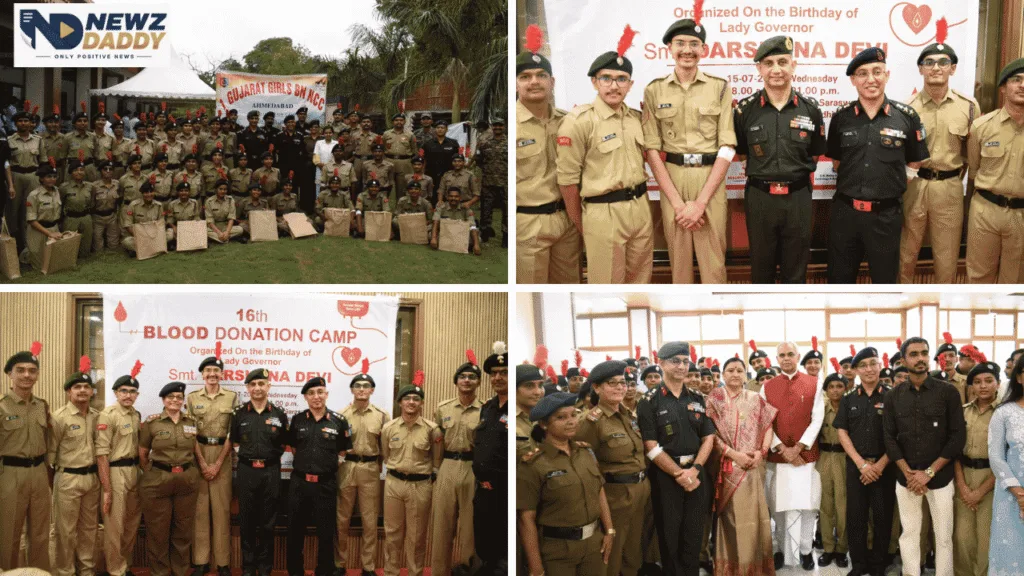
NCC Blood Donation Camp Held at Raj Bhavan in Gandhinagar
NCC Cadets Donate Blood at Raj Bhavan to Mark Gujarat Governor’s Birthday
National Cadet Corps (NCC) cadets from Ahmedabad took part in a blood donation camp at Raj Bhavan in Gandhinagar on 15 July 2026, marking the birthday of the Hon’ble Governor of Gujarat. The programme brought together young volunteers, senior NCC officers and officials for a public health initiative that focused on voluntary blood donation and civic participation.
The camp was organised under the aegis of Group Headquarters NCC, Ahmedabad. During the event, the Hon’ble Governor met the participating cadets and acknowledged their efforts. The interaction allowed the cadets to meet the state’s constitutional head while taking part in a social welfare activity that supports hospitals and patients who depend on donated blood.
Brigadier S.S. Jamwal, Group Commander of NCC Group Headquarters Ahmedabad, also met the cadets. He appreciated their willingness to volunteer and encouraged them to continue serving society with discipline, compassion and a sense of responsibility. His message reflected one of the long-standing aims of the NCC, which encourages young people to combine personal development with community service.
Voluntary blood donation remains one of the safest and most dependable ways to maintain blood supplies for hospitals. Patients undergoing major surgery, accident victims, women facing childbirth complications and people receiving treatment for blood disorders often rely on donated blood. Since blood cannot be manufactured, regular donations from healthy volunteers remain essential for healthcare systems.
India requires millions of units of blood every year to meet medical needs. The National Blood Transfusion Council and the National AIDS Control Organisation have consistently encouraged voluntary, non-remunerated blood donation because it helps build a safer and more reliable blood supply. Public awareness drives organised by educational institutions, government departments, defence organisations and voluntary groups have increased participation over the years, although health experts continue to stress the need for more regular donors.
The NCC has been one of the country’s largest youth organisations since its establishment under the National Cadet Corps Act, 1948. It works through schools, colleges and universities across India, offering military-style training while placing equal importance on leadership, discipline, social responsibility and national service. Thousands of cadets participate every year in activities ranging from environmental campaigns and disaster relief support to road safety drives, literacy programmes and blood donation camps.
Blood donation has become a regular feature of the NCC calendar in many states. Units frequently organise camps in partnership with government hospitals, medical colleges, district blood banks and recognised voluntary organisations. These programmes provide eligible cadets and staff with an opportunity to contribute directly to healthcare services while learning about the importance of public health.
The Raj Bhavan event also reflected the wider role of the NCC beyond its training activities. Community service forms an important part of cadet development, giving young people practical experience in working with public institutions and responding to social needs. Such activities are intended to encourage responsibility, teamwork and respect for public service.
Although not every cadet is eligible to donate blood because of age or medical requirements, many participate by helping to organise camps, assisting medical teams, guiding donors and spreading awareness about voluntary blood donation. These supporting roles help ensure that the events run smoothly while introducing cadets to community-based volunteer work.
The NCC follows the motto “Unity and Discipline”, a phrase that has represented the organisation for decades. Through its training camps, adventure activities, national integration programmes and social service initiatives, the organisation seeks to prepare young people for responsible citizenship. Many former NCC cadets have later joined the Armed Forces, police services, civil administration and other public service professions, while others continue contributing through civilian careers.
Blood donation campaigns organised around national events, commemorative occasions or public celebrations have become increasingly common across India. Such programmes often attract first-time donors who later become regular volunteers. Medical experts say that maintaining a steady flow of voluntary donors throughout the year is more effective than relying only on emergency appeals when shortages occur.
The blood donation camp at Raj Bhavan, therefore, served two purposes. It added to blood stocks needed for patient care and gave NCC cadets practical experience in public service. For the young participants, the programme reinforced the organisation’s emphasis on discipline, responsibility and service to the community while demonstrating how civic participation can make a direct difference to people’s lives.