


NMIA Transport Expands With New Buses and Airport Shuttles
Navi Mumbai Airport Adds More Bus, Taxi and Shuttle Choices for Travellers
Navi Mumbai International Airport (NMIA) is adding more bus, taxi, auto-rickshaw and shuttle services as passenger traffic is set to increase during the winter flying season.
The airport’s latest transport plan includes new Maharashtra State Road Transport Corporation (MSRTC) electric buses, more local bus routes, app-based cabs, prepaid taxis and a free hourly shuttle between NMIA and Chhatrapati Shivaji Maharaj International Airport (CSMIA). The winter schedule runs from 25 October 2026 to 27 March 2027.

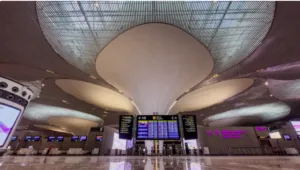
For passengers, the changes matter because NMIA does not yet have a railway or metro station inside the airport complex. Travellers arriving by train still need a road connection for the final part of the journey.
MSRTC will start its e-Shivai electric bus services from NMIA on 7 October. The first routes will serve Pune, Borivali and Dadar East. The announced fare is ₹450 for Pune, ₹210 for Borivali and ₹170 for Dadar East.
Children below 12 years will be eligible for half-fare. Women travelling with a National Common Mobility Card will also qualify for the half-fare provision.
The Dadar route will travel through Sion and Atal Setu. The Borivali service will link NMIA with Chhatrapati Shivaji Maharaj International Airport Terminal 1, Bandra and Atal Setu. Two Pune services are planned each day, with one in the morning and another in the afternoon. Bus links to Thane and Nashik are planned by the middle of November.
For people travelling from Navi Mumbai, the Navi Mumbai Municipal Transport (NMMT) has seven airport routes, numbered A1 to A7. These connect Terminal 1 with Kharkopar, Targhar, Belapur, Nerul, Panvel, Khandeshwar and the Airport Project Office.
Belapur and Nerul buses are planned at intervals of around 15 to 20 minutes during busy periods. Further links towards Vashi and Panvel are also planned.
Chalo Bus is running 21 services each day between NMIA and parts of Mumbai. Its listed destinations include Marol in Andheri East, Bandra, Dadar and the World Trade Centre area in Colaba. Extra capacity is being added during busy periods as demand grows among both passengers and airport workers.
Cab services are also being expanded. Uber Go and Uber Premier are available for passengers, while Uber Auto provides an option for shorter trips. Prepaid taxis and prepaid autorickshaws are also available. Bharat Taxi is due to begin operations from 10 October with a dedicated fleet of up to 40 vehicles.
One of the more useful additions for passengers making an airport connection will be a free shuttle between NMIA and CSMIA. Cityflo, Aarya and Chalo will operate the service, with a bus running once every hour.
The two-airport link comes at an important time for Mumbai’s aviation network. CSMIA is preparing for phased work at Terminal 1 from January 2027. The north section of the terminal is due to be redeveloped, with about 5 million passengers a year expected to be temporarily affected. NMIA is therefore expected to play a larger role as airlines adjust their operations.
NMIA began commercial passenger operations on 25 December 2025. Its first scheduled flight was an IndiGo service from Bengaluru. The airport was inaugurated earlier, on 8 October 2025, after a project that had been under development for many years.
The airport’s first phase has been planned for about 20 million passengers a year, while later phases are designed to take capacity towards 90 million passengers a year. The project is being developed through Navi Mumbai International Airport Limited, with Adani Airport Holdings Limited holding a 74% stake and the City and Industrial Development Corporation of Maharashtra holding 26%.
Road access remains a key part of the airport’s passenger plan. NMIA can be reached through Atal Setu, the Sion-Panvel Highway, Palm Beach Road, Amra Marg and NH-548. The airport’s transport information also lists Panvel and Targhar as nearby railway stations, with buses providing the road link to the terminal.
For passengers, this means the choice of transport will depend largely on where the journey begins. A traveller from Pune may find the MSRTC bus useful, while someone from central Mumbai may prefer a Chalo service or taxi. For people living in Navi Mumbai, NMMT buses offer a lower-cost option.
NMIA says ground transport capacity is being scaled up to 4,594 vehicles and buses, comprising 3,787 app-based taxis, 184 car rentals, 171 autos and 547 buses. There is, however, a numerical discrepancy in the figures released by the airport: these four numbers add up to 4,689 rather than 4,594. The published total therefore needs clarification.
The airport is also putting up transport signs and passenger guidance at designated areas for buses, shuttles, taxis, private vehicles, arrivals and departures. Work is under way to add electric vehicle charging facilities as well.
For travellers, the wider transport network will be an important test as NMIA moves into its first full winter season. The airport has the terminal and runway in place. The next question is how easily passengers can reach it, particularly at busy times and from different parts of the Mumbai Metropolitan Region.