


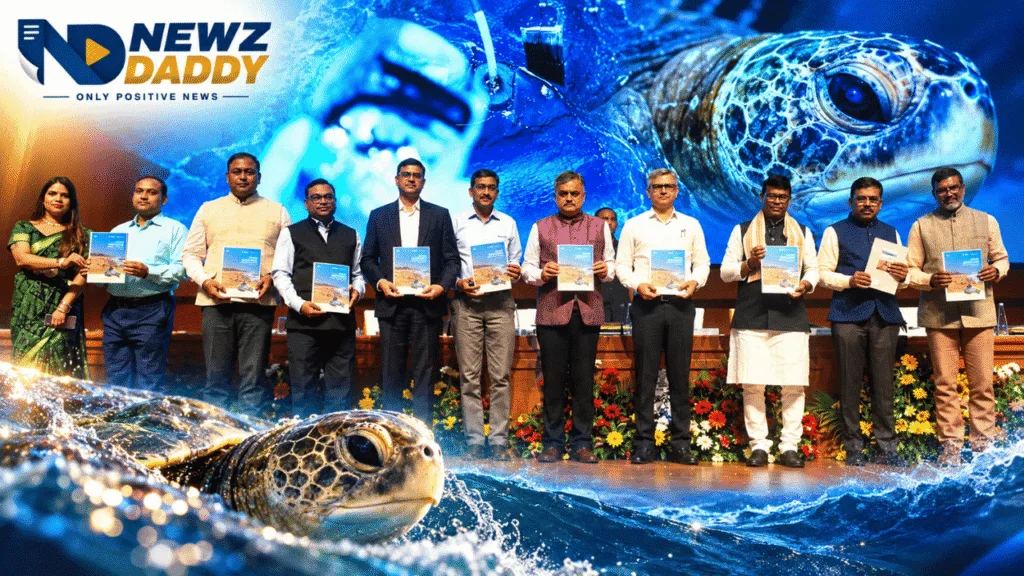
Olive Ridley Study Maps Sea Turtle Routes Towards Sri Lanka
Odisha Releases Olive Ridley Turtle Study, Satellite Tracking Reveals 6,719-Km Journey
A three-year study by the Wildlife Institute of India, Odisha Forest Department, Dhamra Port and Adani Foundation records turtle movements, mating activity and coastal habitat use.
Bhubaneswar, 3 October 2026: A female Olive Ridley turtle travelled 6,719 km over 271 days, reaching waters east of Sri Lanka, according to a new study released by the Odisha government. The findings offer fresh information about the movements of one of the world’s best-known sea turtle species and its use of coastal waters along Odisha.
Shri Ganesh Ram Singh Khuntia, Odisha’s Minister of State for Forest, Environment and Climate Change, Labour and ESI, released the first-year report of a three-year research project led by the Wildlife Institute of India (WII), based in Dehradun.
The study brings together satellite tracking, boat-based surveys and shoreline analysis. It was carried out with the Odisha Wildlife Organisation, the Department of Forest, Environment and Climate Change, Dhamra Port Co. Ltd. (DPCL), and the Adani Foundation.
The research comes at a time when scientists and wildlife officials need better information about where sea turtles travel, feed, mate and nest. Such information can help authorities plan conservation measures along Odisha’s coast and in nearby marine areas.
Researchers tracked 10 Olive Ridley turtles using satellite telemetry over a total of 1,748 days. The data revealed differences in the movements of male and female turtles.
Male turtles began their offshore migration earlier than females. Female turtles stayed in waters close to the shore for longer periods. Researchers also found signs of possible feeding stops along the continental shelf and across the Bay of Bengal.
One female turtle travelled 6,719 km over 271 days before reaching waters east of Sri Lanka. Another travelled nearly 200 km between Gahirmatha and Rushikulya, returning to its original area.
These movements show that Olive Ridleys can cover long distances and use different parts of the coastline during their movements. The findings also raise questions about how activities in coastal and offshore waters may affect their habitats.
Dr R. Suresh Kumar, Senior Scientist in the Department of Endangered Species Management at WII, said, “This study marks the renewal of satellite tracking of Olive Ridley turtles in Odisha after nearly 15 years. The partnership with the Odisha Forest Department, Dhamra Port and Adani Foundation has enabled us to generate new insights into the movement patterns and habitat use of these turtles. The findings provide a scientific foundation for evidence-based conservation planning. We will continue tracking more turtles to build a stronger dataset that can support management strategies and long-term conservation.”
The research team plans to track more turtles in the coming years. A larger dataset could help scientists understand whether the patterns seen during the first year are common across different seasons and turtle populations.
The species faces several threats, including accidental capture in fishing nets, damage to nesting beaches, coastal development and disturbance from human activities. Fishing boats operating near nesting areas can pose a risk to turtles, particularly during the breeding season.
In May 2025, the Indian Coast Guard reported that more than 6.98 lakh Olive Ridley turtles had nested at the Rushikulya river mouth during February that year. The Coast Guard’s annual Operation Olivia uses sea patrols and aerial surveillance to help protect turtles and their nesting grounds.
The Odisha government has also taken steps to strengthen coordination among agencies working on sea turtle protection. In March 2026, the state issued a notification to form a State Coordination Committee for sea turtle conservation. The committee provides an official structure for cooperation on conservation efforts.
Dr Abhishek Lakhtakia, Chief Executive Officer of the Adani Foundation, attended the report release on behalf of the organisation.
Dhamra Port Co. Ltd., part of Adani Ports and Special Economic Zone Limited (APSEZ), is among the partners in the research. APSEZ operates Dhamra and Gopalpur ports in Odisha. The involvement of a port operator in the study places marine conservation alongside the management of commercial activity along the state’s coastline.
The Adani Foundation has worked in Odisha for nearly a decade. Its programmes cover 283 villages across seven districts, with activities in education, scholarships, healthcare and livelihood support. The organisation also supports farmers, women and young people, along with local infrastructure projects involving drinking water, sanitation, roads and rural electrification.
The Adani Group also took part in Climate Week New York, held from 20 to 27 September 2026, where it joined discussions on climate action and the shift towards cleaner energy.
For scientists, the next two years of the Olive Ridley study will be important. The first-year results offer a picture of turtle movements and coastal activity, but continued tracking and field surveys will be needed to understand seasonal changes and identify areas that require further protection.
The 2025-26 survey’s record of 1,390 individual turtles and 67 mating pairs gives researchers a starting point for future comparisons. How those figures change across coming nesting seasons will help build a clearer picture of the conditions facing Olive Ridleys along Odisha’s coast.
Must Read:
Mundra Port in Gujarat Sets New Benchmark for Container Traffic