


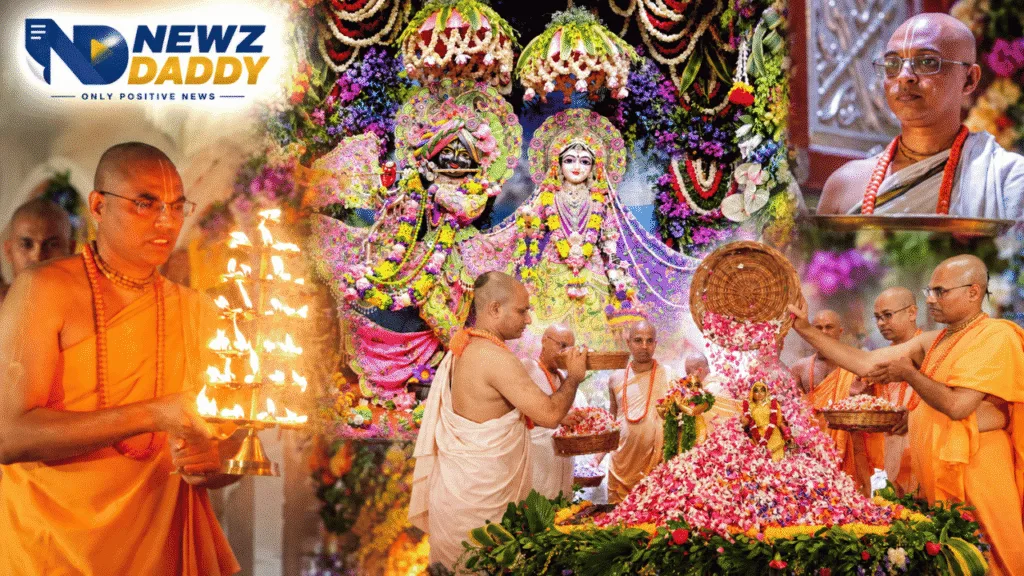
Radhashtami 2026 Celebrated at Hare Krishna Mandir Bhadaj
Hare Krishna Mandir Bhadaj observes Radhashtami with special worship and Abhisheka
Hare Krishna Mandir, Bhadaj, observed Sri Radhashtami on Saturday, September 19, with special worship of Sri Sri Radha Madhav, devotional singing and a series of traditional temple rituals.
Radhashtami marks the appearance day of Srimati Radharani, who is revered by Krishna devotees as the eternal consort of Lord Sri Krishna. The festival falls on the eighth lunar day of the bright fortnight of Bhadrapada. In 2026, it was observed on September 19, exactly 15 days after Sri Krishna Janmashtami. The date is also observed by Vaishnava communities and temples in India and abroad.
At the Bhadaj temple, the celebrations centred on Sri Sri Radha Madhav. The deities were dressed in new robes and decorated with ornaments and flowers. The altar was also decorated with flowers as devotees gathered for the day’s religious programme.
One of the main rituals was a special Maha Abhisheka. The temple said sanctified water from 108 kalashas was used for the ceremony. The water was collected from seven holy rivers. Devotees recited Vedic hymns from the Rig Veda, including the Purusha Sukta, during the ritual.
The temple also arranged an offering of 108 varieties of Rajbhog preparations. In Vaishnava temple practice, food offerings are first presented to the deities before being distributed as prasadam to devotees. Such offerings form an important part of daily and festival worship.
The evening programme included a grand arati, with devotees singing a devotional song in praise of Srimati Radharani. A special lecture on the significance of Sri Radhashtami was delivered by Shri Jaganmohan Krishna Dasa, President of Hare Krishna Mandir, Bhadaj.
The celebrations ended with Maha Arati and a Grand Palaki Utsav. Devotees also recited Radhikashtaka, a devotional composition associated with Srila Rupa Gosvami, a leading figure in the Gaudiya Vaishnava tradition and a principal disciple of Sri Chaitanya Mahaprabhu.
For followers of the Gaudiya Vaishnava tradition, Radhashtami has a place alongside the major festivals connected with Lord Krishna. Srimati Radharani is regarded as the highest example of devotion to Krishna, and devotees use the occasion to offer prayers for Krishna-bhakti, or devotion to Krishna.
The festival is closely linked with the religious traditions of Braj, particularly Barsana and Vrindavan in Uttar Pradesh. Barsana is traditionally regarded as the place associated with Radharani’s appearance, and Radhashtami draws large numbers of devotees to the region each year.
The observance is also marked at Hare Krishna and ISKCON temples in different countries. Rituals can include fasting, abhisheka, devotional singing, special food offerings, lectures and arati. The exact programme differs from one temple to another.
Hare Krishna Mandir, Bhadaj, is located near Science City in Ahmedabad and is run by Hare Krishna Movement Ahmedabad. The temple’s regular schedule includes Mangala Arati in the early morning, Rajbhog Arati at noon and evening worship. Festival days follow a special timetable.
For the 2026 Radhashtami programme, the temple had listed Darshan Arati and Guru Puja at 7.30 am, Rajbhog Arati at noon and Maha Abhishekam at 6.30 pm. The temple also advised devotees to observe a fast until noon on Radhashtami before taking grain prasadam.
Radhashtami is observed on the Ashtami tithi of the bright half of Bhadrapada. Panchang calculations for 2026 place the Ashtami period from September 18 into September 19, with the festival being observed on Saturday, September 19.
The tradition places strong emphasis on Radharani’s devotion to Krishna. This is reflected in the prayers and songs used during the festival. Radhikashtaka, recited at the Bhadaj celebrations, is attributed to Srila Rupa Gosvami and forms part of the devotional literature associated with the Gaudiya Vaishnava tradition.
The Bhadaj celebration therefore brought together several elements of temple worship: deity decoration, food offerings, Vedic recitation, abhisheka, devotional music, a religious discourse, arati and a palanquin procession.
For devotees attending the festival, the day provided an opportunity to take part in prayers centred on Srimati Radharani and seek blessings for deeper devotion to Lord Krishna. The rituals also linked the Ahmedabad temple’s local celebration to a Radha-Krishna festival observed by Vaishnava communities across India and around the world.
Must Read:
Radhashtami 2026: Maha Abhishekam Set for 7 pm at Bhadaj
Janmashtami: Bhadaj Temple Marks Krishna’s Birth at Midnight