


Janmashtami: Bhadaj Temple Marks Krishna’s Birth at Midnight
Hare Krishna Mandir, Bhadaj Marks Janmashtami with Rituals, Music and Food Offerings
Hare Krishna Mandir at Bhadaj marked Sri Krishna Janmashtami on Friday, September 4, with a day-long programme that brought together religious ceremonies, devotional music, food offerings and cultural activities.
The festival reached its main point at midnight, when devotees gathered for Maha Arati to mark the traditional time associated with the birth of Lord Krishna. The temple’s published schedule listed Maha Mangala Arati at midnight, followed by Jhulan Seva. Earlier in the evening, the temple held a Maha Abhishekam for Sri Sri Radha Madhav.

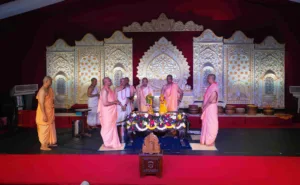
The Bhadaj temple, near Science City, is run by Hare Krishna Movement Ahmedabad. The organisation is part of the wider International Society for Krishna Consciousness, or ISKCON, which was founded in New York in 1966 by A.C. Bhaktivedanta Swami Prabhupada. ISKCON says it now has more than 700 major centres, temples and rural communities around the world.
For the Ahmedabad temple, Janmashtami followed a schedule that began early in the morning. Mangala Arati was held at 4.30 am, followed by darshan, Guru Puja and kirtan. Hindola Seva began at 8 am, while abhishekam ceremonies started at 9.30 am. A Pallaki Utsav for Sri Sri Radha Madhav was scheduled from 7.30 pm to 9.45 pm, before the evening Maha Abhishekam and the midnight Arati.
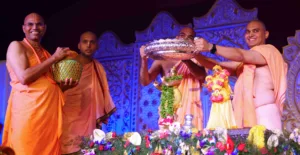

A major part of the celebrations was the Maha Abhishekam, the ceremonial bathing of the deities. According to the temple, devotees used a range of traditional offerings, including panchgavya, medicinal herbs, fruit juices and flowers. The ceremony also included 108 kalashas of water collected from seven holy rivers.
The temple said the arrangements reflected the traditional Vaishnava way of observing Krishna’s birth. Janmashtami is generally marked with fasting, devotional singing, worship and a midnight ceremony because religious tradition places Krishna’s birth at midnight. In 2026, September 4 was the main Janmashtami date, followed by celebrations into September 5, including Nandotsav.
Food was another large part of the event. The temple said more than 1,008 varieties of preparations, including sweets, milk-based dishes and farsan, were offered to Lord Krishna and later distributed among devotees. A 151-kg pure vegetarian cake was also offered.
The temple also said that lakhs of people visited during the festival and that visitors were given farali Krishna prasadam. The large attendance figure is based on the temple’s own account.
Devotional music continued through the day. Krishna bhajans by different artists were scheduled from 9 am until midnight. A Sri Krishna Sankirtan Concert by Sri Nandlal Chhanga and his team was scheduled from 10 pm onwards.
The temple’s programme also included Jhulan, or Hindola, Seva, in which devotees offered worship through the ceremonial swing service. The official festival schedule records the beginning of Hindola Seva at 8 am and another Jhulan Seva after midnight.
Sri Sri Radha Madhav were given a special Janmashtami decoration. The temple said the deities were dressed in pure silk and decorated with stones and jewellery specially prepared for the occasion. A new jewellery set was made in Vrindavan, while flowers brought from different parts of India were used for temple decoration.
The celebrations continued on Saturday, September 5, with Nandotsav and Vyasa Puja. In the Vaishnava tradition followed by ISKCON, Nandotsav is observed the day after Janmashtami. Vyasa Puja marks the appearance day of a spiritual teacher. For ISKCON devotees, September 5 is also associated with Srila Prabhupada, who was born in 1896 on the day of Nandotsav. The temple has therefore included Vyasa Puja as a major part of its annual programme.
Another feature of this year’s celebration was a collective chanting pledge. The devotees said they had undertaken to chant 21 lakh names of Sri Krishna as an offering for peace and prosperity. Visitors were also invited to take part in the japa-yagna.
The temple’s Janmashtami programme was part of a wider effort by Hare Krishna Movement Ahmedabad to take devotional and cultural programmes beyond the temple. Ahead of September 4, its “Swagatam Krishna 2026” programme had reached communities including Chandlodiya, Adani Shantigram, Nikol, Kalol, Sanand and Maninagar. Those programmes included kirtan, devotional music, cultural presentations and talks about Krishna.
The Bhadaj centre also runs activities outside festival days. Its wider Ahmedabad organisation says it provides daily food services and operates a gaushala, showing that the temple’s activities extend beyond religious festivals. The organisation currently reports feeding thousands of people each day and caring for hundreds of cows.
Among those reported to have visited the temple during the Janmashtami celebrations were Gujarat Education Minister Dr Pradyuman Vaja and Ahmedabad Commissioner of Police Shri Anupam Singh Gehlot, both accompanied by their families. The temple said they took part in various events and received the blessings of Lord Krishna.
For Ahmedabad’s Vaishnava community, the festival therefore combined the central midnight birth ceremony with a full day’s programme of worship, music, food distribution and community participation. With Nandotsav and Vyasa Puja continuing the celebrations on September 5, the annual Janmashtami programme at Bhadaj extended well beyond the midnight ceremony itself.