


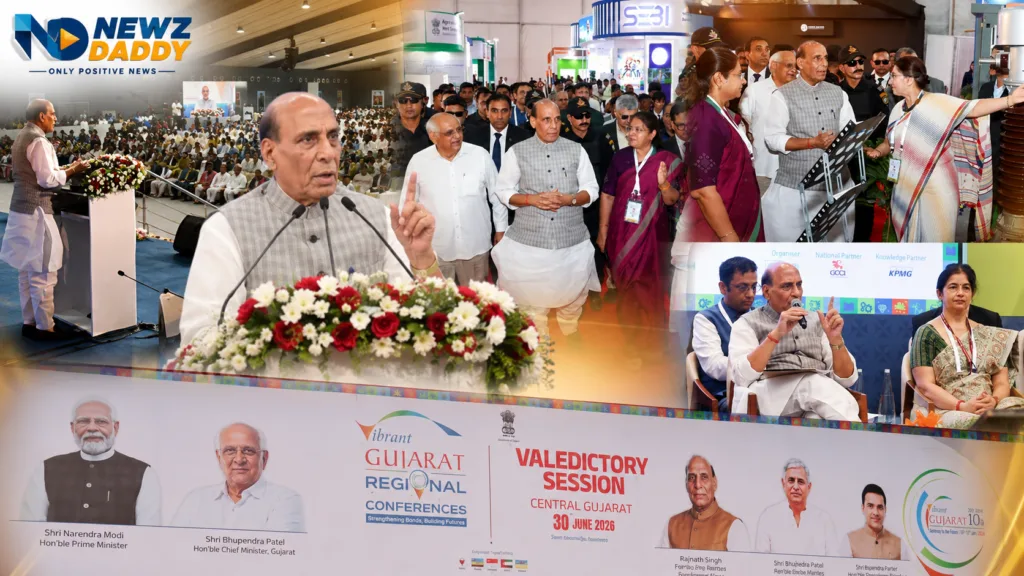
Rajnath Singh Says Industry Holds Key to Viksit Bharat
Regional industries must become partners in Viksit Bharat journey: Raksha Mantri at Vibrant Gujarat Regional Conference
Defence Minister Rajnath Singh on Tuesday urged businesses in Gujarat and other regions of the country to play a larger role in India’s plan to become a developed nation by 2047, saying industrial growth, technology and national security must move forward together.
Speaking at the Vibrant Gujarat Regional Conference in Vadodara on June 30, Singh said the country’s long-term progress would depend on how successfully local industries, start-ups, researchers and manufacturers contribute to national goals.
“Viksit Bharat is not merely a goal of economic development, but a resolve to build an economically prosperous, technologically capable, and socially empowered country,” he said.
The conference brought together industrialists, entrepreneurs, academics and young innovators. Gujarat Chief Minister Bhupendra Patel, Union Minister Rajiv Ranjan Singh and Gujarat Minister for Women and Child Development Dr Manisha Vakil attended the event.
The Defence Minister said changing global conditions have increased the importance of domestic manufacturing and technological capability. He argued that countries that remain economically strong and technologically advanced are better placed to protect their interests and maintain stability.
“History teaches us that great nations stand on three essential pillars: economic strength, technological prowess, and national security. Economic prosperity and technological advancement reinforce national security, while a secure nation provides the stability that allows industry and innovation to flourish,” he said.
His remarks come at a time when many countries are trying to reduce dependence on overseas suppliers for critical technologies, semiconductors, defence equipment and strategic materials.
India has followed a similar path during the past decade through policies aimed at increasing local production and reducing imports in sectors linked to national security. Government figures released this month show that India’s defence production reached a record Rs 1.78 lakh crore during the financial year 2025-26, compared with around Rs 46,000 crore in 2014. Defence exports have also risen sharply to Rs 38,424 crore from less than Rs 1,000 crore over the same period.
Singh credited policy changes, greater private sector participation and support for start-ups for the increase in manufacturing activity. He pointed to programmes such as Make in India, changes to defence procurement rules, the Technology Development Fund, iDEX and the Srijan portal, which encourages domestic companies to produce equipment that was previously imported.
He also referred to measures aimed at simplifying industrial licences, easing foreign investment rules and expanding testing facilities for smaller firms and technology companies.
According to Singh, the government’s objective is to create conditions in which domestic firms can compete internationally while supplying the needs of the Indian armed forces.
He stressed that self-reliance should not be confused with economic isolation.
“Aatmanirbharta does not mean isolation; it signifies a nation standing firmly on its own feet and engaging with the world as an equal partner,” he said.
The Defence Minister said India continues to support technology partnerships, joint ventures and manufacturing agreements with foreign companies when these arrangements help increase domestic capability and create jobs in India.
Gujarat featured prominently in his address because of its growing position in defence and advanced manufacturing.
He said the state’s industrial base, skilled workforce and transport infrastructure place it in a strong position to support future defence production.
One example is the Tata-Airbus aircraft facility in Vadodara, where C-295 military transport aircraft are being assembled for the Indian Air Force. The project marked the entry of private industry into full aircraft production in India and forms part of a 56-aircraft order placed by the Air Force. Forty of these aircraft are scheduled to be produced in India, while the remaining aircraft are being supplied from Spain.
The facility is expected to support thousands of direct and indirect jobs while helping build a domestic aerospace supply chain involving dozens of Indian companies.
Singh also highlighted the production of the K-9 Vajra self-propelled artillery system in Gujarat. The weapon system has become an important part of the Indian Army’s artillery modernisation programme and represents growing cooperation between Indian and international defence manufacturers.
Another area receiving attention is semiconductor manufacturing. The Defence Minister said future economic and military competition would increasingly depend on access to advanced chips and computing technology.
He expressed confidence that semiconductor projects being developed in Sanand and Dholera would support India’s ambitions in artificial intelligence, cybersecurity, communications and space technology.
The Government of Gujarat has been working to position both locations as major electronics and semiconductor centres through new industrial parks and manufacturing incentives.
Singh argued that several of Gujarat’s existing industries could support defence production in the coming years. He cited the state’s strength in chemicals, petrochemicals, electronics, shipbuilding, ports, renewable energy and green hydrogen production.
These sectors, he said, could supply materials, components and technologies needed by military manufacturers and research organisations.
During the visit, the Defence Minister met representatives from private industry and academic institutions at a seminar focused on defence and aerospace manufacturing. Distinguished Scientist and DRDO Director General Dr Chandrika Kaushik also attended the discussions.
Singh later visited an exhibition featuring industry groups, start-ups, women entrepreneurs, tribal products, mobility technology companies and exporters.
The wider event formed part of a new series of regional conferences linked to the Vibrant Gujarat initiative, which began in 2003 when Narendra Modi served as Chief Minister of Gujarat.
Over two decades, the summit has developed into a major business platform attracting investors, policymakers and international companies. The regional conferences are intended to bring that model closer to smaller industrial centres while supporting the goals of Viksit Bharat 2047 and Viksit Gujarat 2047.
Must Read:
NASM-SR Missile Test in Odisha Sparks Proud Moment
Rajnath Singh’s Bold AMCA Defence Move Stuns India