


Rashtriya Raksha University MoU Focuses on Prison Mental Health
RRU, Madhya Pradesh Jail Department Sign MoU on Correctional Training and Prison Mental Health
Rashtriya Raksha University (RRU) and the Madhya Pradesh Department of Jail & Correctional Services have signed an agreement to expand training, research and mental health support in the state’s prisons.
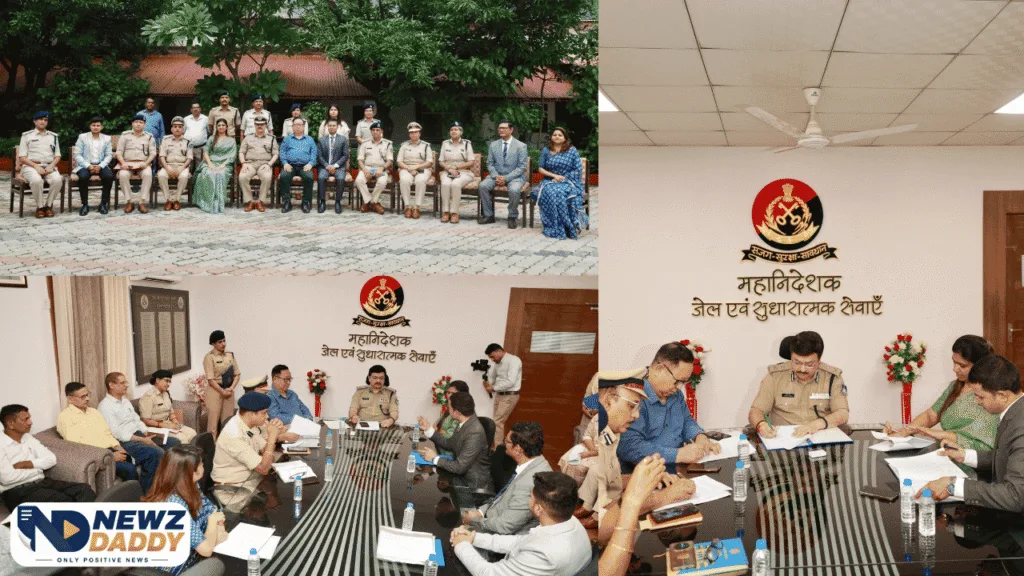
The Memorandum of Understanding (MoU) and an Accreditation & Affiliation Agreement were signed at Jail Headquarters in Bhopal on August 20. The arrangement gives formal shape to work that has already included training prison staff in recognising psychological distress and plans for Psychosocial Care Centres in state prisons.
The agreements were signed under the leadership of Prof. (Dr.) Bimal N. Patel, Vice-Chancellor of Rashtriya Raksha University, and Dr Varun Kapoor, IPS, Director General, Jail & Correctional Services, Madhya Pradesh.
Officials from the Madhya Pradesh prison administration who attended the signing included G. Akheto Sema, IPS, Additional Director General, Jail & Correctional Services; M. R. Patel, Deputy Inspector General, Jail Headquarters, Bhopal; and Manendra Singh Parihar, Jail Superintendent, Central Jail, Bhopal. Superintendents from the Central Jails at Indore and Barwani, along with other senior Directorate officers, were also present.
Rashtriya Raksha University was represented by Dr. Noorin Chaudhary, Acting Director, School of Behavioural Sciences and Forensic Investigations; Dr Geetesh Kumar Singh, Project Director, Global Correctional Administration Studies; Pradeep Rupia, Assistant Director, Rashtriya Raksha University MP Campus; Tanu P. Chandel and Shubham Jain.
The agreement covers academic certification for correctional personnel, affiliation and accreditation of programmes, staff training, research into correctional administration, mental health and rehabilitation, and the sharing of facilities and specialist knowledge. It also provides for internships, fieldwork and other practical learning opportunities involving students, researchers, faculty members and correctional staff.
One of the main areas of work will be prison mental health.
The partnership is expected to support the establishment of Psychosocial Care Centres in state prisons. The proposal is being linked to the Model Prisons and Correctional Services Act, 2023 and the Mental Healthcare Act, 2017.
The Model Act prepared by the Union Ministry of Home Affairs was sent to states and Union Territories in 2023 as a guide for updating prison laws and administration. It covers areas such as prison safety, education, vocational training, rehabilitation, welfare and after-care services. Prison administration remains a State subject, so individual states decide how such provisions are adopted.
The Mental Healthcare Act, 2017 has specific provisions dealing with prisoners with mental illness. Section 103 covers prisoners with mental illness, while Section 104 deals with people with mental illness in custodial institutions. The law also provides for access to mental healthcare and treatment.
For Madhya Pradesh, the new agreement follows several months of work between the two sides.
A proposal to establish a Psychosocial Care Centre received in-principle approval from Jail Headquarters, Madhya Pradesh, in April 2026. The details were discussed at RRU’s Lavad-Gandhinagar campus in May.
That work led to Project PRAHARI, or Psychological Risk Assessment, Health Awareness and Resilience Initiative. The first Madhya Pradesh cohort was held from July 6 to 12 at the Regional Jail Management & Research Institute in Bhopal.
Thirty correctional staff from prisons across Madhya Pradesh took part in the week-long programme. Training covered the identification of psychological distress and risk indicators, risk assessment, crisis communication, de-escalation, documentation and referral procedures. Staff wellbeing was also part of the programme, including the risks of vicarious trauma and burnout.
The programme was organised by Global Correctional Administration Studies under RRU’s School of Behavioural Sciences and Forensic Investigations, in collaboration with the Madhya Pradesh Jail Headquarters. The Union Ministry of Home Affairs’ Press Information Bureau also reported the July programme and said the training covered issues including depression, anxiety, suicidal behaviour, substance dependence and behavioural warning signs.
The July programme was part of a wider effort by RRU to train correctional personnel in mental health. In May and June, the university also ran a PRAHARI programme at Ahmedabad Central Prison for 40 prison officers and staff from Gujarat.
Dr Varun Kapoor, IPS, said the Madhya Pradesh agreements mark a move from an individual training programme towards a permanent institutional relationship. He said correctional personnel work closely with people in custody and can therefore recognise early signs of psychological distress, risky behaviour and substance dependence.
He also said academic certification of correctional training could strengthen the professional standing of the cadre and improve the quality of care in prisons. Kapoor expressed confidence that the proposed Psychosocial Care Centres would offer structured support to people in custody who may otherwise remain without access to such services.
The focus on prison mental health comes at a time when India’s prison policy is placing greater emphasis on rehabilitation alongside security and custody. The Model Prisons and Correctional Services Act, 2023 includes provisions for reformation, rehabilitation, welfare and after-care, reflecting a shift away from prison administration based mainly on confinement.
Rashtriya Raksha University has also developed experience in correctional mental health through its School of Behavioural Sciences and Forensic Investigations. The university’s work includes training correctional officers in mental health and inmate management. It has also been involved with a Centre for Psycho-social Care, Rehabilitation & Reintegration at Sabarmati Central Prison in Gujarat.
Rashtriya Raksha University was established as an institution of national importance under the Rashtriya Raksha University Act, 2020. Its work covers areas including policing, security, criminology, forensics and professional training.
For Madhya Pradesh, the significance of the new agreement will depend on how the planned centres, training programmes and research work are implemented inside prisons. The immediate step is to build on the training already given to correctional staff and create a system through which warning signs can lead to proper assessment, referral and care.
The MoU therefore places prison mental health within a wider academic and correctional training arrangement between Rashtriya Raksha University and the Madhya Pradesh jail administration. Its longer-term test will be whether that arrangement leads to regular training, accessible psychological services and better rehabilitation support for people in custody.
Must Read:
RRU Pasighat VC Roundtable: 16 VCs Meet in Arunachal
RRU Stress Management Training for 1,000 Nigerian Officers