


Smart Border Management Training Begins at RRU with Pride
Rashtriya Raksha University Conducts a Two-Week Training Programme on Smart Border Management for SSB
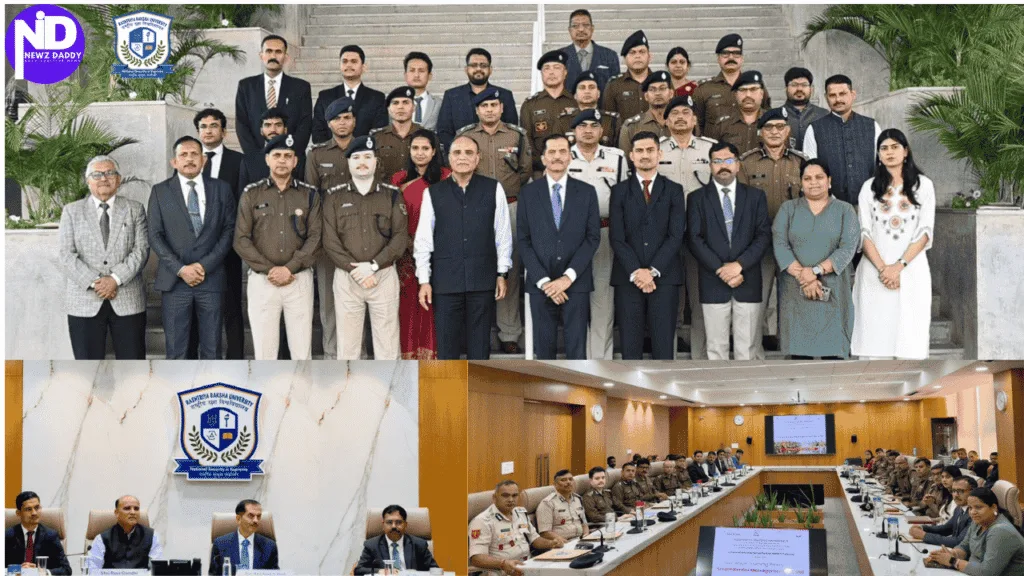
Rashtriya Raksha University, through the School of Internal Security and SMART Policing (SISSP), has commenced a two-week training programme on Smart Border Management for officers of the Sashastra Seema Bal (SSB). The programme is being conducted from February 18 to March 3, 2026, at Rashtriya Raksha University. Such training has become more important in recent years as India shares over 15,000 kilometres of land borders with several countries. Many of these borders pass through forests, mountains, and river areas. These places are often difficult to monitor, which makes special training very useful for officers working there.
The inaugural session of the programme was held on 18th February 2026. The programme was formally inaugurated by Professor (Dr.) Bimal N. Patel, Vice-Chancellor, Rashtriya Raksha University, and Ravi Gandhi, ADG, BSF (Retd.), graced the occasion as the Guest of Honour. Rashtriya Raksha University itself is a national institution set up by an Act of Parliament in 2020. It focuses on training police, armed forces, and security officers. The university was earlier known as Raksha Shakti University. It was created with the aim of improving India’s internal security by combining education, training, and research under one roof.
The training programme is designed to provide a comprehensive understanding of India’s border management and national security challenges, integrating strategic, legal, socio-cultural, and technological perspectives. India’s borders are guarded by different forces depending on the region. The Sashastra Seema Bal is mainly responsible for guarding the Indo-Nepal and Indo-Bhutan borders. These borders are open borders, which means people from both countries can cross without visas. While this helps local people and trade, it also creates risks such as smuggling and illegal movement. This makes the role of SSB very important in keeping the nation safe.
The sessions focus on evolving border security concepts, India’s Neighbourhood First policy, and the strategic importance of borders, with specific reference to the Indo-Nepal and Indo-Bhutan borders. India’s Neighbourhood First policy aims to build friendly and strong ties with nearby countries. Good relations help in sharing information and solving border problems peacefully. At the same time, security forces must remain alert. The Himalayan border areas are not only sensitive but also very tough due to the weather and terrain. Officers often work in cold, remote areas, far from their families.
The programme also covers relevant legal frameworks, inter-agency coordination, emerging cross-border threats, and the application of smart technologies, surveillance systems, and intelligence-based approaches for effective border management. In recent years, smart technology has changed border security. Forces now use drones, night-vision cameras, sensors, and satellite images. These tools help officers watch large areas and detect suspicious movement. Technology also helps reduce risks to personnel, as machines can monitor dangerous areas.
Senior SSB officers with extensive field and operational experience are participating in the programme. These officers bring valuable real-life knowledge from their postings. Many of them have worked in difficult conditions such as dense forests and high-altitude regions. Their experience helps younger officers understand ground realities better. Training programmes like this also give officers a chance to share ideas and learn from each other.
The inaugural session featured a short video presentation highlighting Rashtriya Raksha University’s vision and mandate in national security and policing. Over the past few years, the university has developed modern labs and training centres. These include cybersecurity labs and forensic science facilities. Such facilities help officers learn how crimes are investigated using science and technology. This is important because modern crime often uses digital tools.
Addressing the participants, Shri Ravi Gandhi shared professional experiences from his distinguished service with the Border Security Force, offering insights on leadership, discipline, operational preparedness, and ethical conduct in uniformed services. The Border Security Force, formed in 1965, is one of India’s main border guarding forces. It has played a key role in protecting the country during wars and peace. Officers like Ravi Gandhi bring years of experience that help guide the next generation.
The Vice-Chancellor, Prof. (Dr.) Bimal N. Patel emphasised the importance of mental resilience and psychological well-being for personnel deployed in challenging operational environments. Border duty can be stressful. Officers often face loneliness, harsh weather, and constant alertness. Studies have shown that mental strength is as important as physical fitness for security personnel. Training now includes stress management and mental health awareness to support officers.
He highlighted linguistic and cultural challenges in border areas and underscored the relevance of language skills in enhancing operational effectiveness. Border forces often work with local people who speak different languages. Knowing local languages helps officers build trust. This also helps in getting useful information and maintaining peace in border villages.
He also invited the officers to visit RRU’s advanced laboratories and infrastructure, showcasing the University’s growing role in technology-driven training and research for the armed forces, CAPF, and security agencies. He noted that personnel from over 82 countries have undergone training at RRU, reflecting its expanding global footprint. This shows that India is also helping other nations by sharing its knowledge in policing and security.
As the programme progresses, the exchange of knowledge and professional experience is expected to enhance operational preparedness, strategic thinking, and inter-agency coordination among participating SSB officers. Experts believe that such training improves teamwork between different forces. Strong coordination is important, especially during emergencies.
The programme also aims to strengthen cooperation and mutual understanding among agencies involved in border management and internal security. In today’s world, threats can come in many forms, including smuggling, trafficking, and illegal crossings. Proper training ensures that officers are ready to protect the nation. Programmes like this play a key role in building a safer and stronger India.
Must Read:
Rashtriya Raksha University MoU with SSB Supaul Transforms Training